
 Español
 Français
 Pусский
 繁體中文
 简体中文
 Select another language



n 2004, in a book about the ten values of the family business, Philippe Stern singled out the eleven timepieces that had inspired him most. By then, his museum had been open to the public for three years. In November 2026, the Patek Philippe Museum is marking its anniversary with an exhibition built around his choices as a collector. It is the second anniversary the Geneva museum is celebrating this year, with a separate exhibition dedicated to 50 years of the Nautilus.
Stern began by collecting Patek Philippe watches, with a particular interest in complications. In 1980, his search took a new direction. He began looking further back than 1839, the year Patek Philippe was founded, to the earliest portable timepieces of the 16th century. He also developed an interest in miniature painting on enamel, a Genevan speciality that now features prominently among the museum’s 2,500 or so watches, automata, precious objects and miniature portraits.

Two movements, one crown
The recent acquisitions on display for the anniversary reflect the breadth of Stern’s interests. Two pocket watches in the Patek Philippe collection, both once owned by the American industrialist John Motley Morehead III, merit a closer look. Sold in 1922 and 1925 respectively, each houses two independent movements, allowing it to display two different times. A single crown winds both movements. In the 1925 watch, one movement also drives a minute repeater and a split-seconds chronograph.
The antique collection now includes a watch made in London in 1762 by Thomas Mudge, which the museum identifies as the earliest known perpetual calendar watch. The Cremsdorff pendant watch, dating from around 1650, illustrates another side of the collection. Three figures – Temperance, Charity and Hope – stand out against the turquoise ground of its gold case. Watchmaking, goldsmithing, enamelling and gem-setting all come together in a jewel designed to be worn around the neck.

From workshop to museum
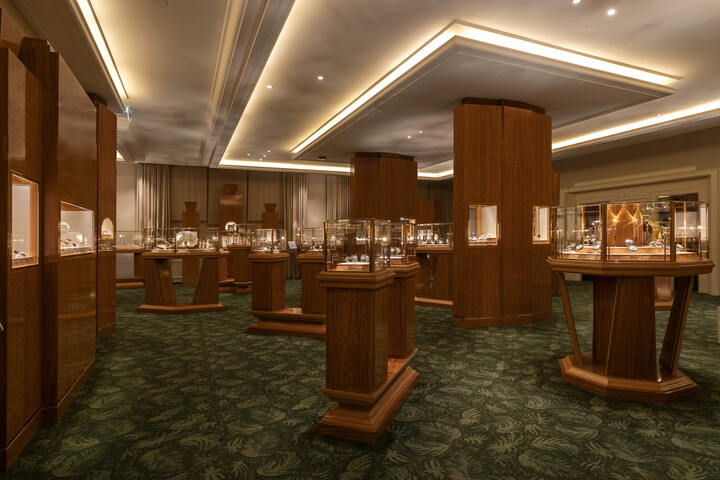
The building on Rue des Vieux-Grenadiers has a watchmaking history of its own. Patek Philippe acquired it in 1975 to house the Ateliers Réunis, where craftspeople made watch cases, bracelets and chains. When production moved to Plan-les-Ouates in 1996, Philippe Stern decided to give his collection a home in the former workshops. His wife, Gerdi Stern, designed the interiors to give the old industrial building in Plainpalais the feel of a private drawing room.
Since opening in November 2001, the museum has welcomed more than a million visitors. Annual attendance now stands at 80,000. Entry into its permanent Patek Philippe collection is governed by a rule unusual for a watch manufacturer’s museum. To earn its place in a display case, a watch must have been made at least twenty years earlier, be out of the catalogue and be judged exceptional enough to leave the manufacture’s vaults.