
 Español
 Français
 Pусский
 繁體中文
繁體中文 简体中文
简体中文 Select another language

ernar Venet is a central figure on the international art scene. He is an artist who has consistently pushed the boundaries of what art can express, using a deliberately limited vocabulary — the line, the arc, the angle — and a simple, almost Spartan idea: form holds value only insofar as it reveals the laws that govern it and the accidents that undo it.
His entire artistic journey unfolds within this tension between the determined and the indeterminate, between geometric order and entropy. Born in 1941 in Château-Arnoux, Venet trained far from academic institutions, through direct engagement with matter itself. As early as 1961, he began working with tar — a humble, industrial material — and in 1963, he poured ten cubic meters of anthracite directly onto the ground: The Pile of Coal.
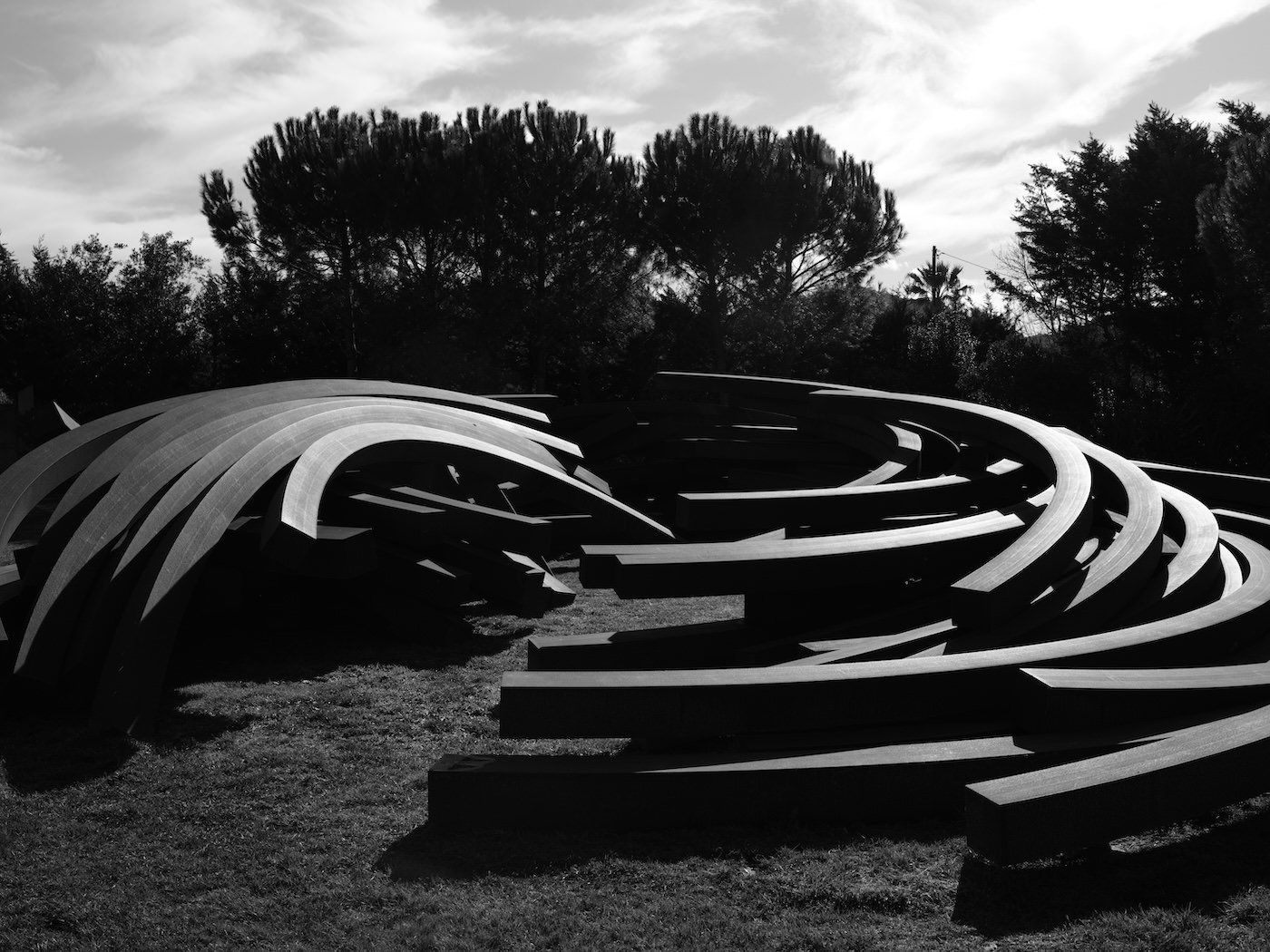
A foundational gesture — a sculpture without prescribed form or dimensions — the work marked the end of composition in favor of a process: “to show the material” allowing chance and gravity to shape the piece anew with each installation.
This breakthrough — widely documented by institutions and retrospectives — established Venet as one of the pioneers of indeterminate sculpture, where form is a consequence rather than a decision.
In 1966, Venet moved to New York, where he immersed himself in the conceptual and minimalist avant-garde, refining his artistic language. Diagrams, equations, and scientific records became artworks; painting itself evolved into a “proposition” as much as a surface. It was during this period that his formal triptych — lines, arcs, and angles — was born, a vocabulary that would accompany him throughout his career.
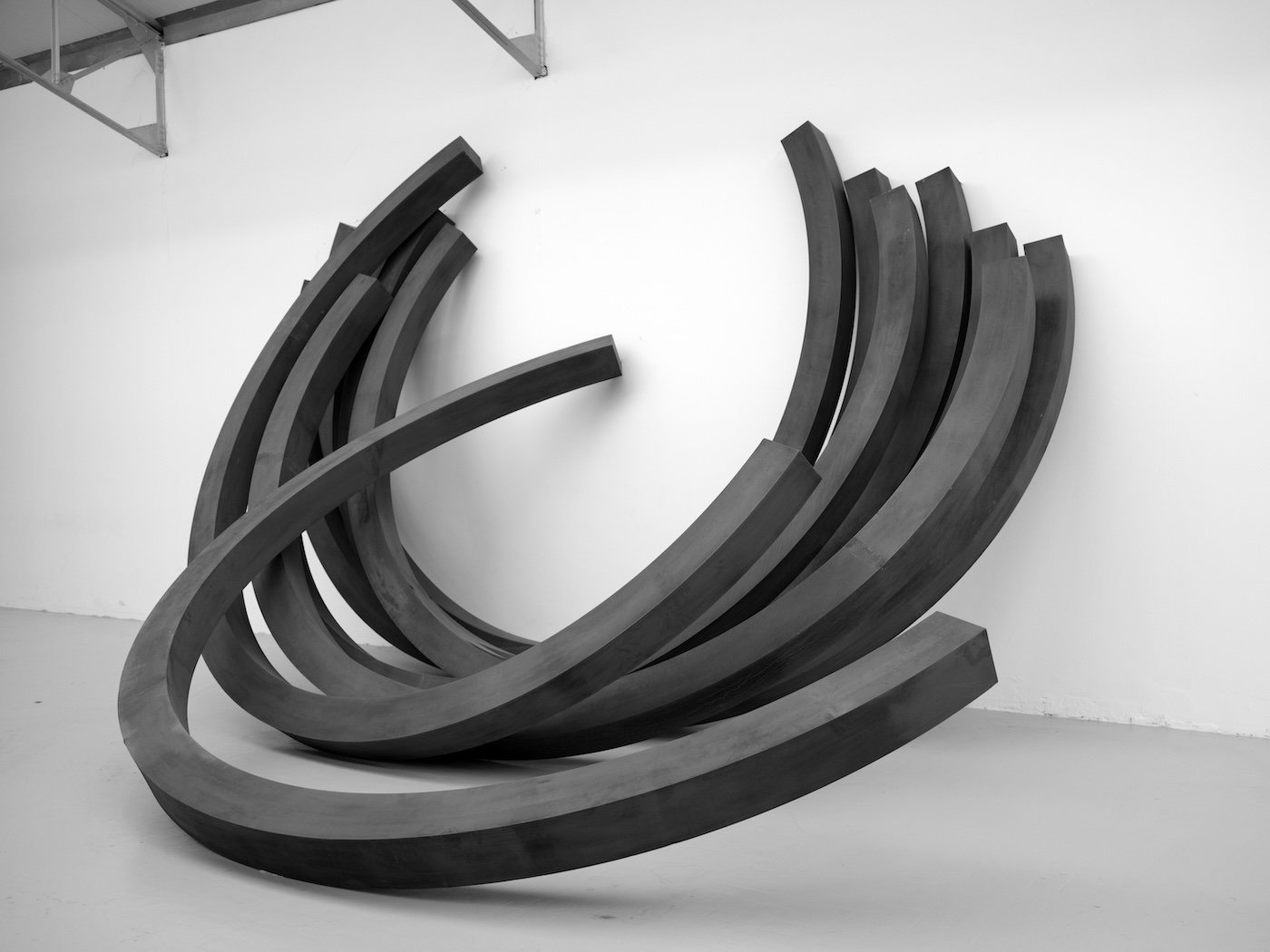
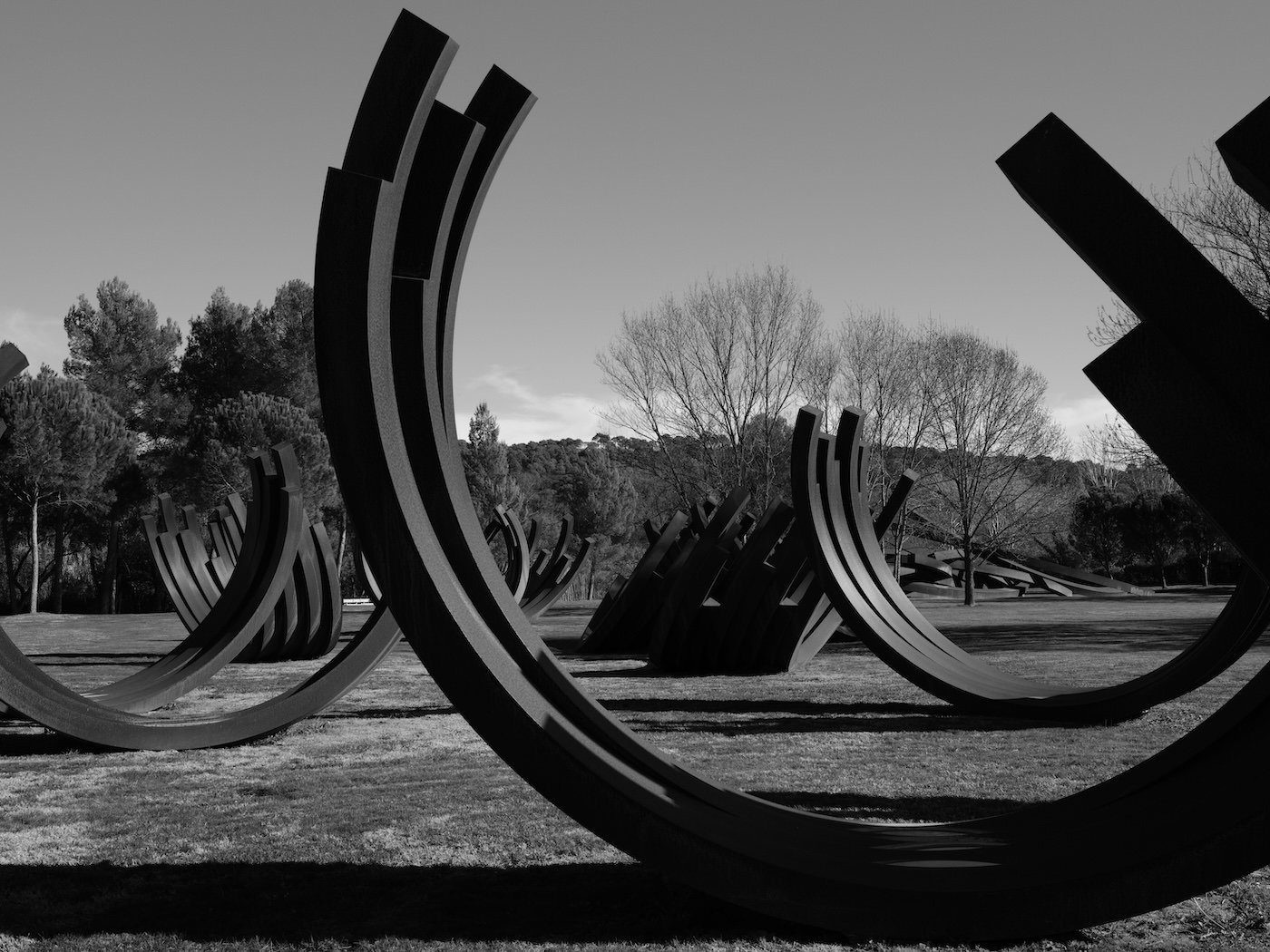
From the 1970s to the 1980s, Venet drew all the consequences of this choice: Indeterminate Lines, Arcs, Angles, followed by Collapses, and more recently, performances in which the fall itself becomes a sculptural act. As he states clearly, his sculptures are “self-referential” — they speak of their own nature and the conditions of their emergence. The “accident” — the decision to embrace collapse as method — becomes a moment of artistic truth. "The day my pieces accidentally fell… I understood that this was a new field to explore," he recalls, adding that enlargement alone has never been enough: “it has to work.”
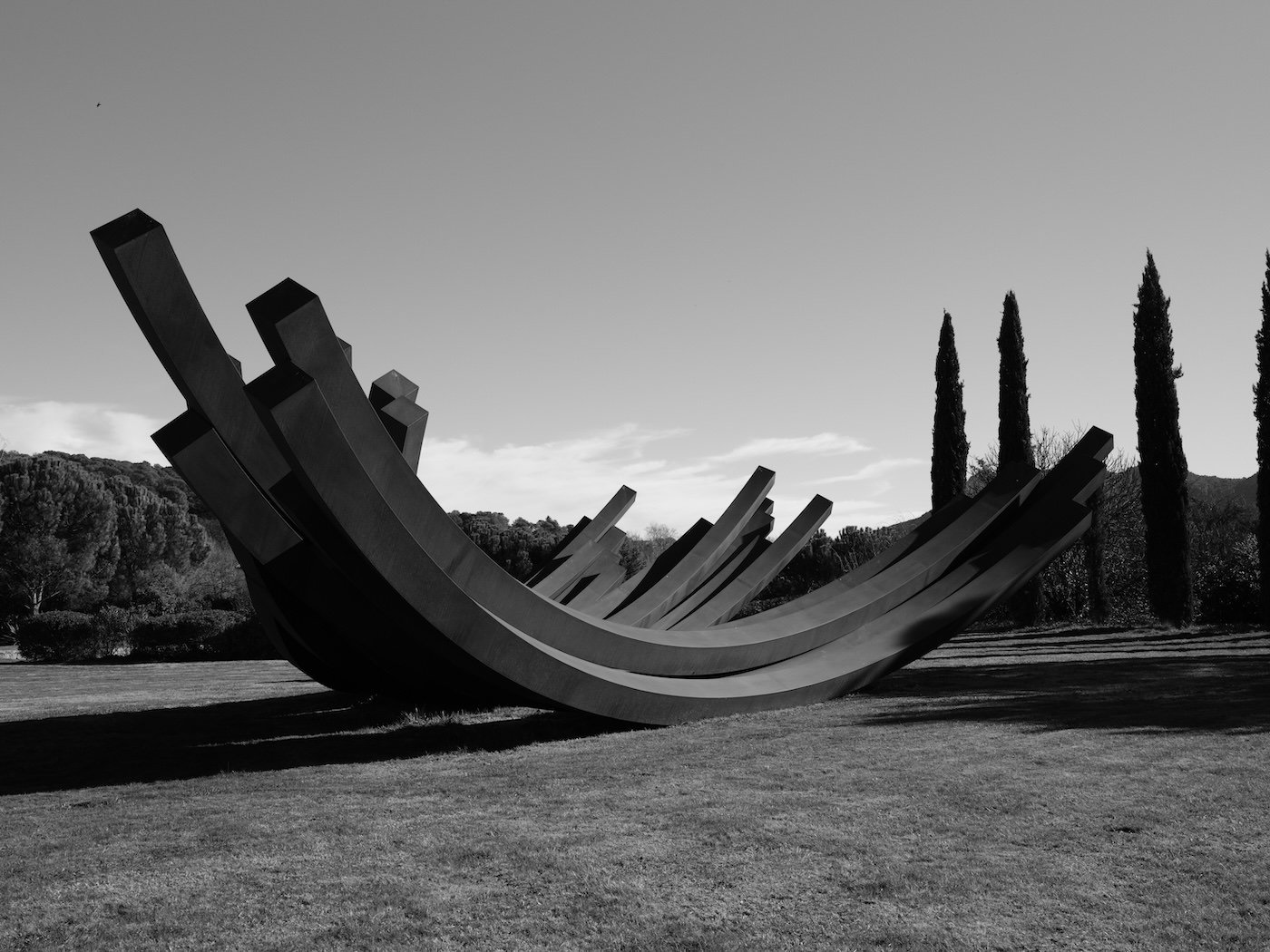
Major milestones mark an international recognition that owes nothing to spectacle for its own sake, but rather to the coherence of a lifelong investigation: the Lyon retrospective (2018–2019), retracing 2019–1959 and gathering nearly 170 works; the occupation of the Louvre-Lens (2021), where The Hypothesis of Gravity extended a monumental beam collapse across both interior and exterior landscapes; the 8,000 m² exhibition at Kunsthalle Berlin (Tempelhof) in 2022, where Venet overturned a series of arcs live with a forklift — a performance encapsulating his philosophy of the organized fall; and Paris, 2023: The Parabola of History, at Place Vendôme, curated by Jérôme Sans. Two Corten steel ensembles — 84.5° Arc x 13 on one side, Collapse: 55 Arcs on the other — disrupted the geometry of the site and silently echoed the history of the toppled column of 1871.
The culmination of this spatial writing in the real world is Arc Majeur (2019), erected above the E411 motorway in Wallonia: 60 meters high, 75 meters wide, several hundred tons of Corten steel. Conceived in 1984 and inaugurated 35 years later, the work stands as one of the largest contemporary sculptures in Europe.
Throughout his career, Venet’s almost total absence of brand collaborations reflects his uncompromising autonomy. One exception, now iconic, is the Bugatti Veyron Grand Sport “Venet,” unveiled at Art Basel Miami in late 2012 and showcased again at the Geneva Motor Show in early 2013. On this car, the artist projected the W16 engine formulas directly onto its bodywork — transforming it into a mathematical sculpture in motion. Dubbed "the fastest artwork ever" by Bugatti, this unique piece stands as a manifesto at the intersection of art and engineering.
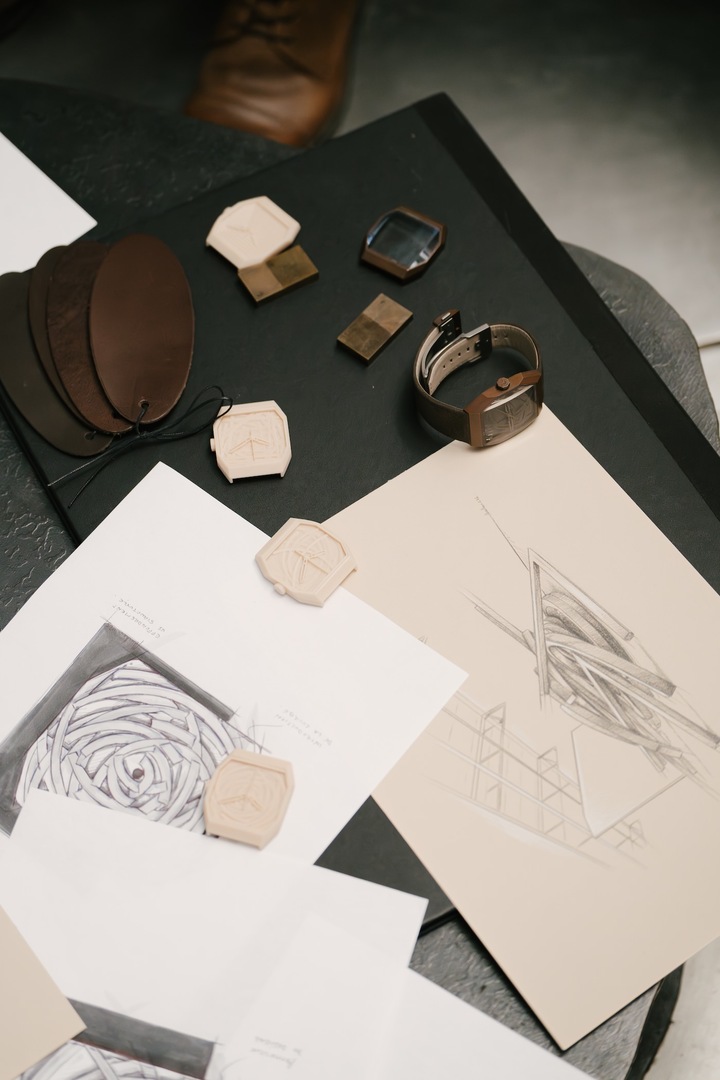
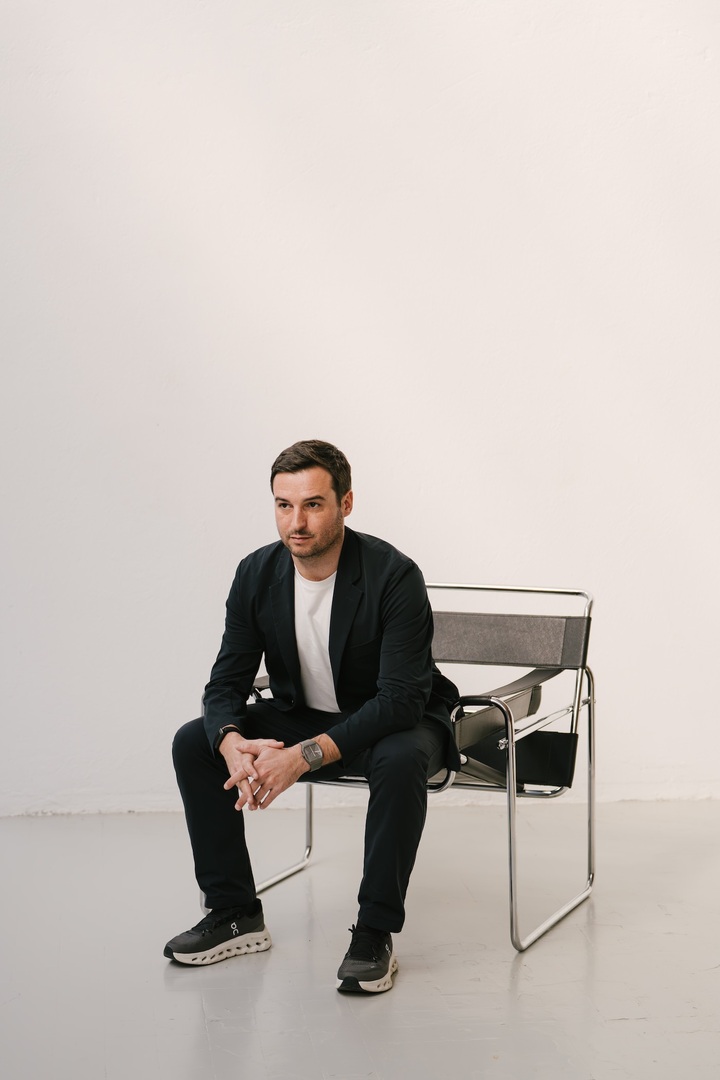
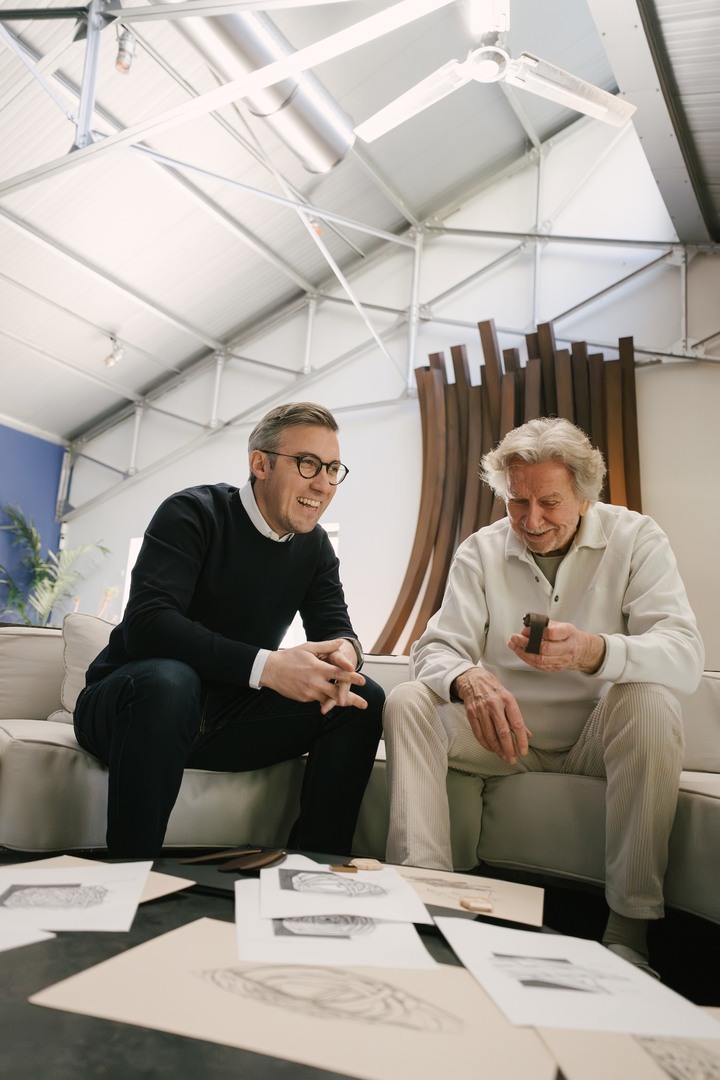
It is within this context that the encounter with Alto took place. Two years earlier, Thibaud Guittard, founder of the maison, approached Venet — not to “apply” a style to a product, but to attempt a genuine philosophical shift in scale: from public monumentality to intimate minuteness; from Corten steel — materially raw and temporally active — to a precious alloy. Venet accepted, drawn by the rigor of the brief: if one cannot betray the logic of the work, then everything remains to be invented. The collaboration began with a question of material. Under the joint direction of Thibaud Guittard and Raphaël Abeillon (Creative Director), the ALTO team mobilized its finest partners to identify a material with the ideal aesthetic, mechanical, and horological properties.
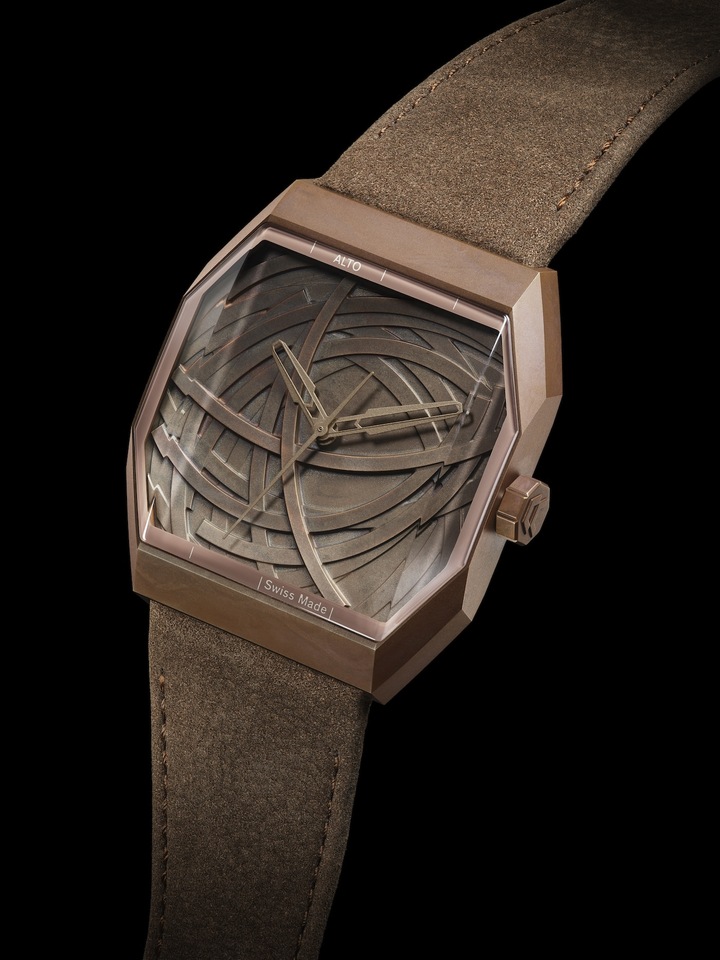
After extensive experimentation, the choice fell upon a bronze composition with a patina both unique and stabilized. Bronze, a noble and non-magnetic material, offered the possibility of transposing art onto the wrist. The selection of the alloy, the development and stabilization of the patina, and the very construction of the watch called upon the advanced expertise of three essential partners, responsible respectively for the case, the dial, and the patina process.
Dozens of tests were required — in close consultation with the artist — to achieve the living color and texture reminiscent of the warm brown tones that characterize Venet’s Collapses, while ensuring the necessary stabilization for a wearable piece.
The technical constraints inherent to this new material demanded a complete rethinking of the watch’s construction — to honor the nature of the bronze while preserving Alto’s identity.
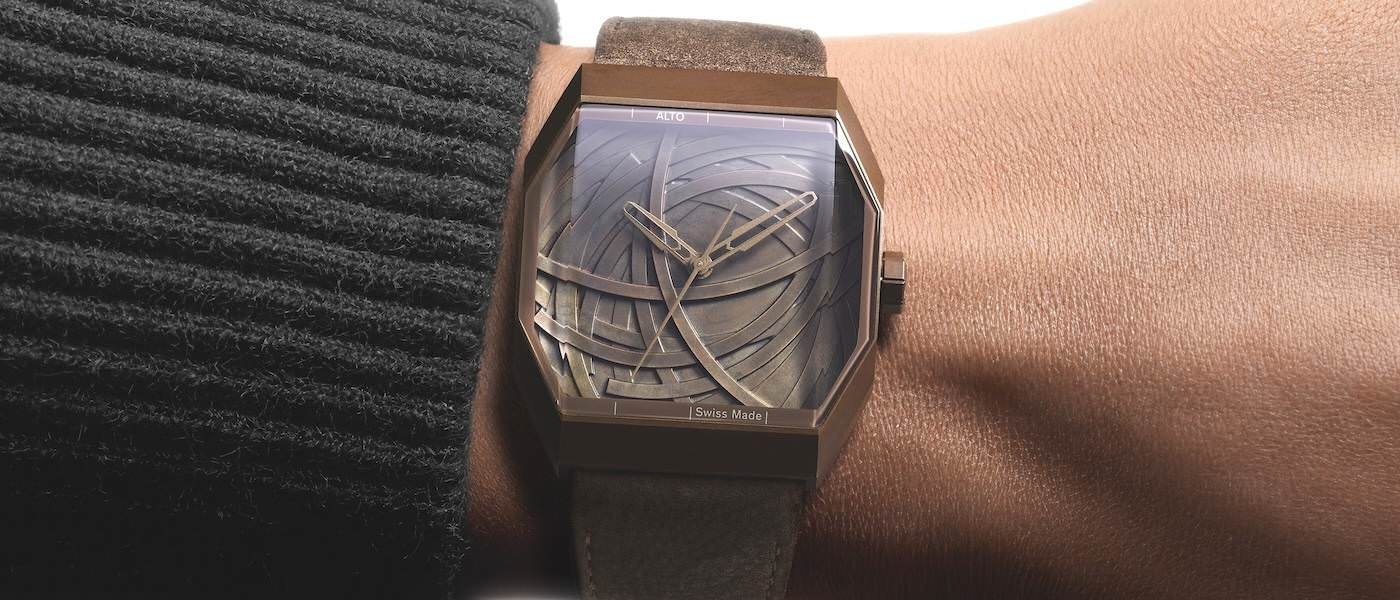
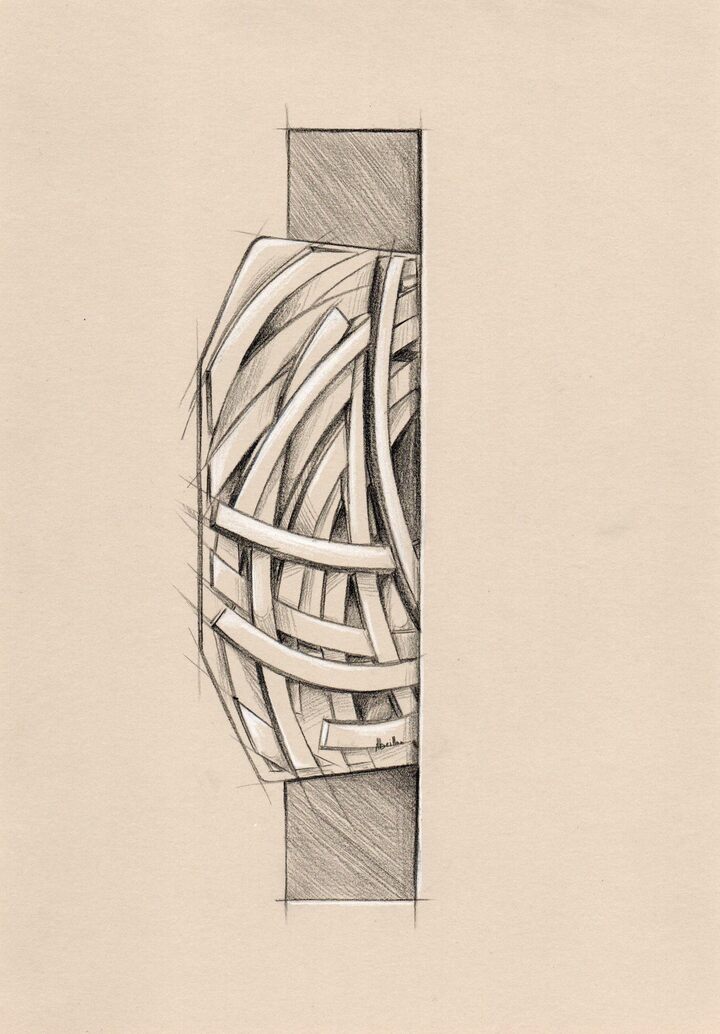
Like Bernar Venet’s art, the stabilized patina that protects the material will continue to evolve slowly, accompanying the wearer throughout their lifetime. Then remained the face of the watch: the design of the dial. Rather than a motif, Raphaël Abeillon and Bernar Venet chose to create a micro-sculpture — a composition of interlaced arcs, a true collapse of the initial architecture in miniature, forming the topography of the dial.
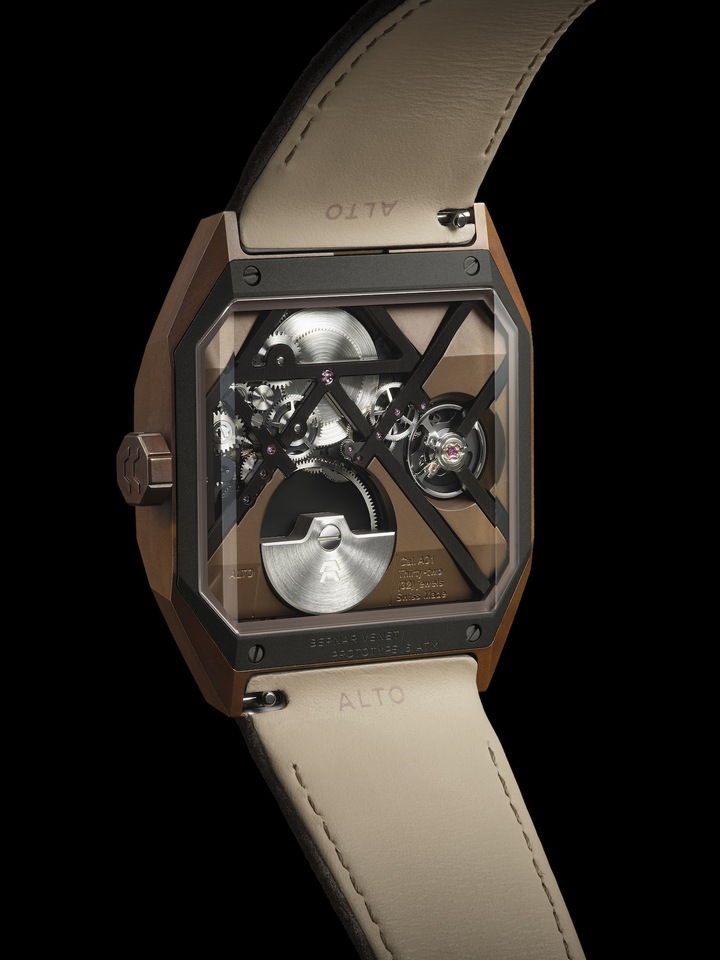
Its apparent casualness evokes random fall, yet it is meticulously orchestrated, echoing Venet’s monumental collapses. The dial is no longer a surface but a stage — with hollows, ridges, shadows, and interstices that hold the grain of the patina; the hands brush against the peaks; the indexes are reduced to a minimal punctuation, so as not to frame the sculpture.
On the wrist, the weight and texture of the bronze make the object a presence rather than an instrument. One wears a fragment of an idea — transposed from the urban scale to the human scale.
The co-creation with the artist was constant, from the selection of the patina to the composition of the collapse. The working sessions between Venet and Raphaël Abeillon had the tone of genuine exchange — sincerity, trials, and revisions — until they reached that point of balance where the timepiece remains fully horological (in volume, reliability, and wearability) while unapologetically affirming itself first as sculpture.
The three technical partners, each bringing their passion, culture, and expertise, contributed a diversity of know-how that marks the completion of an object unprecedented in both its execution and artistic dimension. This translation of scale is felt through contrast.
In Venet’s work, Corten steel — an industrial, “non-noble” alloy — rusts and protects itself, producing its own skin over time. At Alto, bronze — a material historically associated with bells, ancient sculpture, and marine chronometers — is patinated and then stabilized through an original process that captures the exact moment of color and depth, without the artificial gloss of varnish. One is a monument inscribed in climate; the other, an intimate object inscribed in daily gesture.
In both, time acts — meteorological time there, lived time here. Only ten pieces will be produced, each crafted and validated with the artist. Their rarity stems from the extreme precision required in mastering both material and detail — the only way to faithfully embody the project’s original rigor.
On the wrist, the patinated bronze — through its specific composition, patina, and stabilization — emerges as a paradoxical heir to Corten steel: nuanced and profound. Legibility remains strict — hands and markers reduced to the essential — so as not to compete with the “sculptural dial.”
This passage from the monumental to the intimate does not translate “identically”; it condenses, it transforms the medium. Fidelity lies not in imitation, but in the equivalence of experience. Then remains the question of Venet’s place in the history of art.
The major retrospectives (Lyon, Beijing), the Versailles invitation, Arc Majeur, the Asian cycles, and the establishment of a landmark Foundation — all point to a body of work defined by rare qualities: coherence, radicality, and public resonance.
From The Pile of Coal to The Hypothesis of Gravity, from The Line to The Arc, from The Angle to The Collapse, what is at stake is less a “style” than an insistence — to make form a field of experimentation where the world itself, with its laws and its accidents, is revealed.
There are many quotations, but perhaps this one best encapsulates his ambition: “to push the limits” — not for the sake of superlatives, but to expand, as he puts it, “the cultural space” — that is, quite concretely, what we are able to see, to understand, and to carry within us.
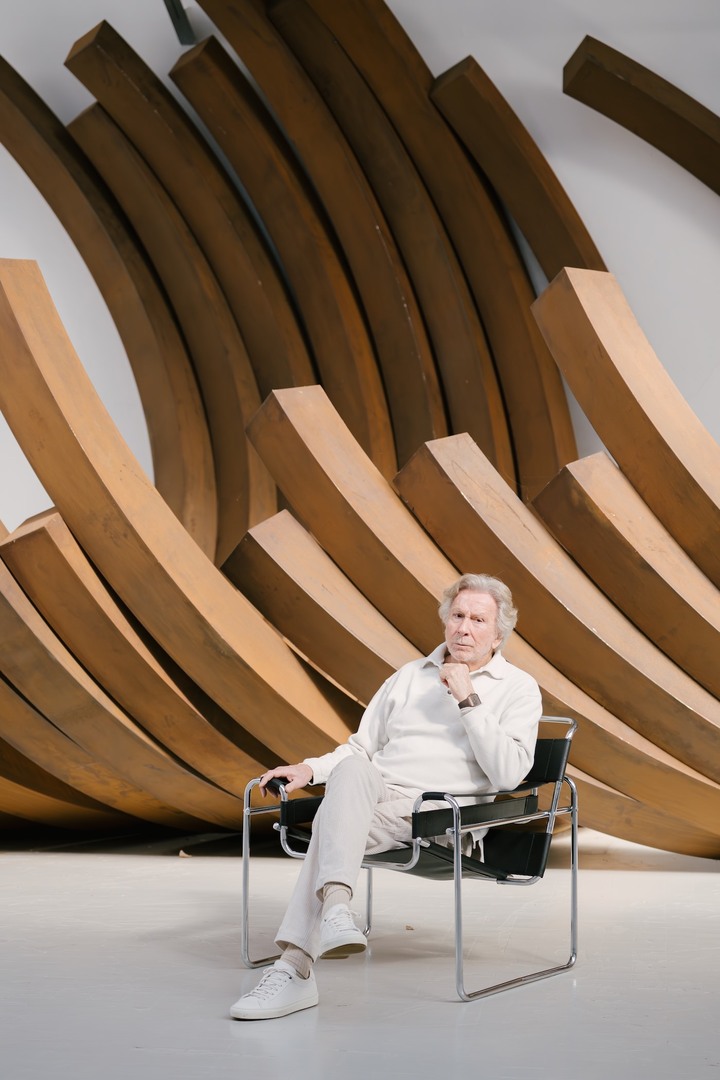
The Foundation, finally, ensures that such a body of work will not close in on itself. A place for sculpture and archives, but also for lending and dialogue, it establishes a demanding genealogy — minimalism, conceptual art — of which Venet has been as much an heir as one of its writers.
That an artist should remind us that works “belonging to history” should not belong to a single individual, and should create an institution to let them live on, is a way of completing the circle: the line returns to its point, yet the space has expanded.
Within this perspective, the ALTO × BERNAR VENET collaboration stands as a discreet but decisive milestone — proof that a vocabulary born from tar and coal, forged in Corten steel and monumentality, can inhabit a minute volume without losing any of its radicality or philosophy. That an arc can collapse — without falling from grace — onto a dial, and that this collapse, each day, might set our gaze back to work: that, perhaps, is the most beautiful measure of time.