

 Español
 Français
 Pусский
 繁體中文
繁體中文 简体中文
简体中文 Select another language

rom its earliest days, the measurement of time has looked to the stars, viewed first with the naked eye, then through telescopes and at observatories. Beyond this scientific and mathematical connection, our experience of time played out in our observations of the cosmos has a poetic dimension that reveals an endless fascination.
Astronomical watches reflect a long and rich tradition at Patek Philippe. Exemplary among them, the “supercomplication” Star Caliber 2000, created to celebrate the dawn of the new millennium, comprises 21 additional indications and functions, including a sky-moon display. The Geneva Manufacture miniaturised its astronomical module the following year, in 2001, and placed it on the reverse of the Sky Moon Tourbillon Ref. 5002, a fascinating wristwatch with 12 complications. Just one year later, in 2002, the nocturnal sky took pride of place on the front of the first Celestial, driven by an ultra-thin self-winding movement with mini-rotor, from the calibre 240 family.
The display of sunrise and sunset times, however, is a rarely seen indication – a complication that Patek Philippe has previously reserved for unique pieces and exclusive limited series. Such pieces include legendary ultra-complicated pocket watches – the James Packard, completed in 1927, and the Henry Graves Jr. from 1933 – or, closer to home, Calibre 89 with its 33 complications, unveiled in 1989 in honour of the Manufacture’s 150th anniversary, and the much fêted Star Caliber, presented in 2000.
A compelling celestial spectacle in real time
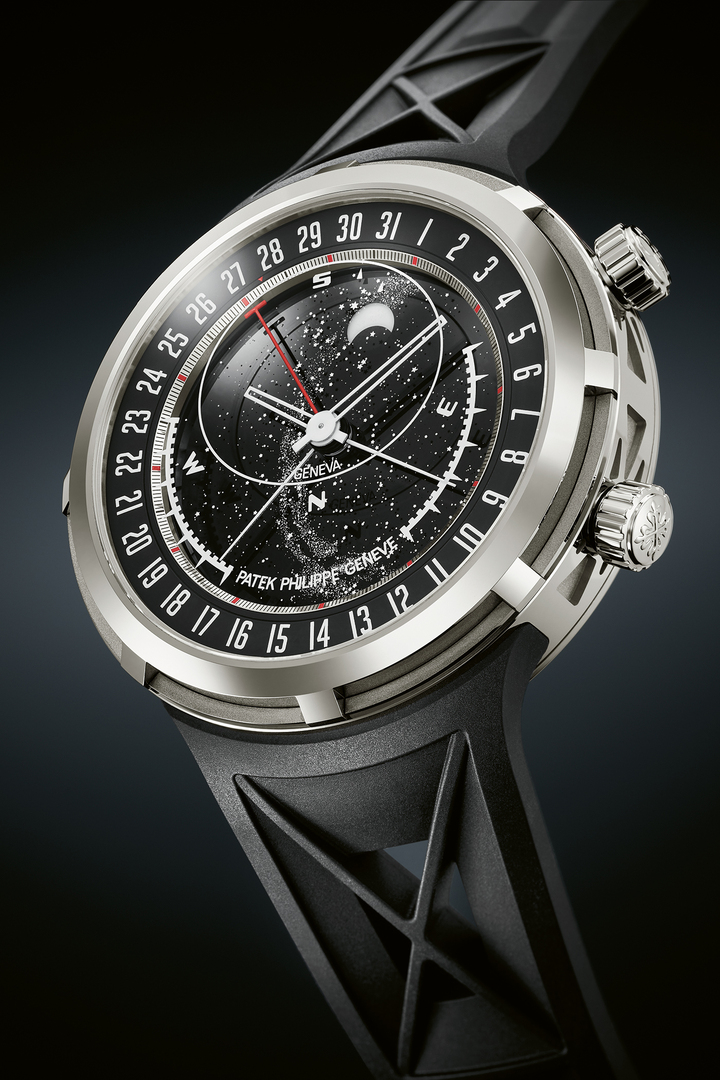
Now and for the first time, on the occasion of Watches and Wonders 2026, Patek Philippe has included the sunrise and sunset complication in a wristwatch: the Celestial Sunrise and Sunset Reference 6105G-001. Moreover, and again unprecedented, the Manufacture’s engineers and watchmakers have combined it with an ingenious and intuitive mechanism enabling instantaneous correction of these indications at the changeover between summer and winter time, and again between winter and summer time (winter time corresponds to the sun’s natural cycle and is the basis for civil time, while summer time is artificially advanced by one hour).
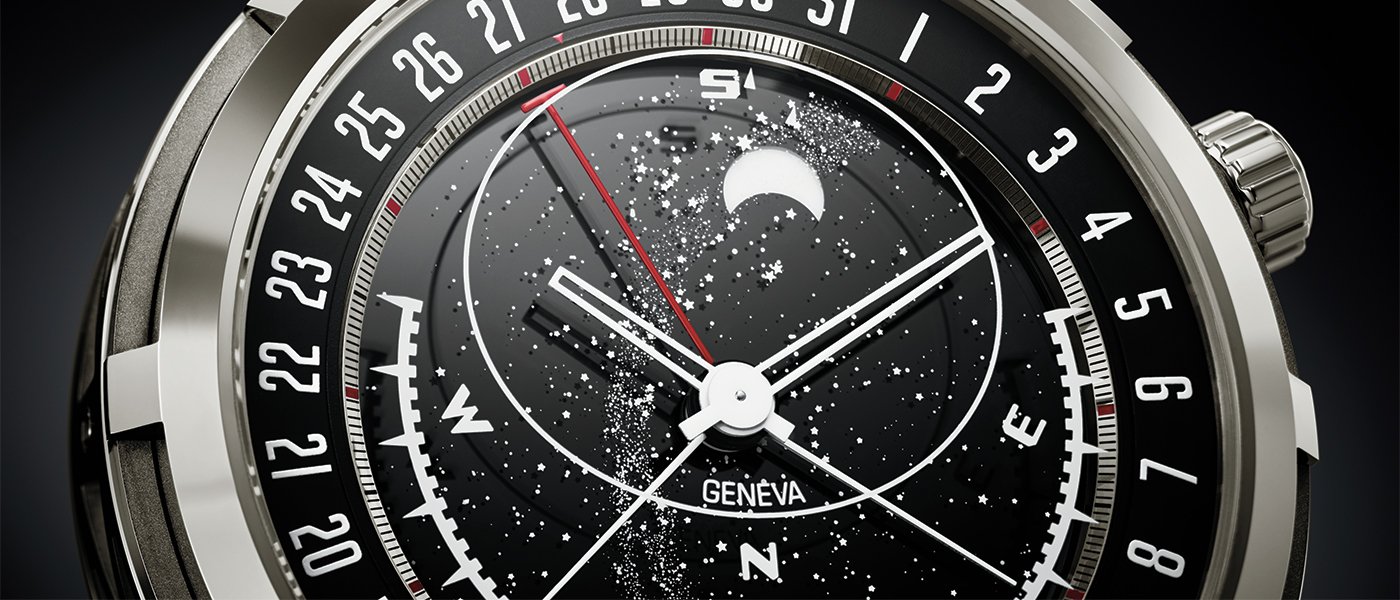
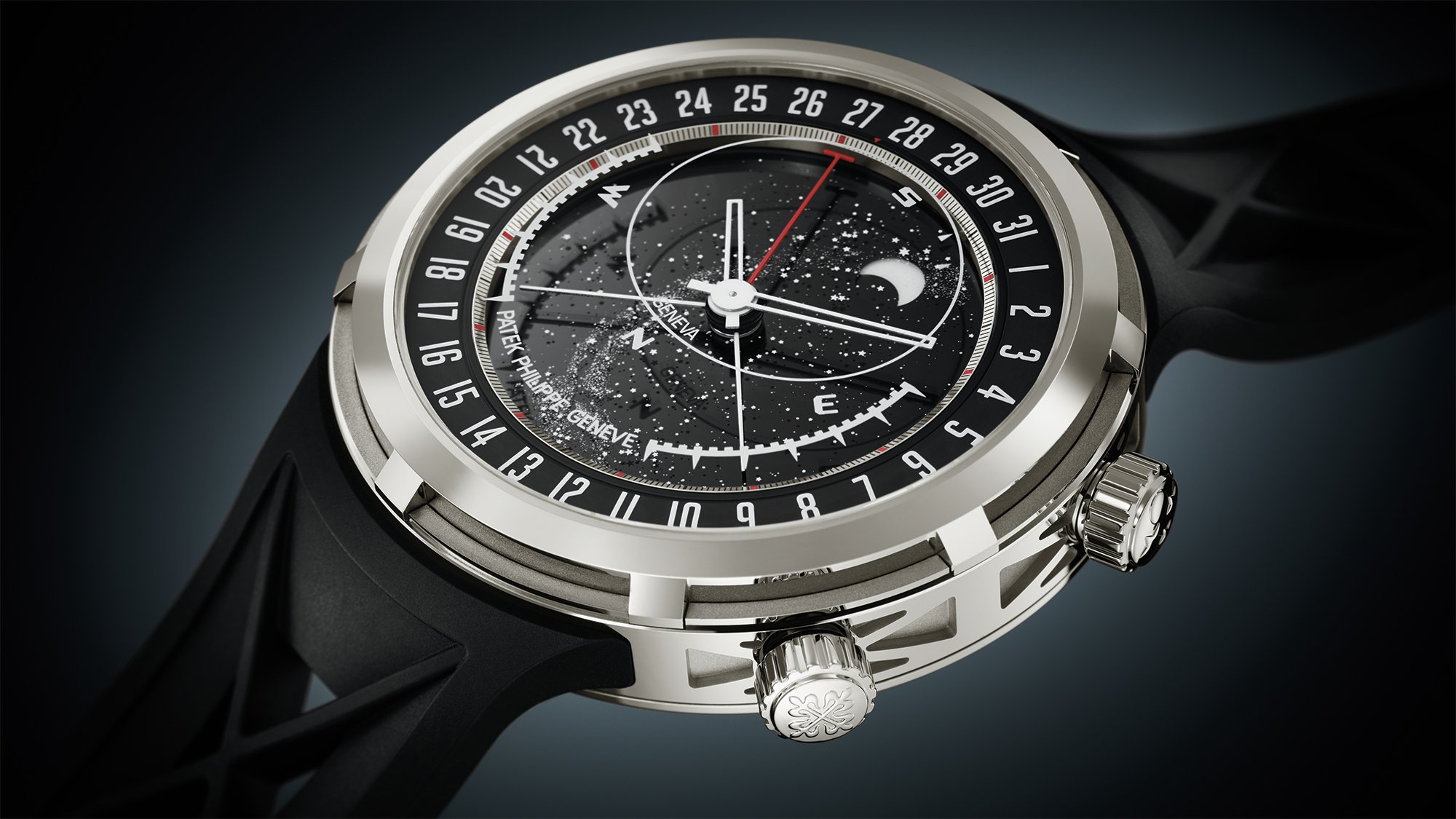
The Patek Philippe Celestial Sunrise and Sunset offers a spectacle of immense depth and extreme precision. The visible portion of the sky above Geneva is shown inside an ellipse on a mobile chart, with the apparent movement of the stars, the angular position of the moon and its changing phases all recreated in real time.
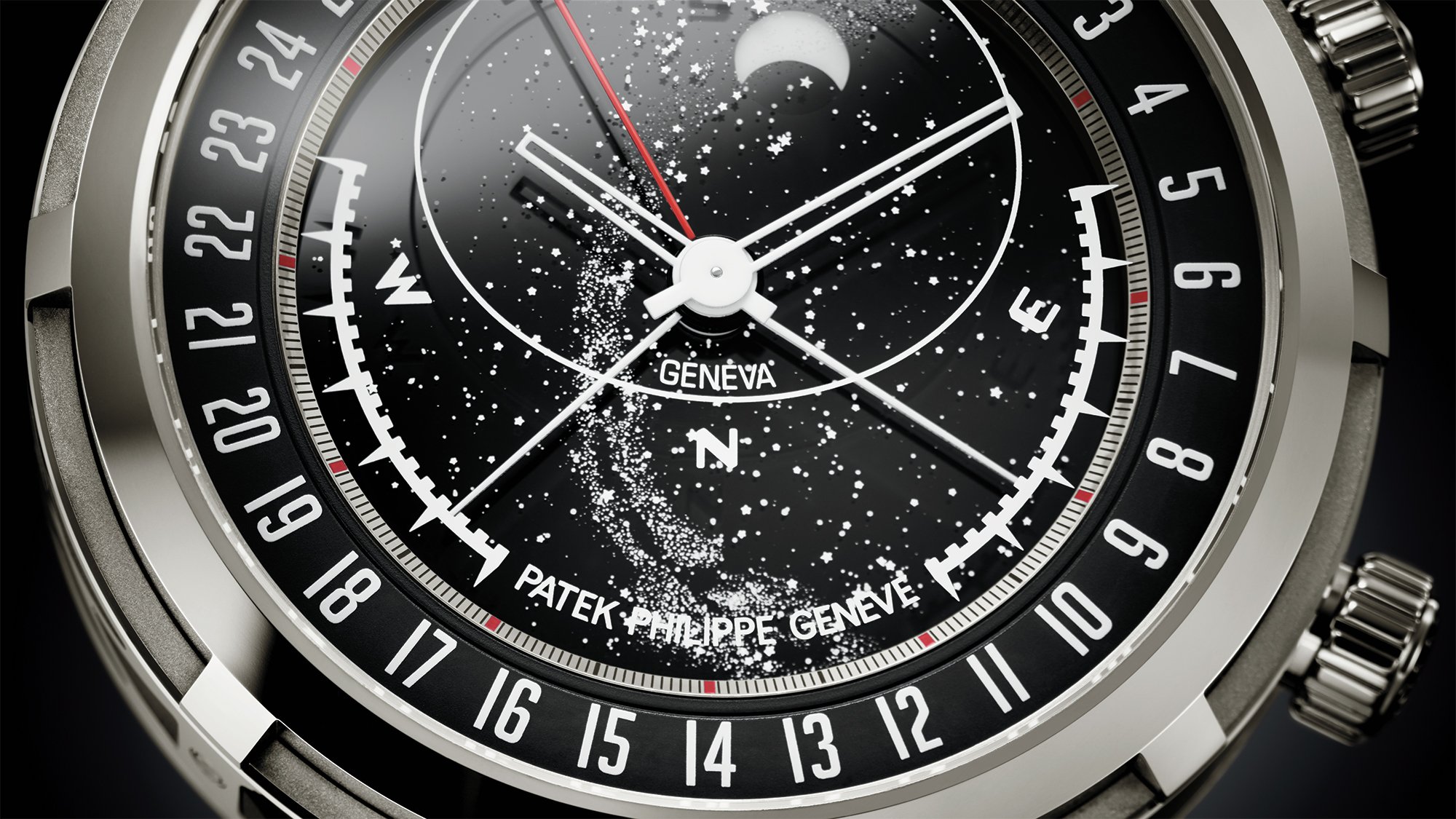
This continuous choreography is orchestrated by three superposed transparent discs which rotate at different speeds: in 23 hours, 56 minutes and a little over four seconds for the celestial vault whose cycle corresponds to a sidereal day (the elapsed time between two consecutive passages of a star across the meridian); an average of 24 hours, 50 minutes and 28.328 seconds for the lunar day; and 29 days, 12 hours, 44 minutes and 2.82 seconds for the lunar month (the elapsed time between two full moons).
One can imagine the complex calculations required to mechanically transcribe and bring to life these different cycles.
These purely astronomical indications are completed by a peripheral date display, shown by a red hammer-style hand on a disc. The 1 on the date disc is not conventionally aligned with 12 o’clock, but offset to the right. This is because the numerals serve a dual function, indicating the date but also tracking sunrise and sunset times, again for Geneva. For this purpose, two scales are symmetrically and harmoniously arranged, with sunrise on the East or right side of the dial and sunset on the West or left side, swept by two slender, baton-style, skeleton hands in 18k white gold, coated with white varnish.
Complex variations due to the tilt of Earth’s axis
Over the days and the seasons, the times of sunrise and sunset vary according to the inclination of Earth’s axis in relation to the plane of its orbit around the Sun. In order to recreate this annual cycle, Patek Philippe’s engineers calculated and developed a mechanism whose two ovoid cams geometrically reflect the tilt of Earth’s axis as it varies over the course of the year. A double feeler-spindle (0.48mm in thickness for extreme precision) reads the two cams’ respective positions by means of two flexible arms that constantly rest on the cams and permanently follow their contours, held in place by a flexible guiding system. Their linear movement is driven by two racks, guided by a structure with two pairs of four spring arms to precisely replicate the feeler-spindle’s movements.
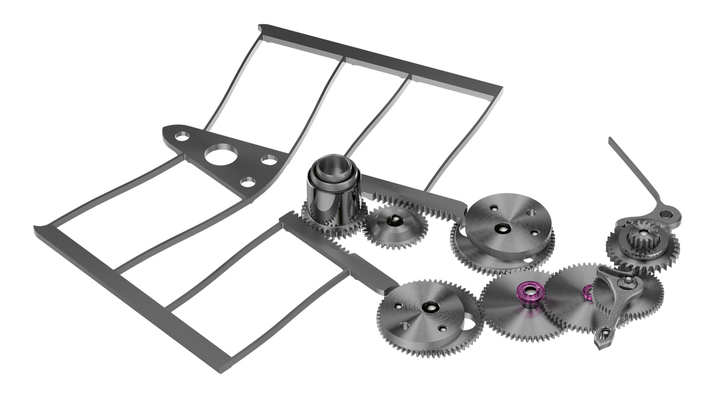
A gear train then transmits the information from this mechanism to the hands that indicate sunrise and sunset times.
Needless to say, Patek Philippe has filed a patent for this innovative and complex system.
The subtle and intuitive correction mechanism for summer and winter time
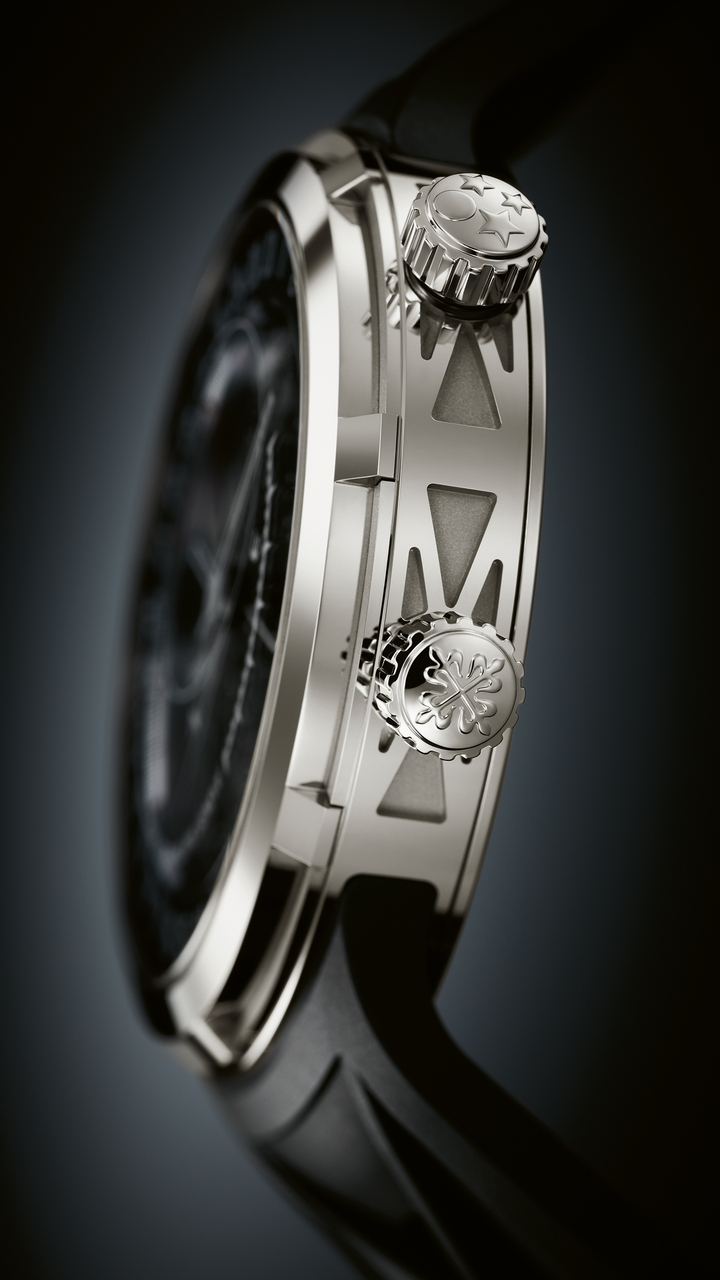
The Celestial Sunrise and Sunset is the first Patek Philippe watch that offers a direct reading of sunrise and sunset times throughout the year. Twice a year, on dates that vary from year to year, in countries that observe summer time and winter time, the time is advanced by one hour or put back by one hour. Thanks to a mechanism – also patented –, the Celestial’s owner can account for this changeover between winter (civil) time and summer time, or vice versa, simply and intuitively by means of two push-pieces in the caseband, at 9 and 10 o’clock.
One press on the corrector at 9 o’clock advances the time display by one hour for summer time, while one press on the corrector at 10 o’clock moves the time display back one hour for winter time. A safety system prevents two consecutive presses on the same corrector. The sunrise and sunset hands remain in the same position; the disc and the date-hand star move 1/31st of a turn backwards or forwards.
Maintaining a slim profile
Patek Philippe’s engineers faced another challenge: how to incorporate these astronomical indications into a compact new movement (totalling 426 parts) while adding the least possible thickness.
Calibre 240 C LU CL LCSO shares the same 38-millimetre diameter as the previous Celestial and, despite its 121 additional parts, measures just 1.12 millimetres more for a height of 7.93 millimetres. A true feat of engineering and design.
This movement is automatically wound by an off-centre mini-rotor in 22k gold, a metal that endows it with the strength required for optimal winding of the mainspring. Power reserve is a minimum of 38 hours and a maximum of 48 hours (the sunrise and sunset indications use only the smallest amount of power).
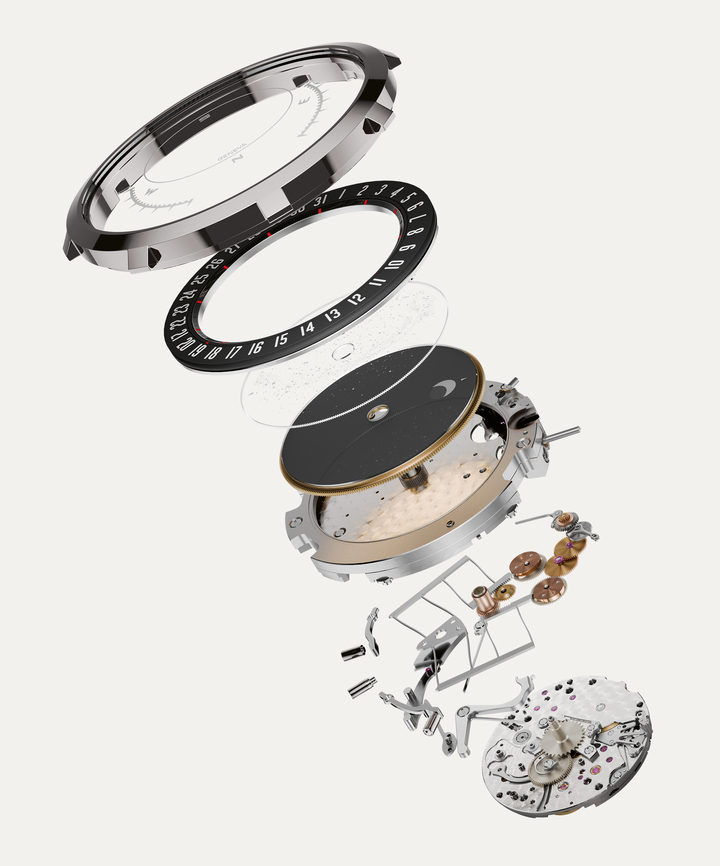
Fitted with a Spiromax© balance spring in Silinvar© and a Gyromax© balance wheel, calibre 240 C LU CL LCSO beats at a frequency of 21,600 vibrations per hour and respects every one of the criteria of the Patek Philippe Seal (revised in 2024) in terms of craftsmanship and precision, with a tolerance of just-1/+ 2 seconds per day.
A case that evokes a space module
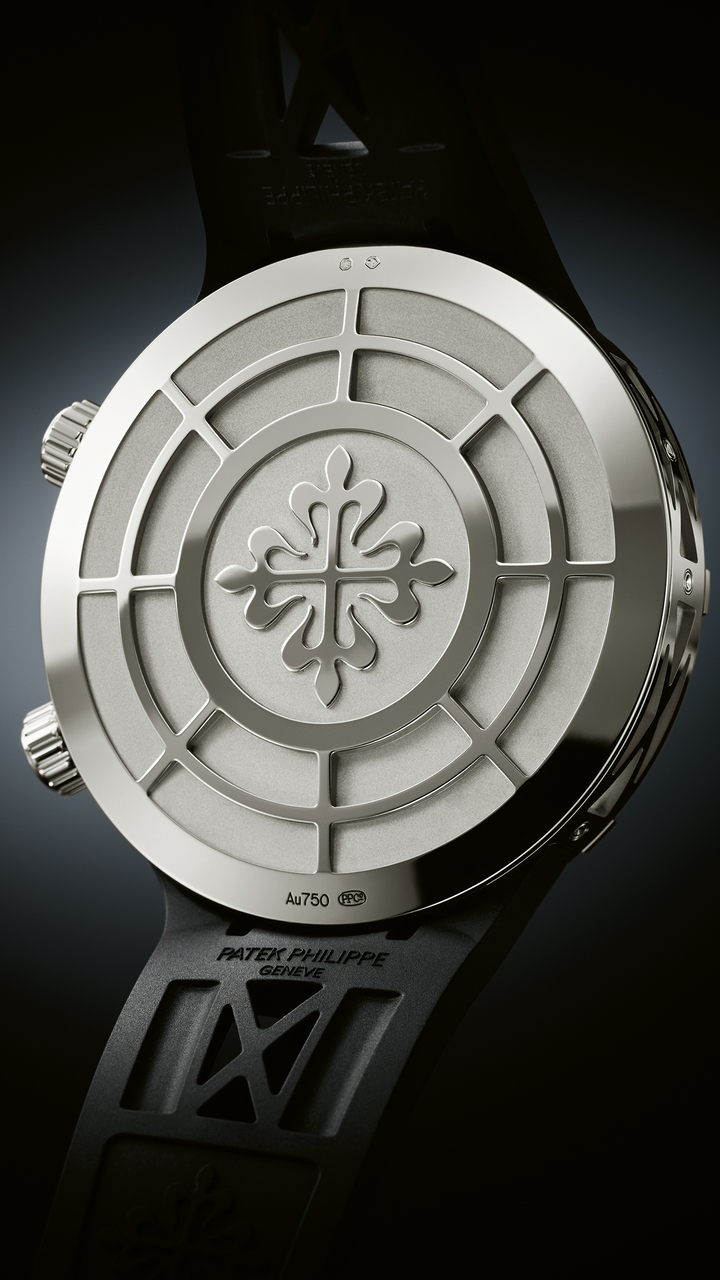
This exceptionally complex movement resides inside a white gold case, 47 millimetres in diameter and 12.39 millimetres in height, that is strikingly modern in design: its distinctive X-shaped pattern evokes the tubular structure of space modules. This sculptural motif, with its contrasting polished and satin-brushed surfaces, is worked directly in the caseband. Unusually for a contemporary Patek Philippe watch, the same motif carries on to the solid case back, completed by a Calatrava Cross at its centre.
This modern, dynamic identity is echoed by the pierced X-shaped motifs of the strap, made from an ultra-resistant black composite. Doing away with traditional lugs, it connects directly with the case by means of an invisible attachment. Wearing comfortably on the wrist, it is secured by a patented triple-blade fold-over clasp in white gold.
Another distinctive feature is the case’s two crowns. The first, at 4 o’clock and embellished with a Calatrava Cross, is for winding and setting the time. The second at 2 o’clock, as its star-and-moon decor suggests, is for setting the astronomical indications: annual index, sunrise and sunset times, the sky chart, angular position of the moon and moon phases.
Easy to use, its patented construction incorporates a bayonet disconnecting-gear that prevents accidental manipulation. When released and turned anti-clockwise, this crown is used to set sunrise and sunset times. Pulled out to its second position, turned in one direction it sets the moon phases and, turned in the other direction, the celestial vault. As for the date, it is set simply by successive pressures on a push-piece that sits flush with the caseband between 7 and 8 o’clock.
Five years of development have culminated in the most sophisticated, most intuitive watch with sunrise and sunset times. The depth and clarity of its display make it a precision instrument as much as an invitation to gaze up at the stars and dream.
THE SIX PATENTS FOR THE CELESTIAL SUNRISE AND SUNSET
- Patent 1: Rack mechanism for the display of sunrise and sunset times – EP3740821 (A1)
- Patent 2: Summer/winter time correction mechanism – EP3731028 (A1)
- Patent 3: Display of summer/winter time from the date disc – EP3731027 (A1)
- Patent 4: Crown with a bayonet disconnecting-gear – EP22174402 (A1)
- Patent 5: Optimised finger-piece – EP3408712 (A1)
- Patent 6: Mechanism for recentring the staff – EP3839662 (A1)