


 Español
 Français
 Pусский
 繁體中文
繁體中文 简体中文
简体中文 Select another language


am not searching for beauty in the way a designer does,” says Bernhard Lederer, his tall frame commanding attention as we meet him in his workshop in Saint-Blaise, in the canton of Neuchâtel. “I am searching for the very source of watchmaking: chronometry. By remaining focused on that quest, a natural path emerges – one that ultimately leads to forms that the human eye instinctively perceives as beautiful.”
In his guest book, a visitor once wrote a simple sentence: “Lederer, for those who know.” The remark captures something essential. Far removed from ostentation for its own sake, Lederer has spent forty years pursuing a carefully considered vision. His work – recognised with growing acclaim in recent years by an increasingly knowledgeable and discerning watch market – is the result of relentless technical investigation conducted with remarkable consistency and intellectual rigour.
Lederer sees himself as part of an unbroken lineage. In relation to the great masters who preceded him, his work is defined by the continuity of a fundamental chronometric quest. “People came to believe that mechanical watchmaking had already solved the essential chronometric questions, and that attention could now be devoted primarily to design and decoration,” he says. “Nothing could be further from the truth.”

In an era that delights in celebrating heritage, the greatest tribute he can pay to the masters of the past is not to replicate their achievements, but to continue their inquiry. Huygens, Harrison, Le Roy and Berthoud were not merely inventors; they were explorers of unanswered questions. What would their mindset be today? What challenges would they tackle? Certainly not the same solutions they developed two centuries ago, executed in modern materials, according to Lederer. “Their mindset was revolutionary. They questioned everything. That is what leads to meaningful breakthroughs. But it is not the easiest path to follow.”
Only the answers change
The constant re-examination of fundamentals has its roots in an unconventional journey. From an early age, Bernhard Lederer developed a fascination with mechanical objects, antique watches and technical books. He spent countless hours wandering through flea markets in search of discoveries. More than the mechanisms themselves, however, it was the questions they embodied that captivated him. Why one solution rather than another? Why do multiple answers exist for the same problem? That curiosity, almost childlike in its intensity, has never left him.

Restoration became his true watchmaking school. By dismantling historical mechanisms and studying the work of the great masters, he came to understand that the history of horology is, above all, an uninterrupted conversation between generations. The questions rarely change; only the answers do.

The work of Antide Janvier, Pierre Le Roy, Ferdinand Berthoud and John Harrison revealed to him that the fundamental challenges of timekeeping – oscillator stability, energy transmission and isochronism – remain as relevant today as they were centuries ago. This conviction would guide his entire career.
During the 1990s, together with his wife Ewa, Bernhard Lederer gained international recognition through BLU (Bernhard Lederer Universe), a brand dedicated to complex watches featuring multiple time zones, universal time displays and astronomical indications. These creations demonstrated not only his technical mastery but also his ability to develop genuinely original solutions.

Yet throughout those years, Lederer never lost sight of his ultimate objective: revisiting the foundations of chronometry itself.
Every stage of his journey brought him incrementally closer to that goal. Before he could tackle the regulating organ, however, he first had to build the manufacturing capabilities required to do so. In that respect, the BLU years proved a crucial stepping stone. In 2006 he unveiled his first fully in-house movement, the MT3, entirely conceived and produced within his own manufacture.
While much of the industry regarded the major chronometric questions as largely settled, Lederer remained convinced of the opposite. That conviction culminated in 2021 with the presentation of the Central Impulse Chronometer – the watch that firmly established him among the most respected figures in contemporary independent watchmaking.
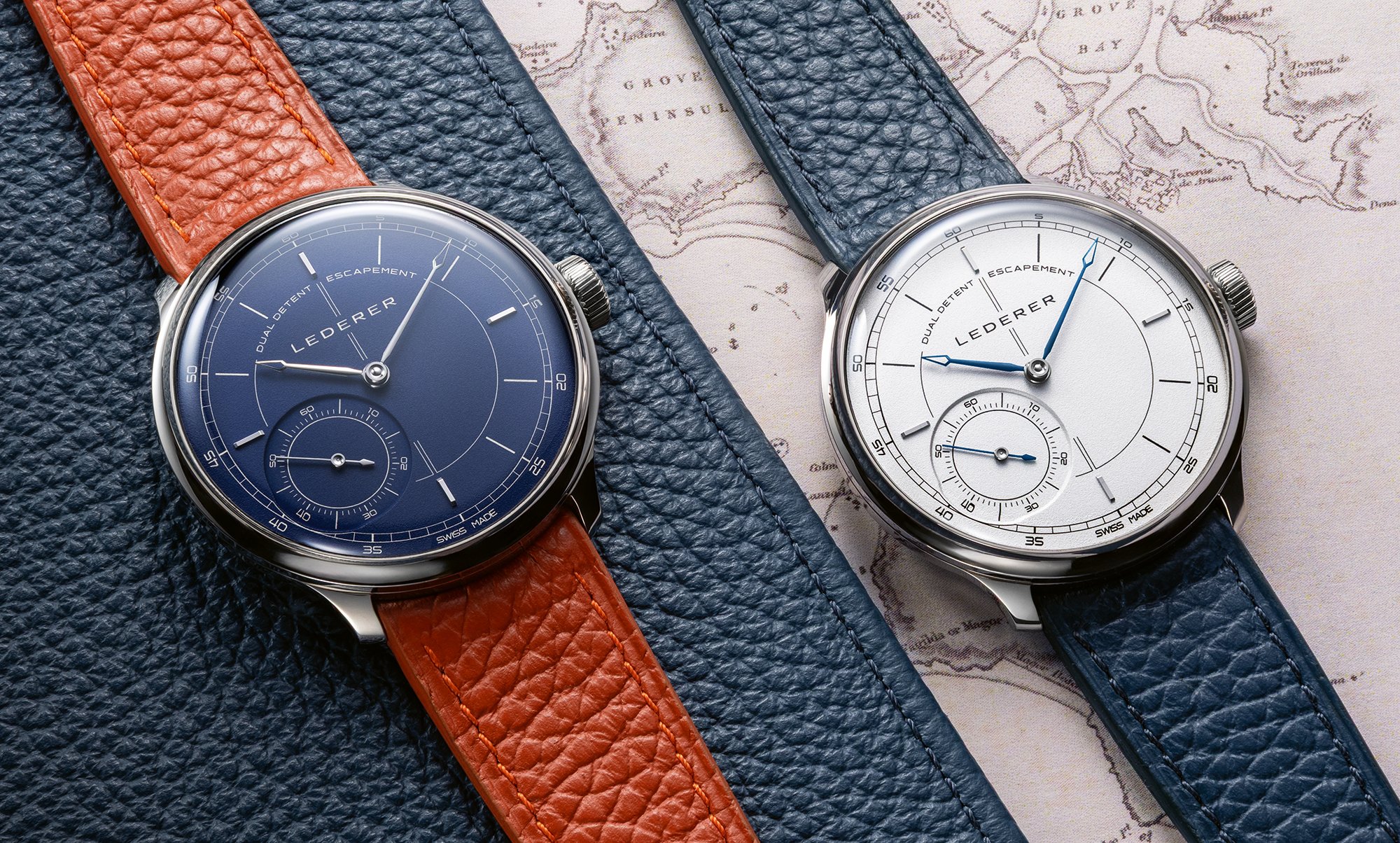
The Central Impulse Chronometer
Awarded the Innovation Prize at the Grand Prix d’Horlogerie de Genève that same year, the Central Impulse Chronometer represents the culmination of decades of reflection on energy transmission and oscillator stability.
Its principle is as ambitious as it is elegant. Two independent gear trains each power their own escapement. Both escapements deliver direct impulses to a single central balance wheel. While inspired by historical research into direct-impulse escapements, the architecture reinterprets those concepts entirely through contemporary solutions. The objective is straightforward: reduce disturbances affecting the oscillator and maintain a more stable amplitude over time.
More than a historical reinterpretation, the Central Impulse Chronometer demonstrates that the great chronometric questions remain fertile ground for innovation. Far from being exhausted, they continue to generate new possibilities.

This philosophy also explains Lederer’s distinctive position regarding modern materials. His refusal to embrace silicon is not rooted in conservatism. He is anything but hostile to progress: his entire career has been built upon questioning accepted principles. Rather, he believes that the most meaningful advances are still to be found within mechanical architecture itself.
For Lederer, precision does not arise solely from material science. It emerges from a profound understanding of the relationships between energy, oscillation and regulation.
A form of eternity
This philosophy is reflected directly in his watches’ appearance. Lederer creations are immediately recognisable through their architectural symmetry and visual equilibrium. On the Central Impulse Chronometer, the two visible gear trains positioned on either side of the dial create a dual symmetry that has become the signature of the manufacture. This arrangement is not decorative. It is the direct expression of the underlying mechanical construction.

Without compromising on the exceptional quality of his finishing, Lederer refuses to establish a hierarchy between technique and aesthetics. The movement, dial, case, volumes and light all form part of a single coherent vision.
This coherence explains why Lederer’s watches resist the conventional categories of independent watchmaking. They seek neither spectacle nor virtuosity as ends in themselves. Instead, they propose a different understanding of innovation – one rooted in fundamental research rather than visual effect. After forty years in the profession, Bernhard Lederer approaches his craft with the same curiosity that propelled him at the beginning. His body of work rests on a simple conviction: horological progress is born not from definitive answers, but from questions important enough to pursue for a lifetime.

In an industry often inclined to celebrate its past, Bernhard Lederer reminds us that the true legacy of the great masters lies not in the solutions they devised, but in the questions they refused to abandon. Chronometry remains an unfinished frontier. That is precisely why the quest endures – and it may never yield a definitive answer. In that perpetual search, watchmaking finds its closest expression of eternity.


