


 Español
 Français
 Pусский
 繁體中文
 简体中文
 Select another language


ontemporary horology has never been short of imagination. Independent creators and established manufactures alike continue to explore new mechanical architectures, complications and materials, challenging familiar conventions along the way.
The question is therefore not whether original thinking still exists, but what happens when a small company chooses to pursue it according to its own logic. On the shores of Lake Como, La Vallée offers one possible answer.
The family-run Italian company, whose horological roots stretch back to 1938, has deliberately maintained a very limited scale of production. Each creation develops through a dialogue between concept, mechanics, architecture, aesthetics and craftsmanship.
La Vallée does not simply develop products. It develops horological concepts. An important distinction. A product can begin with a defined form, function or category. Here, the starting point is a question about an experience, a mechanical possibility or a different way of perceiving time. The various elements then influence each other until the form of the timepiece becomes inseparable from the idea behind it.
ATTIMO, M30TP and COSMO illustrate three different paths.

ATTIMO brings a personal moment back to life
ATTIMO began with a personal premise: to create a timepiece around a moment of profound significance to its owner.
In its Golf and Polo interpretations, the upper scene can be individually conceived in precious metal around a defining sporting achievement. A figure in the owner’s likeness recreates the winning shot or decisive stroke, turning the scene into a physical reminder of an instant worth remembering.
The idea extends beyond personalisation. ATTIMO uses the passage of time to bring that moment back to life: at every hour, the winning shot is recalled.
Mechanical function and personal meaning are intertwined from the outset. The relationship between the object and its owner is one of the foundations of the concept, shaping both the scene and the way it is experienced.
M30TP makes the mechanism the object
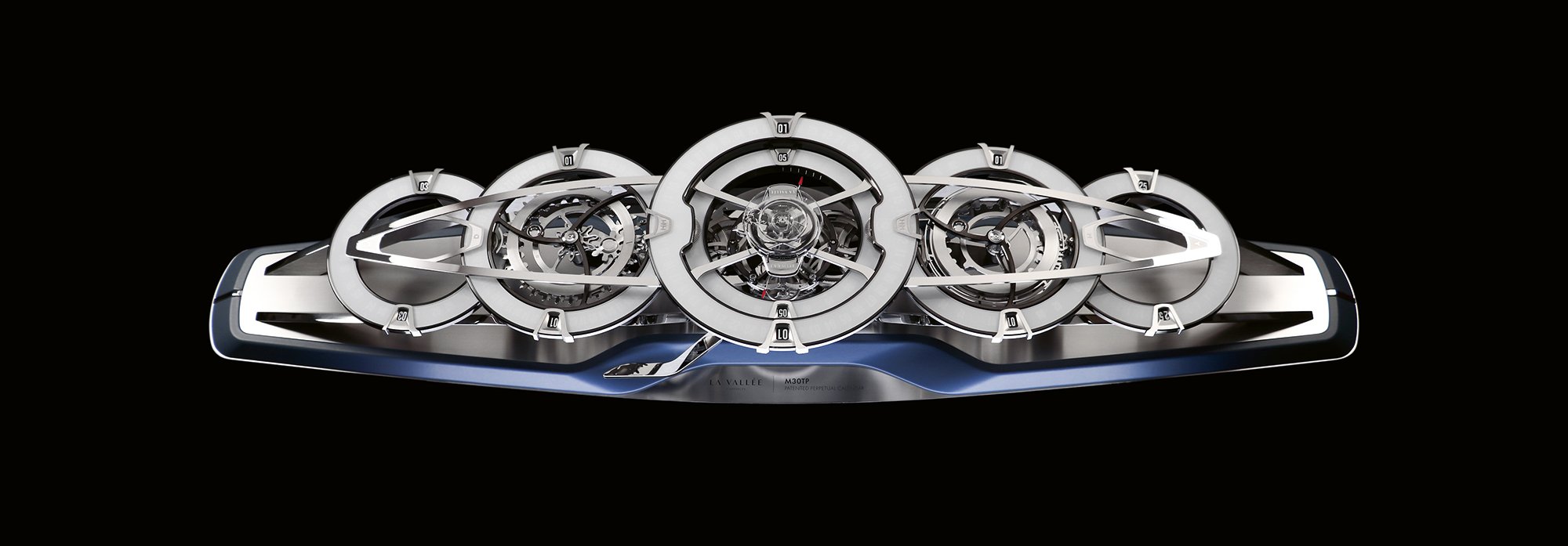
M30TP followed a different path. The ambition was to create a timepiece whose mechanical architecture would surprise the observer, without referring to an existing object or familiar horological form. Its symmetrical structure is designed to be viewed from both sides, allowing people gathered around it to discover the movement from different perspectives.
The mechanism is not hidden behind a dial. Its architecture becomes the object of observation. Conceived and developed by Luciano Sasso, La Vallée’s head of research and development, M30TP also explores mechanical simplification. The aim is to find highly optimised ways of achieving complex functions, going beyond a reduction in the number of components.
Its patented perpetual calendar uses just seven moving elements, including four gears, and allows bidirectional adjustment without lubrication. The challenge lies in reconsidering the architecture of the function rather than demonstrating its complexity.
The same thinking informs its regulating organ: a low-frequency, five-minute tourbillon, magnetically suspended beneath a large, 72-millimetre balance wheel. Its measured movement contributes to the contemplative nature of the object.
M30TP invites the observer to pause, look again and discover how the mechanism works, and why it has been constructed in this way.
COSMO follows a mechanical challenge into new territory
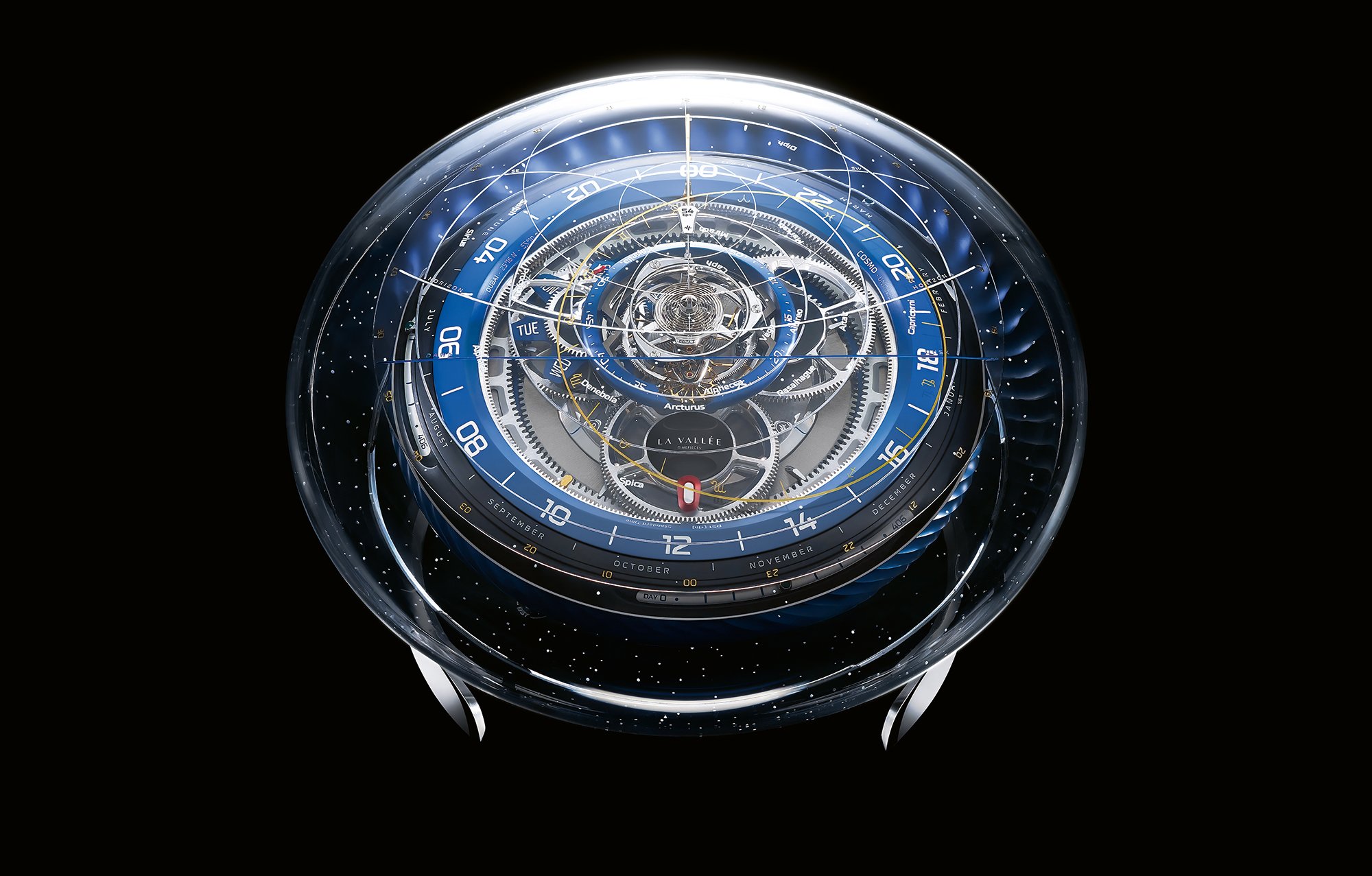
COSMO began with a challenge: obtaining an exceptionally long power reserve while driving a large, heavy, low-frequency escapement.
Sasso’s research opened up two possibilities: delivering energy through a new patented transmission system based on only two eccentric gears, and making the entire mechanism rotate continuously around its own axis.
The mechanical research influenced the architecture, which in turn shaped the astronomical indications, the aesthetic expression and the way the object could be experienced.
The result is a 14.5-kilogram mechanism that rotates once every sidereal day and has a power reserve of 406 days. Its components move at different speeds, generating time, calendar and astronomical indications through their relative motion.

COSMO is difficult to place within conventional horological categories. Its ingenuity lies in the synthesis of its technical solutions and the way they work together.
Even the hand-blown Murano glass dome participates in that synthesis. It reinforces the sensation of suspension, forms part of the setting and winding interaction, and acts as an acoustic resonator, making the rhythm of the escapement perceptible.
Mechanics, architecture, aesthetics and interaction were developed one in dialogue with the others.
A concept before a form
For collectors familiar with contemporary independent clockmaking, this approach suggests a distinction between creating a clock in the form of a recognisable object and developing one whose form, architecture and mechanics emerge from a horological concept.
In the first approach, an existing visual language can supply the narrative. At La Vallée, the starting point is a question rather than an object to reproduce.
This changes the development process. The concept raises questions about mechanics, architecture, indications, materials and interaction; these elements then influence one another throughout development. The timepiece takes shape not simply as an unusual clock, but as a horological object conceived as a complete system.

Complications, in this context, become opportunities to reconsider how a function can be achieved, how a mechanism can be observed or how an object can alter the experience of time. The company’s deliberately limited production allows this thinking to extend into the making of each piece. Hand finishing, assembly and refined materials form part of the overall conception of the timepiece.
ATTIMO, M30TP and COSMO consequently share neither a common shape nor a common complication. They share a way of thinking. One begins with a personal moment, another with the ambition to create a striking mechanical architecture, and the third with a mechanical challenge whose solution opened a new direction.

La Vallée’s Italian background brings another set of references to that process. Art, architecture, industrial design, automotive engineering and craftsmanship have long developed in Italy through a close relationship between technique and aesthetic expression. That culture provides a further influence on the dialogue between mechanics and form.
Is there still room for original thinking in contemporary horology? La Vallée’s answer takes the form of three very different objects, each shaped by the concept from which it began. La Vallée develops concepts. The timepieces are their expression.


