


 Español
 Français
 Pусский
 繁體中文
繁體中文 简体中文
简体中文 Select another language


he soft, warm tone of her voice contrasts with the firmness of her handshake. The slender, knotted fingers of artist Vanessa Barragão bear witness to an intense life of craftsmanship. “Creating with our hands is essential to our mental health,” she tells us during our visit.
Those words neatly sum up a highly personal approach grounded in strong convictions about social and environmental responsibility. Back in 2016, while completing her master’s degree in fashion design at the University of Architecture in Lisbon, the young artist decided to gather “a collection of wool yarns that I had dyed by hand”.

What made them special? Every one of those yarns had been destined for destruction, surplus from Portugal’s textile industry. Since then, work after work, Barragão has demonstrated that beauty can emerge from what others discard. In direct lineage with Portuguese artist Bordalo II, her discreet but effective form of activism has propelled her onto the international art scene.

What techniques and materials does she use in her daily practice? And how have her works managed to stand out in a textile-art landscape already occupied by internationally renowned figures such as Joana Vasconcelos?
Stitch by stitch
“I never planned to open an independent studio. It happened very naturally,” Vanessa Barragão recalls. After completing her master’s degree in fashion design, she moved to Porto, the industrial heartland of the country. Things then began to move at remarkable speed. While collaborating with the Beiriz Traditional Carpet Factory and developing her own textile language in parallel, she received a commission for a tapestry from London Heathrow Airport.

Still under 30, Barragão threw herself wholeheartedly into the unexpected project. Measuring more than six metres wide and two metres high, the work is a vast hand-made world map, rich in colour and strikingly vivid detail: “Botanical Tapestry”. It required eight kilograms of jute and cotton, along with 42 kilograms of wool yarn reclaimed from waste generated by Portugal’s textile industry, to depict the five continents and oceans. It is a monumental feat of handwork, immersive and almost hypnotic, in which even the Chinese ginkgo biloba finds a place.

Exhibitions in Taipei, New York and Australia soon brought the textile artist wider recognition. In 2020, however, that rapid rise was accompanied by a necessary return to her roots. She left Porto and opened a studio in her native Algarve. As she explains: “My roots and my family are essential to me. I grew up watching my parents and grandparents work with their hands. That is how my passion for making things by hand became part of my life.”
Barragão then surrounded herself with a collective of craftswomen, with her mother and sister among the closest members of the team.

The atmosphere in the studio is warm and informal. Everywhere, large balls of brightly coloured yarn are carefully arranged on broad shelves, sharing the walls with works in progress. A computer, set apart on a desk, provides the only digital link with clients. The women talk as they work. Several pieces are underway at once, from floor rugs to wall tapestries. Coral, pink, burgundy, earth tones, Naples ochre and sandy yellow mingle freely in a richly coloured setting.

“I don’t have a favourite colour. Even the dullest shade can come alive in a rich chromatic combination,” she says.
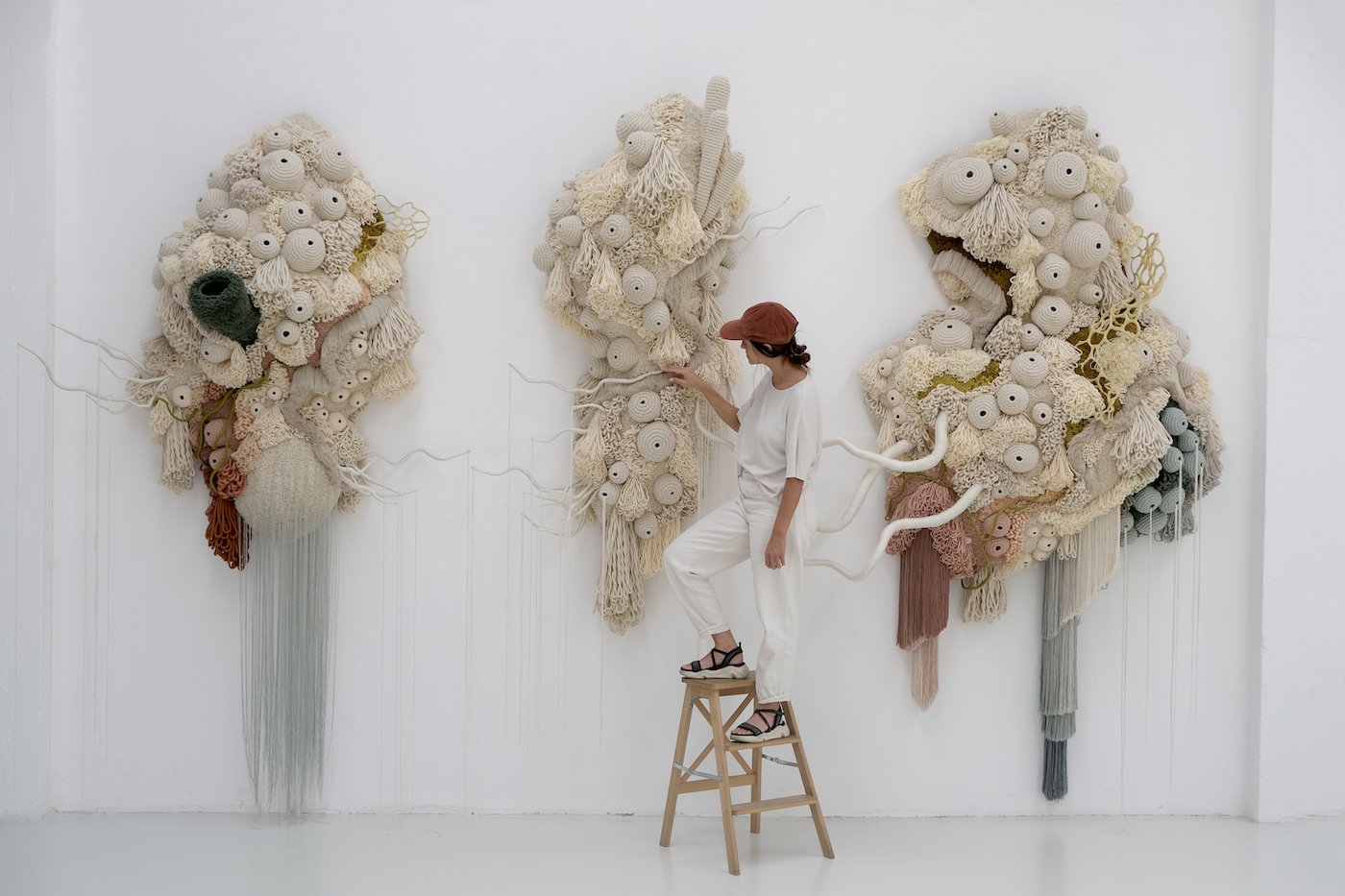
The urge to touch the work is difficult to resist. Barragão gets up and returns to a piece hanging on the wall. Latch hook in hand, she feeds a burgundy wool thread through the grid of a Smyrna canvas. With disconcerting ease, she forms a loop a few centimetres long. Before us, a colourful marine landscape begins to emerge. The precision of the gesture gives the work its singular character.

Smyrna canvas and latch hook
On the day of our visit, Barragão is working with a very particular needle. Around ten centimetres long, its hooked tip gives it its name: the latch hook. This technique is worked on a gridded canvas also known as Smyrna canvas, named after present-day Izmir in Turkey.

For centuries, this maritime port was a key transit point for carpets travelling from the East towards France and England. In the 16th and 17th centuries, these works became so renowned that European weavers and embroiderers developed their own substitutes. Working on gridded canvases, artisans recreated the effect of the celebrated carpets by hooking loops and dense knots to produce a three-dimensional surface.

Barragão, however, brings her own creativity to this traditional process. The Smyrna canvas is attached to a metal framework made from welded wires. The resulting rigidity allows almost any form the artist can imagine: clusters of spheres, elongated “balloons”, even flattened domes.
This versatility opens up a wide field of experimentation for the Barragão studio collective, far removed from repetition or the faithful copying of a predetermined pattern. As the artist puts it: “We invent. We go beyond the crochet technique. That is why I define myself as a textile artist.”

Passing on knowledge, creating together
Vanessa Barragão welcomes many interns, “particularly from French-speaking countries”. Open to anyone eager to learn, she shares her expertise generously, in direct continuity with her own family heritage.
Her projects are numerous, and she is already planning a move to another studio — still in the Algarve, as close as ever to her roots. One more reason to pay her another visit.

BIOGRAPHY
1992 Born in Faro, Portugal
2010 Moves to Lisbon, where she studies fashion design for six years at the University of Architecture in Lisbon.
2016 After completing her master’s degree, she moves to Porto. She divides her time between collaborations with the Beiriz Traditional Carpet Factory and personal projects. Her studio takes shape during this period.
2019 Her monumental “Botanical Tapestry” is installed at London Heathrow Airport.
2020 Returns to her native Algarve and opens a studio in Albufeira.
2022 Joins the Homo Faber programme as a “rising star”.
2024 The Portuguese state and Prime Minister António Costa present the United Nations with the tapestry “Coral Vivo” (“Living Coral”) to mark the 30th anniversary of the United Nations Convention on the Law of the Sea.


