


 Español
 Français
 Pусский
 繁體中文
繁體中文 简体中文
简体中文 Select another language


et’s set the scene…
When the Nautilus made its debut in 1976, Jimmy Carter had just been elected President of the United States. China was mourning Mao Zedong. Concorde was flying Paris-New York. Apple and Microsoft were new kids on the block. A luxury watch was expected to be classic in design and unobtrusive on the wrist. In the midst of this, Patek Philippe released the Nautilus, a watch that resembled no other. It measured 42mm in diameter, was neither round nor rectangular, had two “ears”, an integrated bracelet, and was made from stainless steel but priced like a gold watch!
What was the (still conservative) Patek Philippe thinking when it launched such an avantgarde design, introducing the concept of the luxury sports watch in the process? Initial reactions were lukewarm to say the least but the Nautilus, through its elegant and rugged personality, would steadily forge its reputation and earn a cult following.

The story behind a success
Gérald Genta’s design for the Nautilus owes nothing to chance nor artistic whim. Every detail corresponds to a functional consideration. Indeed, as with any successful design, form follows function. In this instance, that of a case whose 120-metre water-resistance was a feat of engineering for a slim, elegant sports watch that would be part of regular production. Inspired by the shape of a ship’s porthole, the Nautilus case is built from two parts. The monobloc back/middle has a single opening, for the winding stem. The bezel is fixed and compressed against the two hinges of the case (the famous “ears”) by four screws. “A construction that recalls the portholes of old transatlantic liners, with their hinge and tension bolt system that hermetically compresses the gasket against the steel frame,” writes Patek Philippe.
This disruptive design, a radical departure from the then dominant aesthetic, was reinforced by the superbly executed finishing that contrasts polished and satin surfaces. The now emblematic horizontally embossed dial confirmed the Nautilus’s sporty personality, as did the integrated bracelet. Solid but also extremely comfortable, it tapers gently towards the clasp. Instantly recognisable, the Nautilus would be the epitome of sporting elegance.
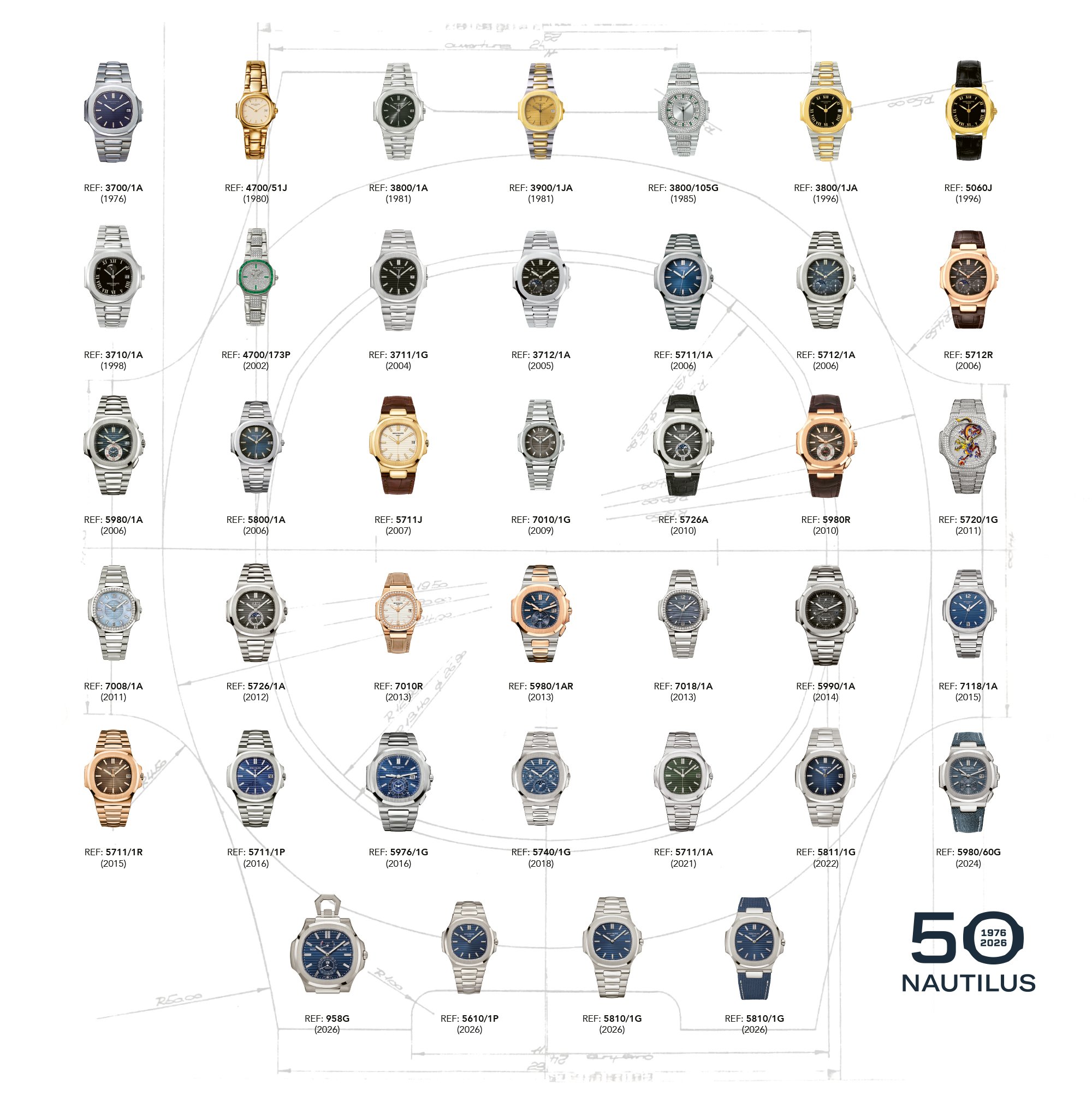
Over the years, and as its reputation grew, the Nautilus welcomed numerous complications, displays and even grand complications, including Travel Time, moon phases, flyback chronograph, annual calendar and perpetual calendar. Ladies’ models appeared and, after steel, the Nautilus would lend itself to platinum, rose gold, white gold, diamond-setting… all while remaining faithful to – and proud of – its original design.
For its 50th anniversary, the Nautilus appears in four new iterations, each issued as a limited edition: two 41mm “Jumbo” models, one in white gold on a metal bracelet (reference 5810/1G-001, a 2,000-piece limited edition) and one in white gold on a composite strap (reference 5810G-001, a 1,000-piece limited edition); a 38mm Medium model in platinum (reference 5610/1P-001, a 2,000-piece limited edition) and, unexpectedly, a 50.65mm desk clock in white gold (reference 958G-001, a 100-piece limited edition).


All three wristwatches are equipped with Calibre 240, a self-winding movement with an ultra-thin, 2.53-millimetre profile that allows for an even slimmer case, just 6.9 millimetres high, that retains the original construction while ensuring exceptional comfort on the wrist.
The understated dial – which focuses on the essentials of hours and minutes, with applied baton-style hour markers (subtly adorned with baguette diamonds on reference 5810G-001), rounded baton-style hands and the signature horizontal embossed pattern on the sunburst blue dial – underscores the geometry and cult design of the Nautilus.


The Desk Clock Reference 958G-001
Issued as a very limited 100-piece edition, this daring desk clock remains instantly identifiable even without a bracelet.
In addition to hours and minutes, the sunburst blue horizontally embossed dial displays an instantaneous date by hand, instantaneous day of the week in an aperture, small seconds at 6 o’clock and an indicator for the full eight-day power reserve, as well as a “spare” ninth day.

The hinged cover serves also as a stand for setting the clock on a desk. It is decorated with blue horizontal embossing, protected by a sapphire crystal, and a Calatrava cross. Visible through a second sapphire crystal, the movement is the manual-winding 31-505 8J PS IRM CI J calibre that was introduced in 2025.


