


 Español
 Français
 Pусский
 繁體中文
繁體中文 简体中文
简体中文 Select another language


n 1996 Europa Star was criticised for publishing an analysis in which Jean-Claude Nicolet, a teacher at the watchmaking school in La Chaux-de-Fonds, scientifically demonstrated that the tourbillon served no useful purpose in a wristwatch. And yet whatever their aesthetic appeal, wristwatch tourbillons were rarely the paragons of precision they were supposed to be.
They were also extremely costly and collectors expected their newly acquired watch to keep time with a degree of accuracy comparable to the price they had paid… and were frequently surprised to find this wasn’t the case.
Greubel Forsey were the first watchmakers to exploit the tourbillon’s full potential, whether rotating on one or multiple axes. Introduced in late 2023, the Tourbillon Cardan is the brand’s 8th Fundamental Invention.
Two arched rings
Eighteenth-century watchmakers triumphed over the challenge of keeping accurate time at sea by ingeniously suspending their chronometers in gimbals (cardan in French). This two-axis system keeps the balance and spring horizontal, even as the ship rolls and pitches. Greubel Forsey’s Cardan system operates along the same lines. Every 48 seconds, two arched rings tilt within a range of +30 to -30 degrees, so that the balance never stays in an extreme position.
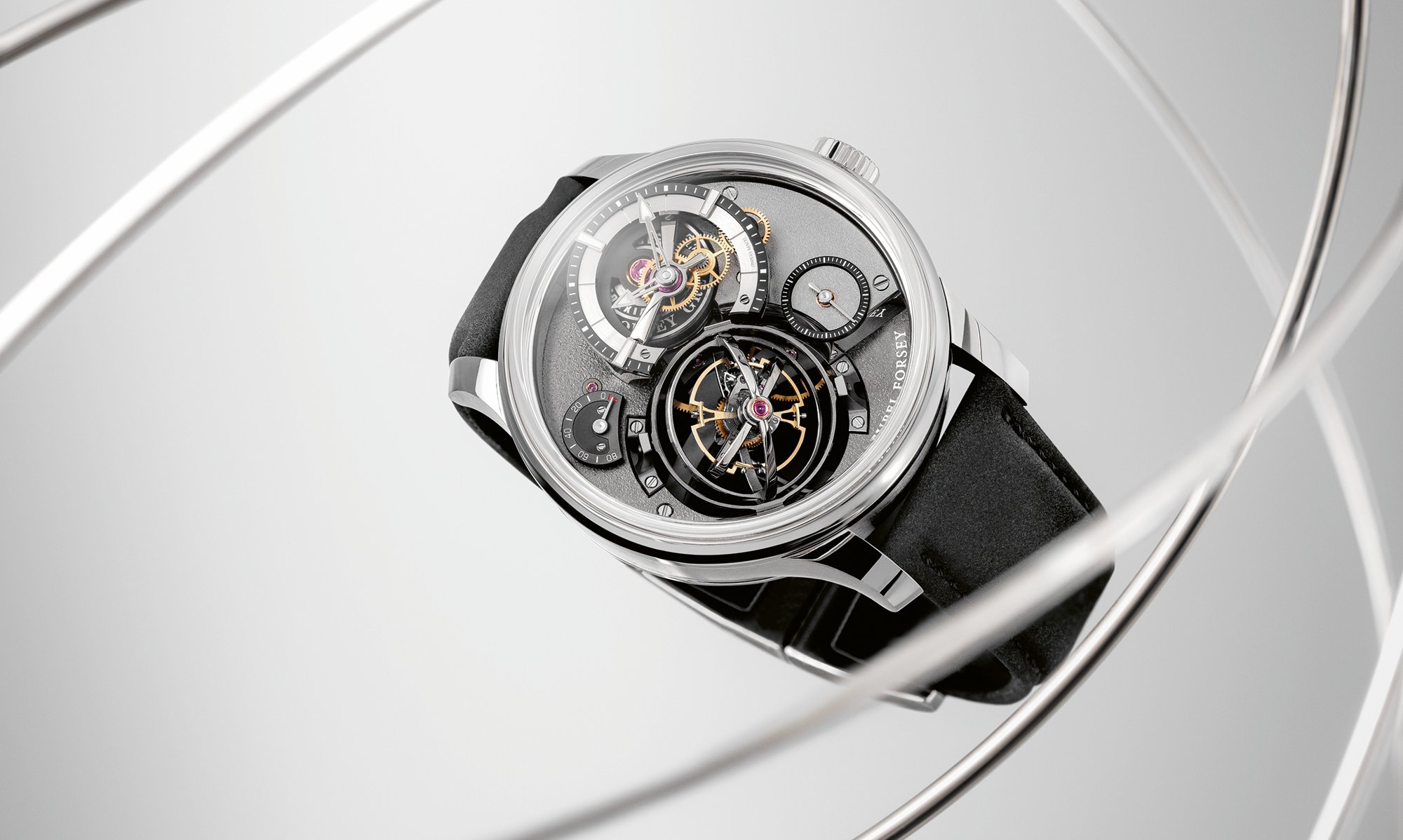
This high inertia balance measures 12.6mm in diameter. Compare this with the average diameter of between 8 and 10mm for the balance in a men’s watch.
A balance’s moment of inertia depends to a large extent on its diameter. The more mass is concentrated at the rim of the balance, away from its centre, the higher the moment of inertia, which slows oscillations. A balance with a higher moment of inertia in relation to its mass delivers better isochronism and consumes less power from the mainspring.
30 degree inclination and rapid rotation
The tourbillon’s 30° angle (the same as for the first Greubel Forsey watch) was calculated so that the balance is never in an extreme position for an extended period, and does not take up too much room in the cage. The tourbillon completes one rotation in 16 seconds, which makes it the fastest Greubel Forsey tourbillon to date. By moving through more positions in less time, it offers a much higher average performance and therefore greater precision.

Four barrels
A multi-axis tourbillon consumes a lot of energy. The movement has four coaxially stacked barrels in order to optimise torque, the rotational force that drives the gears, and provide sufficient power reserve (80 hours). They are fitted with a slipping mainspring – a feature of automatic movements but rare in manually-wound movements – to avoid excess tension when winding and prevent excessive variations in rate caused by variations in amplitude.
Multiple positions
Rotating the balance through multiple positions means it doesn’t remain too long in a position that would negatively impact precision. These unfavourable, usually vertical, positions are the reason a watch with a standard balance is subject to variations, while wearing the watch adds another virtual axis.


