


 Español
 Français
 Pусский
 繁體中文
繁體中文 简体中文
简体中文 Select another language


nspired by the Space Age, Century founder Hans-Ulrich Klingenberg asked an unconventional question: could a mechanical watch movement be protected from its environment by sealing it in a vacuum? The idea would become one of the defining features of the independent watchmaker, which now marks its 60th anniversary with the Mastersphere collection.
Originally developed in 1959, the patented concept drew on the work of 17th-century German scientist Otto von Guericke, whose experiments demonstrated the power of atmospheric pressure. In 1966, Century introduced its first Vacuum model, bearing a logo inspired by his celebrated Magdeburg hemispheres. Six decades later, the Mastersphere revisits this approach, combining vacuum technology with the brand’s signature hand-cut sapphire.

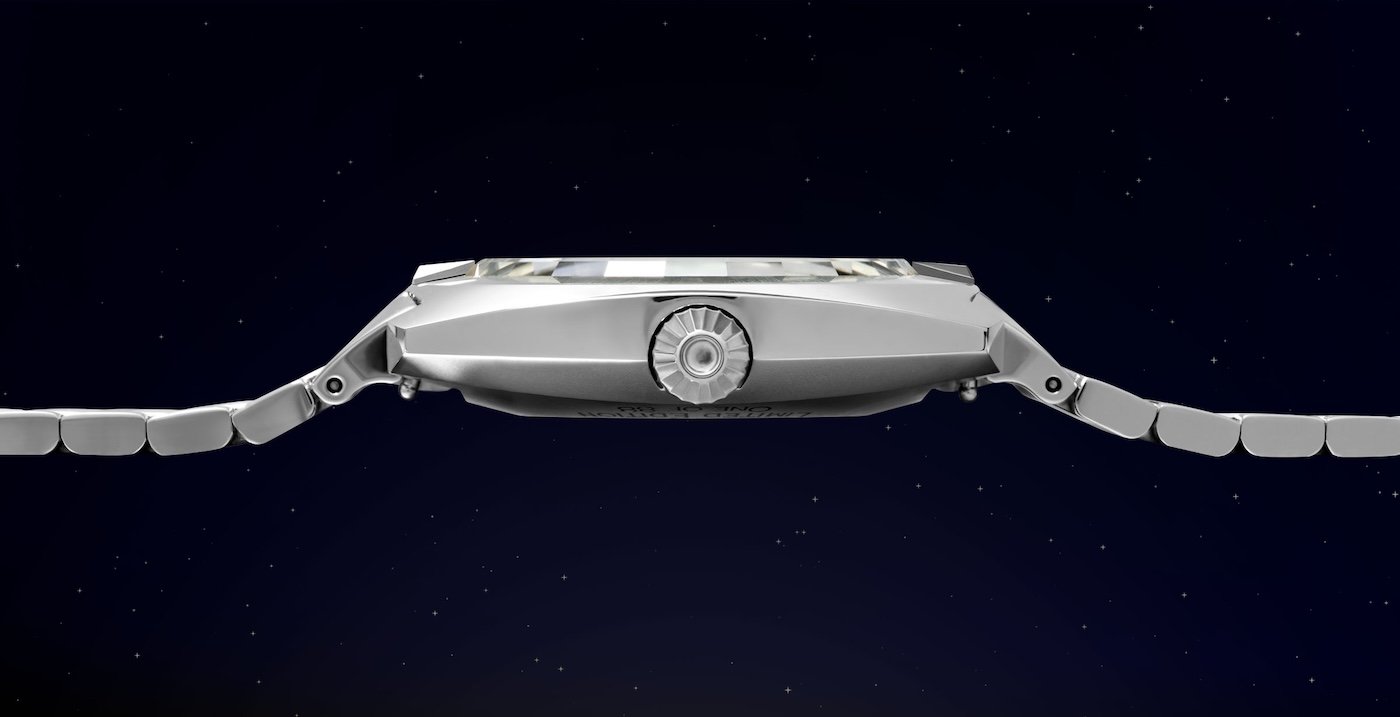
At the heart of the Mastersphere is a front-loaded, monobloc case in 316L stainless steel. With no separate case back, its construction reduces potential points of air ingress. A dedicated high-precision pump extracts 99.99995% of the air, according to Century, creating a vacuum intended to shield the movement from dust, airborne particles, oxygen and moisture.
Inside, an automatic movement modified in-house from 4 Hz to 5 Hz beats at 36,000 vibrations per hour. The higher frequency is intended to improve rate stability while giving the seconds hand a smoother sweep.
The Century sapphire crystal is cut and polished by hand, with 24 right-angled double facets. Rated 9 on the Mohs hardness scale, it combines scratch resistance with the distinctive geometry that has become a brand hallmark. The pressure differential between the case interior and the surrounding atmosphere holds the crystal in place, with two steel safety clamps providing additional security.
A triple-seal crown, used to set the time and date, completes the construction.

Water-resistant to 100 metres (10 bar), the Mastersphere bears the inscription “Limited Edition – One of 88” on the back of its case.
Beyond protection from external contaminants, Century presents the vacuum environment as a means of improving long-term mechanical performance. The brand cites historical comparative tests as evidence of enhanced rate stability when a movement operates in isolation from atmospheric fluctuations.
The approach also has implications for lubrication. By limiting exposure to oxygen and moisture, the vacuum is intended to preserve the oils and reduce mechanical wear. Century maintains that this substantially reduces servicing requirements, while the seal is designed to retain the vacuum over decades.
The brand supports the technology with worldwide after-sales service, including dedicated procedures for restoring the vacuum when intervention is required.

The Mastersphere’s 36 mm stainless steel case takes the form of a softly rounded square, recalling the design language of the original Vacuum watches. Three metallic dial colours are available: black, sky blue and vintage golden brown.
Flat baton hands reinforce the restrained aesthetic. The hour hand carries three strips of Super-LumiNova®, while the minute hand has two, ensuring legibility in low light.
A stainless steel bracelet gives the watch a sportier character, while an interchangeable leather strap offers a more understated alternative. A spring-bar system allows the wearer to switch between the two.
Each dial variant is limited to 88 pieces, with every watch carrying the same “Limited Edition – One of 88” inscription. The collection brings together two enduring elements of Century’s identity: its early experiments with vacuum technology and its expertise in faceted sapphire.
The vacuum logo provides a direct link to the scientific inspiration behind the concept. In von Guericke’s Magdeburg hemispheres experiment, air was evacuated from two joined copper hemispheres. Atmospheric pressure held them together so firmly that two teams of eight horses could not pull them apart.
Klingenberg’s interest in testing extended beyond the case construction. He asked COSC to assess complete watches sealed in a vacuum, rather than uncased movements as was customary at the time—an unusual and costly undertaking.
Today, Century says the Mastersphere is adjusted to chronometer-grade tolerances reflecting historical COSC standards. This is distinct from current COSC certification. Each watch also undergoes an internal 72-hour vacuum-integrity test, conducted without the safety clamps before final assembly, to verify the seal.
For CEO Philip W.A. Klingenberg, the anniversary collection connects the company’s founding idea with its continued independence: “Celebrating sixty years of Century means honoring a rich family heritage while continuously reinventing our craft. With the Mastersphere, we pay tribute to our original 1966 Vacuum watch by hermetically shielding the mechanical movement within an absolute void, sheltered by our signature hand-cut sapphire. It stands as an enduring symbol of six decades of family audacity and independent watchmaking.”


![Ulysse Nardin Freak [One Blue Enamel]: Mechanical Innovation Meets Métiers d'Art](local/cache-gd2/07/d0aba540377cc21c0bb7e936b89ca7.jpg?1792241248)
