


 Español
 Français
 Pусский
 繁體中文
繁體中文 简体中文
简体中文 Select another language


hile the tourbillon has become a familiar presence in contemporary haute horlogerie, its resurgence was far from inevitable. In the 1980s, only a handful of manufactures continued to invest in its development, laying the foundations for the complication’s return to prominence. Breguet’s reference 3350 ranks among the most influential of these pioneering creations.
The legacy of Calibre 558
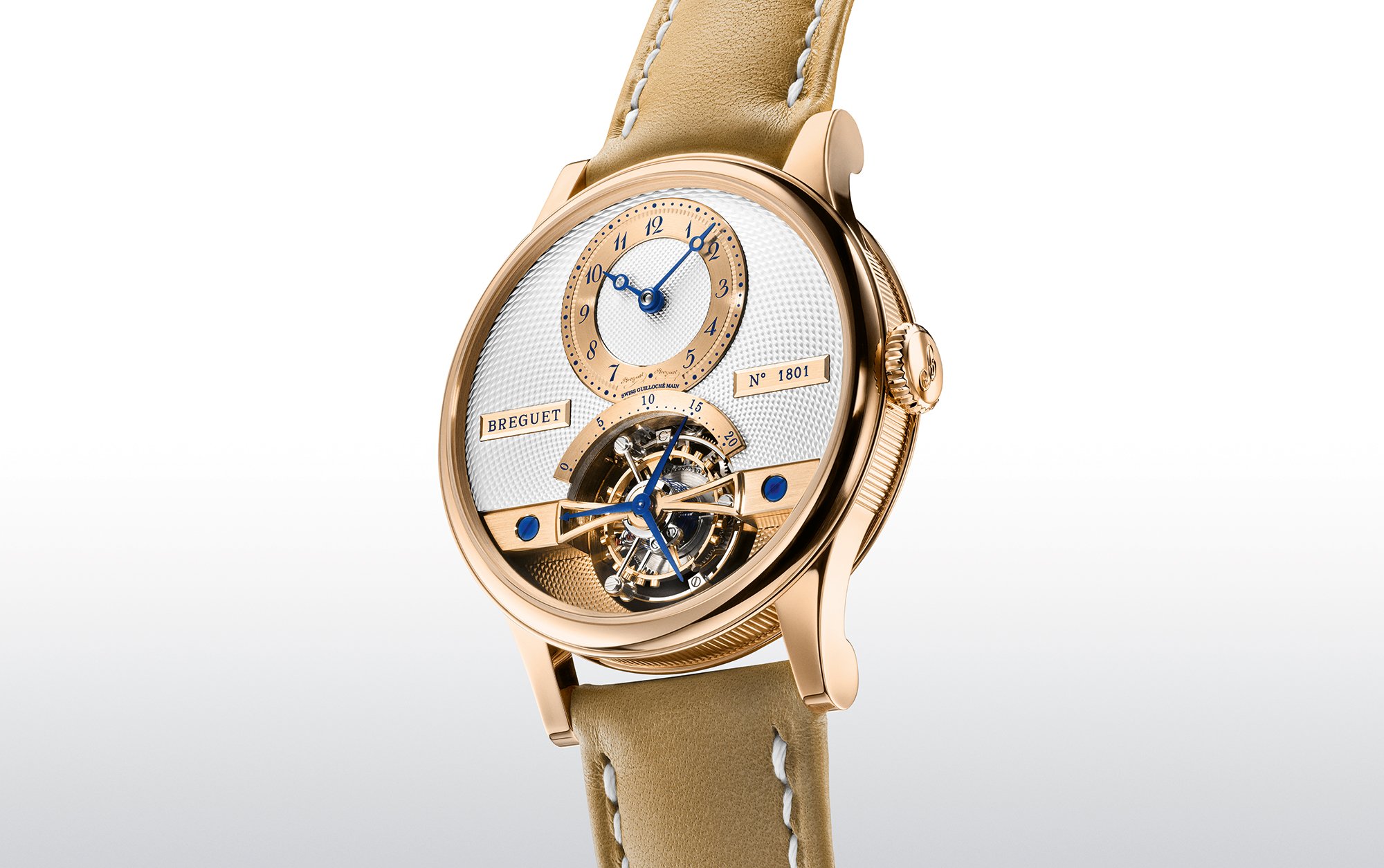
The Classique Tourbillon 7357 retains the essential architecture of its predecessor while introducing a new-generation movement. Calibre 187B is a direct descendant of the calibre 558, one of the most significant tourbillon movements in the recent history of the brand.
Its defining characteristics remain intact. The movement is manually wound, displays the hours and minutes alongside a running seconds indication carried by the tourbillon cage, and beats at 18,000 vibrations per hour (2.5 Hz). At a time when frequencies of 3 or 4 Hz dominate contemporary watchmaking, such a cadence may appear unusual. Yet it reflects Breguet’s commitment to historical continuity: the same frequency characterised both the calibre 558 and many of Abraham-Louis Breguet’s own timepieces.
The movement now delivers a 60-hour power reserve and incorporates several contemporary technical solutions. The balance spring is crafted from Nivachron, while the escapement employs silicon components. Together, these technologies enhance chronometric stability while providing effective resistance to the magnetic fields that increasingly affect modern mechanical watches.
Calibre 187B measures 30mm in diameter and 4.85mm in height. It comprises 190 components and 21 jewels.
Revisiting a modern classic
The watch preserves relatively compact proportions, measuring 35mm in diameter and 9.2mm thick. These dimensions place it close to the historic reference 3350.
Breguet has nevertheless thoroughly reworked the case architecture. The lugs adopt the profile introduced during the brand’s 250th anniversary celebrations in 2025 and follow the curvature of the wrist more naturally. The caseband retains the manufacture’s traditional hand-guilloché fluting. Two versions are offered: one in platinum and the other in Breguet gold.

The dial incorporates several of the manufacture’s signature design codes. Crafted from 18-karat gold, it combines two historic guilloché motifs: Clous de Paris at the centre and barleycorn around the periphery. The distinctive Breguet Arabic numerals, introduced by Abraham-Louis Breguet at the end of the eighteenth century, remain unchanged.
The tourbillon aperture at six o’clock has been reinterpreted compared with the 1989 model. The carriage is positioned slightly below the surface of the dial, creating a greater sense of depth. The upper bridge has also evolved. The single transverse bridge of the historical reference gives way to a polished double bridge with elegantly arched profiles.
As on the earliest models, decoration extends to the reverse side. Through the sapphire caseback, the movement reveals a mainplate adorned with a new guilloché pattern named “Dent de Vaulion”, inspired by the iconic peak overlooking the Vallée de Joux, where the manufacture is located.
How Breguet keeps reinventing the tourbillon
The Classique Tourbillon 7357 is accompanied by several other anniversary launches, each illustrating a different interpretation of Breguet’s emblematic complication.
The Classique Tourbillon Sidéral 7255 features a flying tourbillon combined with a so-called “mysterious” construction, in which certain transmission components are made from sapphire and rendered virtually invisible.

The Tradition Tourbillon 7047 pairs a tourbillon with a fusée-and-chain transmission designed to deliver more constant torque throughout the mainspring’s unwinding cycle. This remains one of the most complex movement architectures currently produced by the manufacture.
The Marine Tourbillon Équation Marchante 5887 combines three major complications: a tourbillon, a perpetual calendar and a running equation of time.
Finally, the Expérimentale 1 represents perhaps the most ambitious technical development of the anniversary collection. Its calibre 7250 incorporates a constant-force magnetic escapement and a tourbillon operating at 10 Hz (72,000 vibrations per hour) – four times the frequency selected for the 7357 (see Europa Star issue 1/26).
A living legacy
Among the various models unveiled to mark this anniversary, the Classique Tourbillon 7357 is undoubtedly the one most closely connected to the modern history of the tourbillon at Breguet. More than a commemorative edition, it embodies the continued evolution of an architecture first introduced in 1989 and refined ever since.
It also serves as a reminder that, for the manufacture that invented the tourbillon, innovation remains inseparable from continuity. More than two centuries after Abraham-Louis Breguet secured his patent, the “queen of complications” continues to evolve – patiently, consistently and very much alive.


