


 Español
 Français
 Pусский
 繁體中文
繁體中文 简体中文
简体中文 Select another language


hree months after the Overseas’ debut, in January 1997 Europa Star sat down with the then CEO, Claude-Daniel Proellochs, to talk about Vacheron Constantin’s motivations in launching what was a considerably sportier model than anything the brand had produced so far.
Proellochs cited three fundamental reasons for the launch: consumer appetite for steel watches; the need to broaden appeal to include a younger customer base, and to counter economic headwinds by stimulating distribution and boosting the European market. Beyond economic factors, Proellochs also insisted on the importance of “effectively responding to changes in consumer attitudes and tastes, which will shape markets going forward.”
When the Overseas launched, the quartz-driven steel version was the brand’s most competitive model, retailing at CHF 6,200. At the higher end, the lineup included gold and diamond-set self-winding models, priced at CHF 32,000. Expectations were that the Overseas would significantly increase sales volume but, as Proellochs insisted, “this doesn’t mean Vacheron Constantin will become a one-product brand.” Words that ring true, thirty years on.

The origins of the Overseas
The Overseas didn’t appear out of nowhere. It has a progenitor: the 222, unveiled in 1977 for the manufacture’s 222nd anniversary.
The work of a young German-born designer, Jorg Hysek, the 222 already broke the manufacture’s classical mould, with a 37mm steel case, integrated bracelet, notched bezel, and a discreet Maltese Cross in gold, at 5 o’clock on the remarkably slim (7mm) monobloc case.

Fitted with the ultra-thin 1120 calibre on a Jaeger-LeCoultre 920 base, the “Jumbo” 222 remained in production until 1984. An estimated 1,000 were built, making it something of a rarity. It was reissued in 2022, first in yellow gold then steel.
An even earlier and stylistically distinct source, the Heritage Chronomètre Royal was Vacheron Constantin’s first foray, in 1975, into a segment of integrated-bracelet sports watches in steel.

Three generations of Overseas
Introduced in 1996, the Overseas has evolved over three generations, steadily affirming its sporty character and versatile nature.
The team behind the first-generation Overseas were Dino Modolo, a young freelance designer, and Vincent Kaufmann, an in-house designer who would go on to develop subsequent models. This very first Overseas featured a 37mm case whose solid back was engraved with a depiction of the Amerigo Vespucci three-master, named after the Florentine explorer who gave his name to the Americas: a fitting symbol of the “spirit of exploration” that would accompany the Overseas from its inception.
In steel or gold, the integrated bracelet was composed of flat, straight links. The movement, Calibre 1310, was a COSC-certified self-winding calibre on a Girard-Perregaux 3100 base.

Three years later, in 1999, the Overseas gained its first chronograph, on a Frédéric Piguet 1137 base.

By the second generation, which arrived in 2004, the Overseas’ sporty nature was even more apparent. Case size increased from 37mm to a more assertive 42mm, while the metal bracelet was completely redesigned so that the links, when viewed across the bracelet, formed the Maltese Cross emblem.
The dial was given a fine guilloché finish. Powering the collection, Calibre 1126 was built on a base by Jaeger-LeCoultre (which since 2000 had been part of the Richemont group alongside Vacheron Constantin, acquired in 1996). A detail worth noting: a soft-iron inner cage protected the movement against magnetic fields.

This second generation produced a multitude of models, including various complications in addition to jewellery versions.
The third generation
The third and current generation appeared in 2016. Stylistically refined with more fluid lines, it retains the principal features that have shaped the Overseas’ identity and its success, such as the integrated bracelet with the Maltese Cross links and the notched bezel – with a change in the number of notches, from eight to six. One key difference, however, is the introduction of a sapphire display back that exposes the mechanism. This is significant, as it corresponds to the arrival of fully in-house movements, including the 5000 series and all with the Geneva Seal hallmark.


Mechanisms aside, the most striking innovation would be the quick-change system that enables the wearer to swap straps without tools. Now adapting instantly to any occasion, the Overseas is presented with a metal bracelet, a leather strap and a rubber strap (models supplied on an alligator or calfskin strap come with just one additional strap, in rubber).
Over the past decade, this new-generation collection has expanded considerably. Hours-minutes-seconds models have been joined by numerous complications as well as skeleton versions. Alongside gold and silver, the Overseas’ traditional metals since 1996, versions in titanium and platinum illustrate this model’s remarkable versatility.
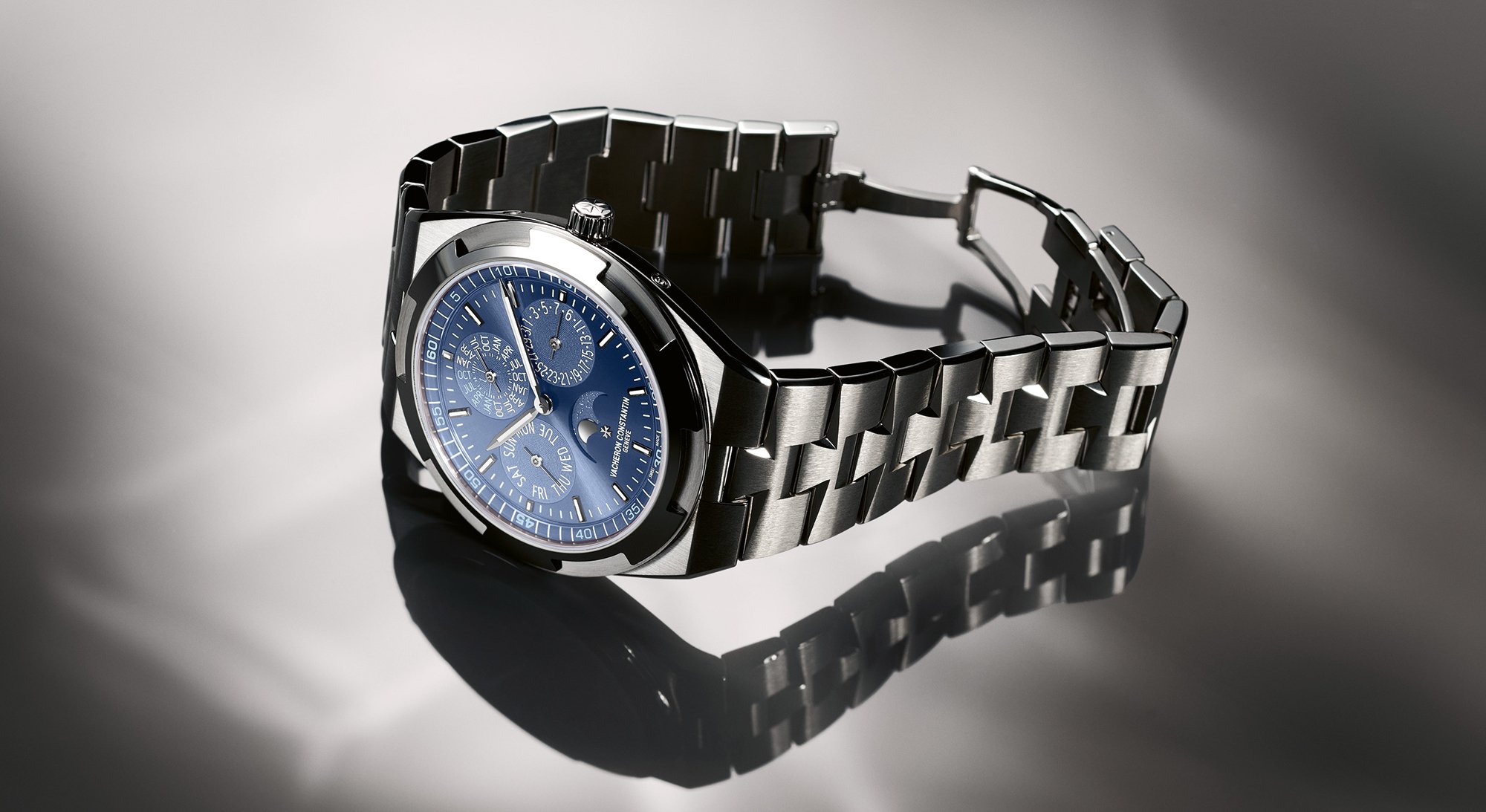
Overseas Perpetual Calendar Ultra-Thin Azure Dial
Launched for the collection’s 30th anniversary, the Overseas Perpetual Calendar Ultra-Thin Azure Dial is the ultimate expression of the Overseas’ classical elegance, sporty personality and horological excellence.
All these qualities are captured — one could say elevated — by the new azure shade. Lighter, less intense and less saturated than the now iconic 2016 blue, this new shade brings a unique character and hints at the wide-open spaces to which the Overseas aspires.

As the light shifts, this softer varnished blue takes on different tones while the lustre of the white gold case and indices lends a rare sense of depth to the dial. Legibility — essential in a perpetual calendar — is achieved by the harmonious balance between the various displays, including moon phases, which stand out subtly in a complementary blue. Ensuring night-time visibility, indices, hour and minute hands are accented with blue Super-LumiNova.
Destined to become a loyal travel companion, this new model comes with the Overseas-exclusive interchangeable strap system. The integrated white gold bracelet is fitted with a folding clasp, complete with micro-adjustment system, while the two textured rubber straps, one white and one denim blue, fasten with a white gold pin buckle.

Ultra-thin architecture
Crafted from 18k white gold, the case of the Overseas Perpetual Calendar Ultra-Thin Azure Dial measures 41.5mm in diameter and 8.1mm high. It houses Calibre 1120 QP/1, a self-winding perpetual calendar movement with indications of hours, minutes, date, day of the week, month (28, 30 or 31 days) and leap year – none of which require adjustment before 2100 – together with a superb moon phase display.
This grande complication movement, which fits 276 components into its compact space, is developed and manufactured entirely by Vacheron Constantin. It builds on the Genevan manufacture’s long-established tradition of ultra-thin movements, not least two now legendary calibres: the manual-winding Calibre 1003, the world’s thinnest when launched in 1955 with a height of just 1.64mm, and the self-winding Calibre 1120 from 1968.

The patience and expertise of Vacheron Constantin’s watchmakers are evident in the beauty and complexity of a movement whose meticulous finishing and harmonious architecture are revealed through a sapphire crystal case back. In the grand tradition of Haute Horlogerie calibres, bridges are bevelled and decorated with Côtes de Genève, the mainplate is decorated with perlage, and the components for the perpetual calendar receive vertical or circular satin finishes. Such excellence is confirmed by the watch’s Geneva Seal hallmark.
Engraved on the 22k gold oscillating weight, a compass rose is the symbol of the Overseas collection and a beautiful evocation of Vacheron Constantin’s 2026 theme: Explore All Ways Possible.


