


 Español
 Français
 Pусский
 繁體中文
繁體中文 简体中文
简体中文 Select another language


ainte-Croix was a typical linear village of the Jura mountains until its transformation, in the late nineteenth and early twentieth centuries, into a small town. Factories sprang up in fields and tall buildings replaced the farms along the main road. The inhabitants became factory workers. Protestantism had accustomed them to the idea that work, as well as providing a livelihood, made the world less chaotic and society more orderly, and so they laboured from dawn till dusk. They began manufacturing music boxes, automata, disc phonographs, typewriters and cameras.”
“In this first half of the 1950s, the Thorens factories were producing the best hi-fi turntables on the market; Paillard sold its virtually indestructible Hermès Baby portable typewriters to itinerant writers across the world; Reuge and Lador exported millions of musical movements whose cylinders and vibrating combs transformed toys, snuffboxes and countless other items into marvellous musical objects.”
(…)
“The Bolex H16 camera, introduced in 1935, functioned without electricity: a hand crank engaged its spring-driven motor and set the various mechanisms in motion. Exceptionally robust, it withstood desert sandstorms, salt-water spray at sea, and the freezing temperatures of the polar regions (...) The world’s best filmmakers praised its technical qualities.”
Les Petites Musiques (extract), Roland Buti, Editions Zoé, 2025
When everything falls apart
This long extract from Roland Buti’s novel Les Petites Musiques perfectly captures Sainte-Croix in the 1950s and 1960s: a flourishing town, renowned the world over for the quality of its precision mechanical production as well as for its music boxes and automata: mechanical artistry of equal precision!
The advent of video then computer technology would sound the death knoll for these industries: Bolex was sold in the early 1970s, Paillard-Hermès-Precisa closed down in 1989. Diane Esselborn, curator and director of MUMAPS in Sainte-Croix, describes the “shock” this represented for the small town as their world fell apart around them. A consequence of this deindustrialisation, Sainte-Croix lost some 3,000 inhabitants: roughly the number of people employed by Paillard in the mid 1960s.

“There was a lot of resentment among the population,” Esselborn tells us. The town felt assailed from all sides. Automata manufacturing had almost died out. The sale, in 1996, of the Guido and Jacqueline Reuge collection – including the first ever music box, built by the Genevan watchmaker Antoine Favre in 1796 – to Japanese industrialists represented an irretrievable loss. Adding insult to injury, despite protests, the Swiss Confederation had granted national museum status to the Musée des Automates à Musique in Seewen, in the canton of Solothurn, together with CHF 14 million of state funding. For Sainte-Croix, whose claim to similar recognition was entirely legitimate, and which was already struggling, this was yet another blow.
Strength in numbers
“There was a deep sense of nostalgia,” Diane Esselborn continues, “and a shared determination that this heritage should not be allowed to crumble away.” Sainte-Croix was, at the time, home to three museums. The oldest, the Musée des Arts et des Sciences (MAS), had been founded in 1872 and was given its own building in 1905. An encyclopaedic museum, whose collections covered history, archaeology, science, even zoology, its role was to educate the local population, in particular its youth.
Established since 1955 in the neighbouring commune of L’Auberson, the Musée Baud was named after its founders, a family of farmers turned music-box repairers (in 1865 there were 29 music-box manufacturers in the communes of Sainte-Croix and L’Auberson). Over a period of decades, brothers Freddy (1915-1998), Robert (1917-2010) and Auguste (1924-1973) assembled their extraordinary collection of music boxes, orchestrions, singing birds, gramophones, fairground organs and musical automata. Housed first in a barn and later in a building in the village of L’Auberson, at the height of its fame the collection was seen by as many as 30,000 people a year.
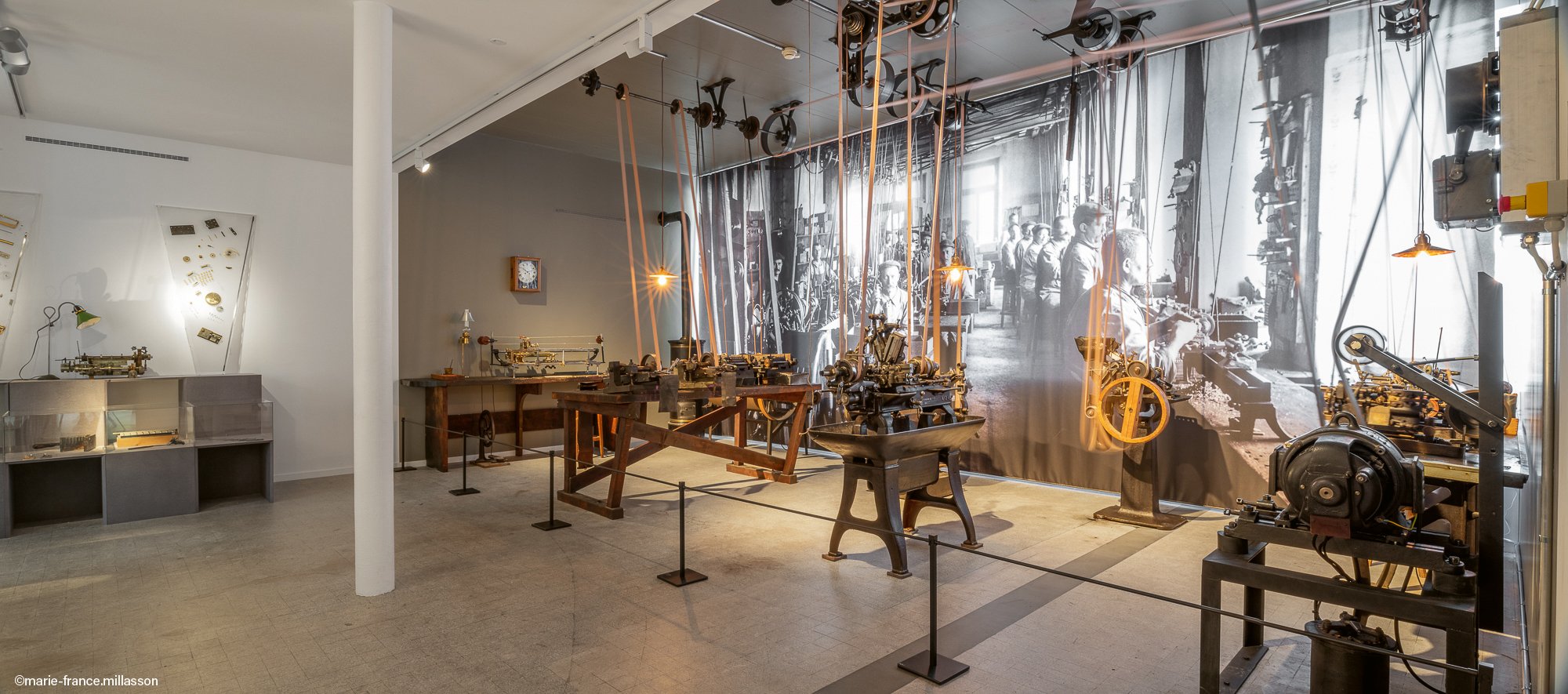
Determined to bring this dwindling pool of skills back from the brink and restore a once thriving heritage, in 1985 a group of mechanical art enthusiasts and artisans, soon joined by watch and clock restorers, launched the Centre International de la Mécanique d’Art (CIMA).
Located in the former Paillard factory, CIMA’s objective was to preserve and promote this rich local heritage, but more importantly revive this economic activity by commissioning projects and by attracting businesses to the area. A new designation, mécanique d’art, was coined as a framework for this objective, encompassing the principles, techniques and skills involved in the “production of an artwork fitted with a mechanical movement.”
Creation of MUMAPS
Faced with a decline in visitor numbers and the need to professionalise teams still composed of volunteers, in 2014 talks began. Adding to the urgency were fears that, ten years after the relocation to Japan of the Guido and Jacqueline Reuge collection, the fabulous Baud collection might suffer the same fate and be sold.

Responding to these dangers, a project was formed as of 2019 to unite MAS, BAUD and CIMA in a single museum complex. The authorities and population of Sainte-Croix rallied around the project and thanks to this, and generous donations, the Baud collection was acquired for CHF 2 million, the heirs having agreed to lower the initial asking price. An architectural competition was launched to redevelop the CIMA building. Work began in 2020 and the new premises were opened in 2024.
Guided tour
As Diane Esselborn explains, “MUMAPS is unusual in that it not only exhibits and conserves a local heritage; it contributes directly to its preservation and development.” She emphasises the importance of the museum’s relations with local craftsmen and women: “If we don’t play the music boxes, the automata, the gramophones, they lose an important part of their raison d’être. Of course, we need skills to make them work, and we’re in the unusual position of being surrounded by artisans who possess those skills. Without these craftsmen and women, it would be almost impossible.”


Far from being simply a repository, MUMAPS thus plays a critical role in the development and future of art mechanics in Sainte-Croix, even beyond. The objects on display, whether artistic, artisanal, handmade, semi-industrial or industrial, trace a narrative thread. Don’t be surprised to see a camera mechanism or an early cable binding next to a magnificent nineteenth-century Pierrot or a singing bird on an elaborately decorated snuffbox. Each is a representative of mechanical artistry. [Read A Conversation in Sainte-Croix]

Extending over three floors, MUMAPS collections are presented on the one hand historically, in what resembles a curated storehouse of objects that visitors can explore at their leisure, and on the other as a thematic presentation accompanied by demonstrations of objects in action: music boxes, some of which produce sound of remarkable richness and quality, automata from various periods, vast mechanical orchestras, gramophones, and more.
A living heritage that records a rich past but also serves as a catalyst for the future of mécanique d’art.


