


 Español
 Français
 Pусский
 繁體中文
繁體中文 简体中文
简体中文 Select another language


e should perhaps begin by discussing the fundamentals of chronometry…
Dominique Renaud: In which case we’ll start by distinguishing two units within the movement, which are the regulating organ, meaning the balance and balance spring which is the base time, and the escapement, which supplies energy to this base time and in return receives information from the balance. So it fulfils a dual function as it delivers energy and divides time into sequences.
There are several types of escapement. The main ones are the Swiss lever escapement, which is the most widely used type and which delivers two impulses to the balance, one as it swings one way and the other as it swings back, and the detent escapement which only gives one impulse to the balance during its back-and-forth motion, resulting in what we call a coup perdu or lost beat. As a side note, the escapement in my very high frequency DR01 experimental watch gave one impulse for nine lost beats!
Why? What are the benefits?
First we need to remember that each impulse to the balance interferes with its motion. This is why marine chronometers were fitted with a detent escapement that gives a single impulse, so the balance is only disturbed once per oscillation, once for each back-and-forth motion. Fewer disturbances means greater precision.

In which case, why wasn’t the detent escapement the first choice for wristwatches?
The lever escapement is easier to implement. It needs less torque to gain amplitude and is self-starting, whereas a detent escapement needs a little nudge to get it going, which isn’t exactly practical for a wristwatch. Also, the detent escapement is harder to regulate, not to mention greater sensitivity to shocks, which can cause the watch to stop.
What about George Daniels’ co-axial escapement?
It’s a bit of a hybrid, a bit of a mix, you could say, being both a detent and a lever escapement. It creates less friction than a lever escapement but slightly more than a detent. Its precision is very good although not equal to that of a detent escapement.
For someone regulating a movement, friction and disturbances will be their main concern...
That’s right. A watchmaker has to keep the various disturbances in mind. Take the lift angle, for example, which is the exact point where the impulse is given. The sharper the lift angle, the more disturbances it will cause. In the other direction, there’s the unlocking angle, which creates disturbances of its own. When regulating a movement, we can reduce this unlocking angle by removing safeguards, which will reduce friction. It’s about striking the right balance, not forgetting that disturbance due to the impulse also depends on the duration of the impulse. Because the detent escapement acts directly on the balance wheel, bypassing the pallet lever for the impulse, there is less disturbance.
Where does the balance spring come into this delicate equilibrium?
The balance spring is an integral part of the balance wheel, of the base time. What matters is both the inertia of the balance wheel and the elasticity of the balance spring, what we call Young’s modulus in specialist terms. Again, we aim to keep disturbances to the balance spring at a minimum, hence successive improvements such as the Breguet overcoil, the Phillips curve, etc. We aim for the greatest possible regularity and, at the same time, the greatest freedom. A balance spring that has more freedom keeps better time and creates less disturbance.
Among all these interactions, we often forget to mention the energy supply...
The barrel, manual or automatic winding, distribution of energy, the role of the jewels… these are all part of the fundamentals. In the Renaud Tixier Monday watch, we set out to improve the efficiency of automatic winding and specifically winding by micro-rotor, which no-one had really looked into. We all know a rotor’s winding power depends on the wearer’s arm movements. We searched for a way to harness the arm’s micro-movements, for example when someone is sitting at their desk, using a computer. Normally, a micro-rotor doesn’t capture these tiny movements. We came up with the idea of incorporating an inertia wheel, that we’ve called the “Dancer”, into the micro-rotor. It absorbs even the tiniest amount of energy which it transfers to the rotor, making it more efficient.

What you could call research into one of the fundamentals...
That’s right. I try to open up new directions. There is still so much to do, working from what already exists. The balance wheel exists, it’s there, but we can still do a lot with it.
You once told me you’re not a theoretician but you “think in space”.
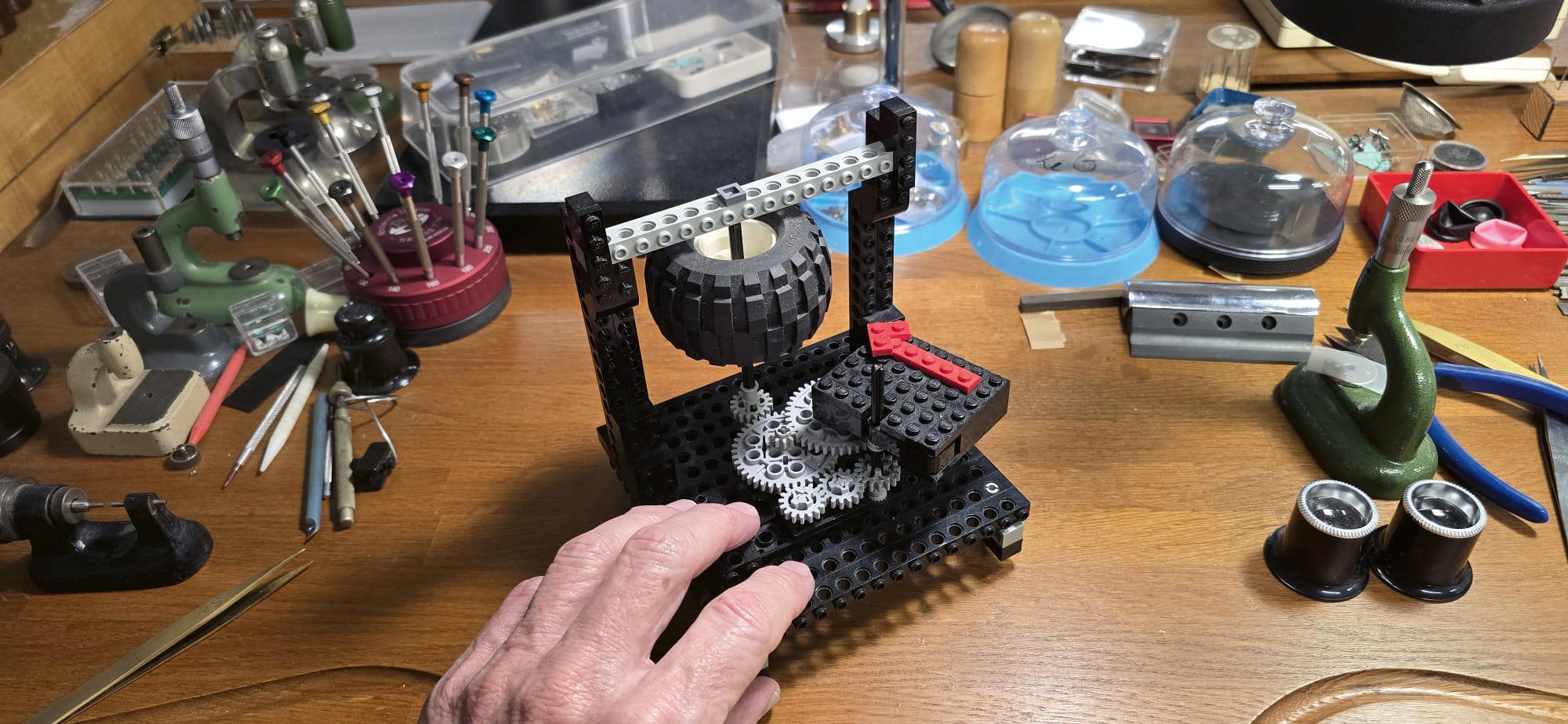
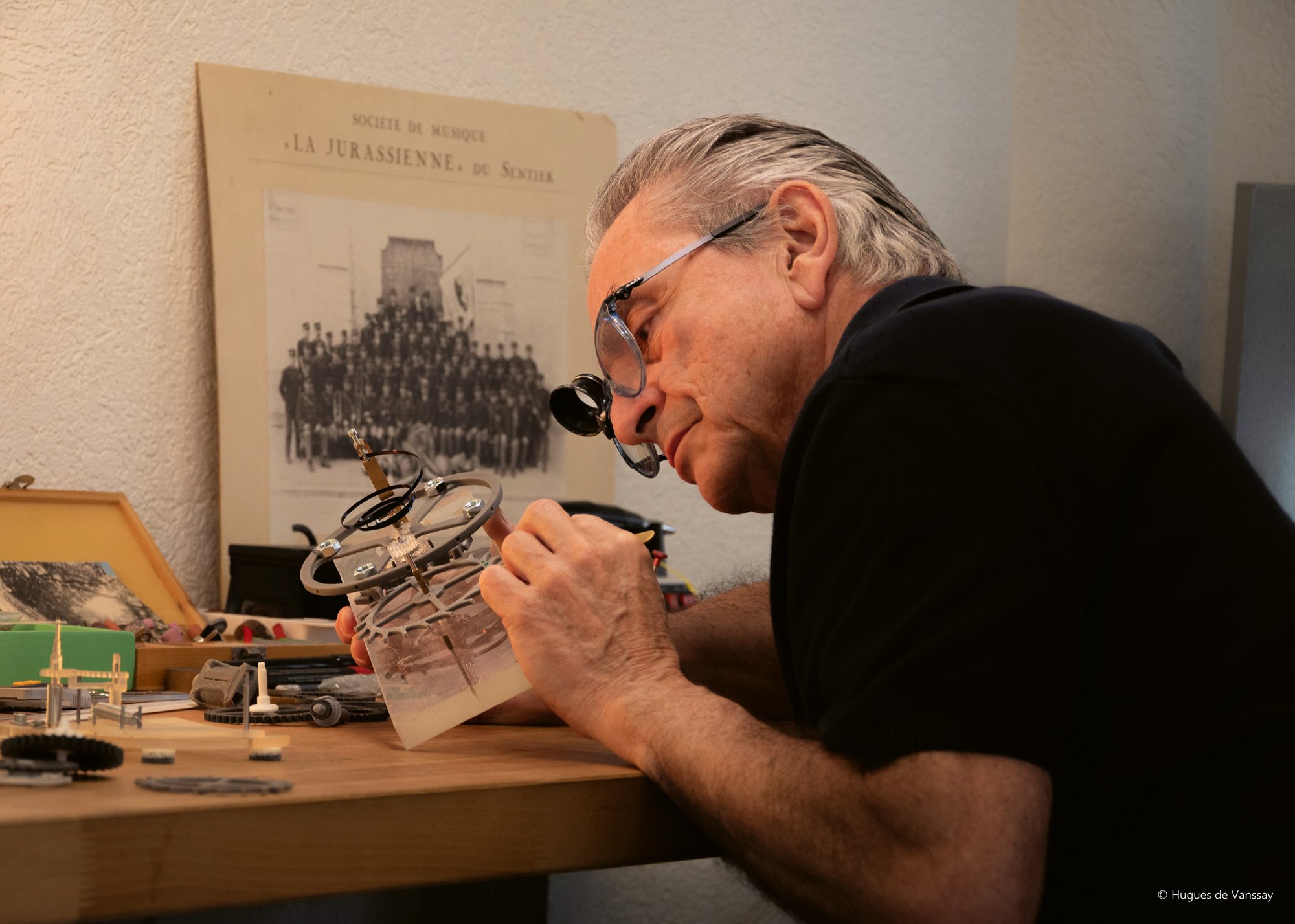
I feel I understand things via a spatial vision, by thinking in three dimensions. I can picture interactions, friction, the different levels, where to put the parts, and so on, without having read all the books. [laughs] I have my model in my head which I then make on a large scale so I can work on it, but also so I can explain what I’m looking for to others. I’ve never considered chronometry as simply chasing after quantifiable precision. To my mind, the mechanical watch isn’t there to compete with quartz or the atom. If offers a different reading of time. A human reading, encapsulated in material, inertia, friction and controlled error.

So precision isn’t an end in itself?
Precision is the consequence of a coherent, balanced system. Time isn’t divided up. It’s breathed. Whereas modern watchmaking fragments time into smaller and smaller units, often I’ve looked to draw out time, make it readable, almost palpable.
As in your most recent watch, the Pulse60, whose “ultra-amplitude” balance beats at just one hertz?
A slow, ample, living balance isn’t a weakness. It’s a statement. Time doesn’t progress in jolts. It oscillates, comes back on itself, sometimes it hesitates, like a human. I’ve developed high-frequency mechanical watches with low amplitudes, where precision is achieved through speed, repetition and constant correction. Then I chose to explore a different path, with low frequency, huge amplitude, deliberate slowness, longer breathing. It’s not a contradiction, it’s continuity. Going from a small, intense amplitude to a large, slow, free amplitude isn’t backtracking. It’s looking at the same problem from the other shore.
You say that you see every movement architecture as a “hypothesis on time”...
High frequency explores time that’s divided into fragments, stabilised by a rhythm. Low frequency explores time that’s drawn out, stabilised by inertia. One seeks exactitude through rapidity, the other through equilibrium. I don’t believe there is a single solution in watchmaking any more than there is a single way of experiencing time. Exploring extremes is to reject the dogma, reject reassuring repetition and accept that mechanical truth is often revealed at the furthest limits. Either way, the question remains the same: how can a mechanism be exact without becoming violent? How do we create stability without preventing the movement from living its life? I’m not looking to triumph over time through precision. I want to have a conversation with time through mechanisms.
THE PULSE60, AN EXPLORATION OF LOW FREQUENCY
In a heartbeat
Driven by the entirely original Dominique Renaud BUA2024 movement (BUA stands for Balancier Ultra Amplitude), the Pulse60 explores the benefits to be gained from the lowest possible amplitude in a contemporary mechanical watch: one hertz. At this frequency, the balance makes just one oscillation per second or 60 beats per minute, which is close to the ideal resting heart rate. Thus each oscillation corresponds to one second.

This drastic reduction in the number of impulses, hence shocks to the escapement, mechanically limits disturbances to the balance’s natural motion—more so as, once it starts to swing, this 20mm high-inertia balance freely maintains its movement, which makes it even more resistant to micro-variations in torque from the mainspring and to small shocks.
By way of illustration, Dominique Renaud compares his large balance to a tightrope walker’s pole: “a long pole increases stability, making it easier to maintain balance. With a short pole, each disturbance has a bigger impact so the tightrope walker must constantly correct their position." Similarly, the large balance stabilises rate to the second, absorbs tiny variations and smooths irregularities, thanks to its large, slow and controlled beat.
A completely new construction
In the majority of conventional movements, the geometry of the balance, the roller and the impulse pin strictly limits amplitude. If the balance exceeds a certain angle it knocks the back of the pallet fork, causing the movement to run fast.

So as to give his balance complete freedom and amplitude above 360 degrees without knocking (its maximum theoretical amplitude is actually around 700 degrees), Dominique Renaud completely revised the design and construction of his regulator, opening up a new field for exploring amplitude in a wristwatch.
This greater freedom, allowing the balance to oscillate for longer and over a greater distance before and after impulse, avoids interactions with the escapement. Its rate is more stable and less sensitive to micro-variations. The number of disturbances to which it could be exposed is minimised. Dominique Renaud sees this as one step closer to “the ideal oscillator”.
An architecture designed around the balance
Everything about the Pulse60’s soft but rigorous architecture draws the eye to the 20mm balance that pulsates to the rhythm of the 15mm balance spring that is its visible “heart”. Held, suspended almost, by an openworked bridge, this large balance sits below three subsidiary dials, like a trilogy of moons or planets, framed by a machine-guilloché background that forms a quietly beautiful, celestial backdrop.

Hour and minute indications are at 12 o’clock, small seconds are at 9 o’clock with a natural dead half-second—two ticks per second, thanks to the one hertz frequency—and a torque indication at 3 o’clock (using a system that Dominique Renaud devised during his time at Renaud Papi, that “reads” the amount of available energy directly from the barrel). The hands for all the indications are a distinctive metallised blue.
This geometry is perfectly underscored by the slim, smoothly rounded case, which has almost no bezel and no lugs, topped with a curved crystal. It flows seamlessly into a rubber strap that can be easily swapped out, thanks to a push-button interchangeability mechanism.

HHDR, Haute Horlogerie Dominique Renaud
After the Monday by Renaud Tixier, a collaboration between Dominique Renaud and Julien Tixier, the Pulse60, signed Dominique Renaud, is the second expression of HHDR, or Haute Horlogerie Dominique Renaud.
Recently established in Tolochenaz, Switzerland, HHDR has a multigenerational team of around twenty watchmakers, movement designers, engineers and other specialists. It is part of DR Group, a structure built around Dominique Renaud to provide this watchmaker-explorer with the resources to express his innovative ideas to the full.


