


 Español
 Français
 Pусский
 繁體中文
繁體中文 简体中文
简体中文 Select another language


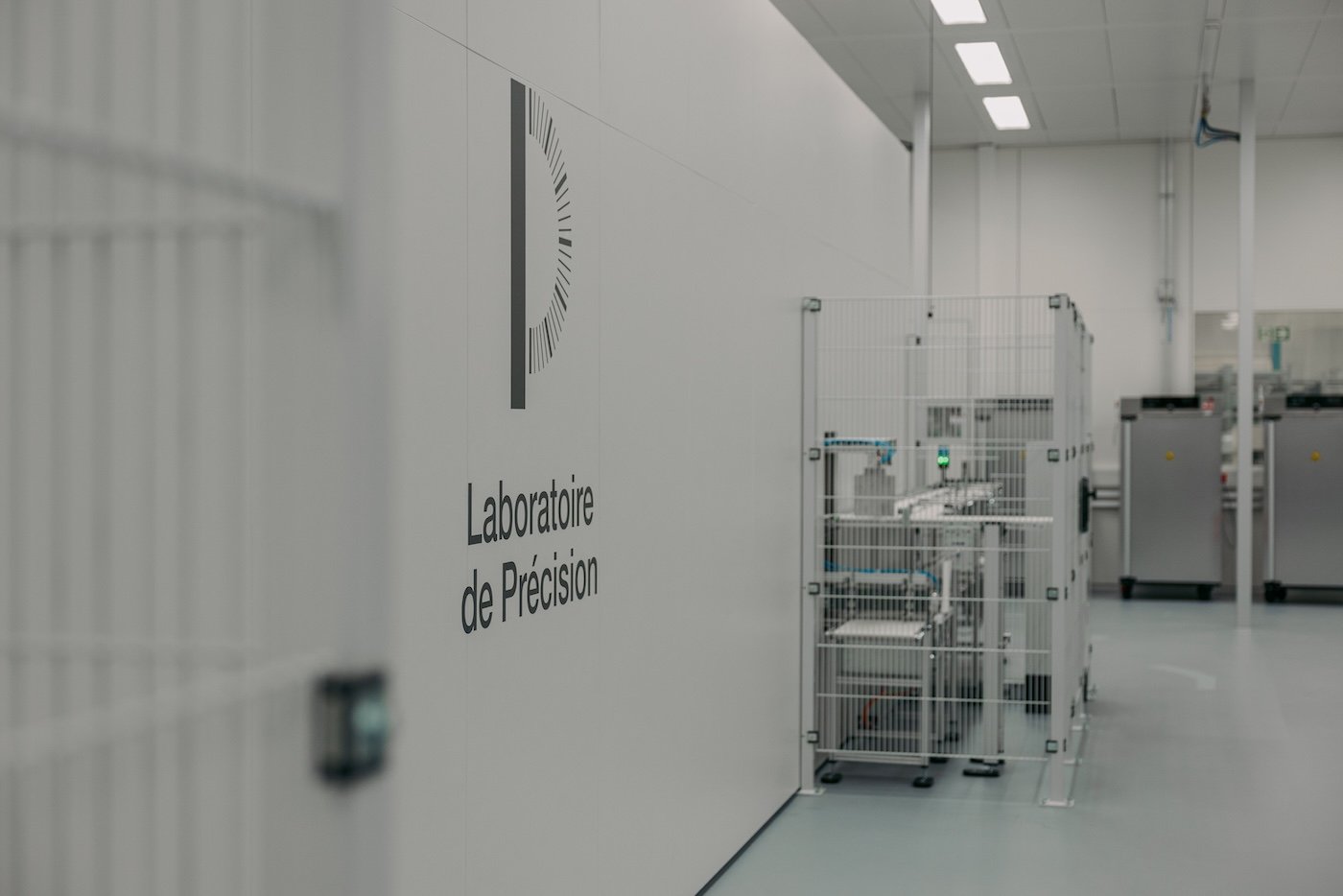
he recently inaugurated “Factory 37” operated by ETA in Villeret houses movement production facilities, but also a new type of space on its ground floor: the Laboratoire de Précision. Although owned by Swatch Group, the certification body, launched in 2023, presents itself as neutral and independent, open to any brand inside or outside the group. For now, only Omega is using it – somewhat recalling the early days of the METAS Master Chronometer certification and its exceptionally demanding anti-magnetic standards when it was introduced in 2015.
The Laboratoire de Précision is accredited by the Swiss Accreditation Service (SAS) according to ISO/IEC 17025:2017 standards and certified by METAS for the Master Chronometer protocol. It is therefore the first laboratory capable of delivering both Chronometer and Master Chronometer certifications under one roof.

In little more than a decade, Omega has certified more than three million Master Chronometer watches. More than one million owners have registered online to access the detailed results of their watches. This rapid expansion prompted the brand to internalise and rethink chronometric measurement entirely. The transfer of testing activities to the Laboratoire de Précision is now underway. In just two years, the facility has already measured and certified more than 200,000 Omega movements.
A big data approach
At the heart of the laboratory lies a small “black box” designed to collect all measurement data while housing the movement during testing. Dozens of these units are aligned across the testing installations in Villeret. Developed over five years of R&D, this fully autonomous and wireless cube can simultaneously test ten movements for more than 80 hours without recharging. It forms the core of the Dual Metric Technology developed here.

Traditional chronometer certifications rely primarily on optical measurements taken at defined intervals – a robust method, but one based on snapshots. With Dual Metric Technology, Omega shifts to another dimension. Each unit incorporates sensors measuring temperature, position, acceleration, atmospheric pressure and magnetic fields. Most importantly, it continuously records the acoustic signature of every movement.

Operating according to a “big data” logic, the system collects around 5,000 acoustic measurements and 3,000 environmental data points per watch every day. Over the past two years, the laboratory has accumulated more than 24 million data points.

From photography to film
“Traditional methods captured a single measurement point per day. We now generate data from the very first second,” explains laboratory director Alexandre Hundzinger. “The watch’s performance is constantly correlated with the exact conditions affecting it.”
The system no longer simply measures deviation: it identifies precisely when, where and under what circumstances it occurs. Thermal sensitivity, amplitude variation, the influence of pressure or position – every oscillation is time-stamped according to the International System of Units (SI) and integrated into a proprietary big data architecture stored for ten years in the laboratory’s own data centres.

One of the major technical challenges was achieving complete isolation from external disturbances. “We had to guarantee total acoustic insulation against external vibrations and mechanical oscillations,” says Alexandre Hundzinger.

“Our ambition was to create a new way of characterising the real behaviour of a mechanical watch. Stability over time is essential. Between SAS and METAS protocols, we are talking about 25 consecutive days of testing. We are no longer dealing with a snapshot, but with a continuous film of precision,” he adds.
The Constellation Observatory
Unveiled this year, the new Constellation Observatory collection is intended as a showcase for this technology. Until now, precision testing required a seconds hand to allow optical tracking of the movement. Thanks to the continuous acoustic measurement developed by the Laboratoire de Précision, that constraint disappears. Hence the deliberate absence of a seconds hand on the model. Incidentally, this also makes the Constellation Observatory the first two-hand watch to obtain Master Chronometer certification.


The choice of the Constellation line is far from incidental. Omega’s chronometric heritage runs deep: in 1952, the Constellation became the brand’s first serially produced chronometer collection. The new Constellation Observatory therefore marks a return to chronometric fundamentals – albeit with 21st-century tools.


This development naturally raises another question. Historically, Omega has been one of the major clients of COSC, Switzerland’s leading chronometer certification body (which, incidentally, is introducing this year a new “Excellence” certification exceeding the requirements of the ISO chronometer standard, editor’s note). Will all Omega models eventually be certified by the Laboratoire de Précision, which positions itself as a direct competitor while also being SAS-accredited? Omega CEO Raynald Aeschlimann adopts a diplomatic stance: in his view, having two certification solutions available provides additional security.

Professor Gaetano Mileti of the University of Neuchâtel, chairman of the Laboratoire de Précision’s board and a specialist in atomic clocks, sees the acoustic approach adopted by the institution as a fundamental evolution in horological metrology.

Within the laboratory, watches are subjected to magnetic fields of 15,000 gauss, pass through magnetisation and demagnetisation tunnels, undergo temperature variations, wrist-wear simulations, water-resistance tests and even cold-water drops designed to reproduce real-life thermal shocks.
The real difference lies in how these phenomena are observed. This may well be the true breakthrough represented by the Laboratoire de Précision and its Dual Metric Technology: transforming watch certification from a final verdict into a dynamic tool for understanding mechanical behaviour. An evolution that could ultimately reshape the culture of Swiss chronometry itself.


