


 Español
 Français
 Pусский
 繁體中文
 简体中文
 Select another language


acing south, the Atmos workshop’s large windows overlook a bucolic landscape in endless shades of green. The visitor’s gaze lingers on the Orbe, a river often shrouded in thick fog. We are in the heart of the Vallée de Joux, the verdant home of Swiss precision engineering, at 8, rue de la Golisse, to be precise.
Extra-large workbenches line this spacious room, almost ten metres wide and some twenty metres long. The dimensions of an Atmos clock, so different from those of a Reverso or Master wristwatch, demand space… and light. Glazed wooden cabinets cover one wall, reaching up towards the workshop’s high ceilings. Their gleaming wood, “polished by the years”, to borrow the words of poet Charles Baudelaire, radiates a warm honey hue. An exceptional setting in which to work.

On the shelves, dozens of Atmos clocks quietly mark the passing of time, carefully protected and seemingly displayed for an imaginary audience. Each day, a watchmaker records their timekeeping performance on individual cards. Some await an assessment by a specialist from the brand’s heritage department before any restoration of their exterior can begin.
The room holds treasures of astonishing inventiveness and feels more like a museum of decorative arts: shagreen sits alongside tortoiseshell, jade, wood marquetry and intricate Japanese lacquerwork. Every visit brings a surprise, since the Atmos clocks here are destined to return to the interiors they adorn. In a constant state of flux, this “museum” of mechanical artistry is a never-ending temporary exhibition.

Certain models are enjoying a fresh wave of enthusiasm, as the brand’s head of heritage confirms: “We are seeing growing interest in Atmos clocks at auction, as we are in vintage pieces more generally.” Recent results bear him out: in May 2026, an Atmos Marqueterie “Gustav Klimt” sold at Phillips for HKD 1,003,300 (around €111,000), while this past July, an Atmos Hermès created in collaboration with the Cristalleries de Saint-Louis fetched €79,440 at Artcurial Monte-Carlo.
The enigmatic Marina
That day, the head of heritage had a special surprise in store: two highly unusual Atmos clocks, brought out of storage especially for our visit, were waiting for us.
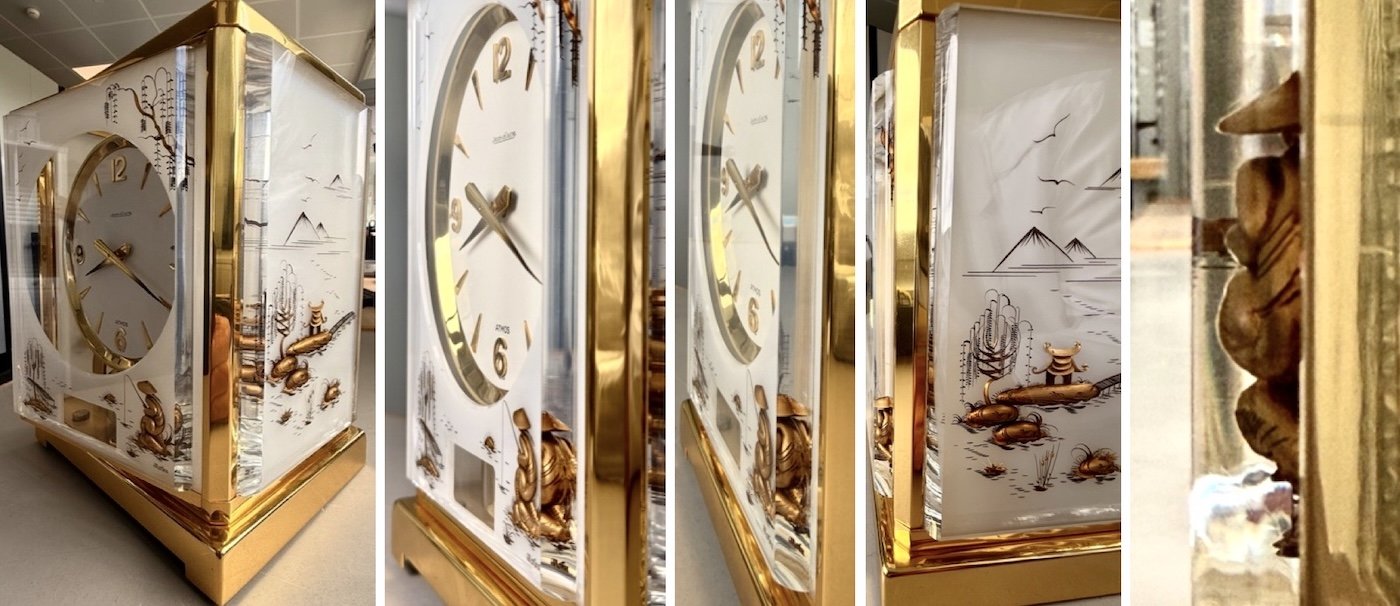
The first, with its “Chinese” decoration (ref. 5805, inventory number 5425), belongs to a collection of four references known to collectors as “Marina”. Produced between 1962 and 1975, the series also includes “Bees” (ref. 5803), “Caravel” (ref. 5804) and “Fish” (ref. 5806).

Discreetly applied to every Atmos in the collection, the enigmatic signature is probably that of the craftswoman working behind the scenes. In one of history’s many ironies, Marina would thus be one of the very few craftswomen afforded the privilege of signing her work on a Jaeger-LeCoultre piece. Our efforts to identify her through the manufacture’s archives and former employees proved fruitless. Her identity now lost, she also embodies the sometimes one-sided relationship between watch brands and outside artisans: the brand endures, while the craftspeople fade into oblivion, as explored in a recent article.

Yet her craftsmanship reveals remarkable ingenuity. She carves the material — in this case acrylic — in reverse, working from the back of the panels. Gold leaf is then applied to reveal the chosen motif in a striking three-dimensional effect. The carved elements come to life, creating an imaginary miniature theatre.
At the lower right of the Atmos case before us, a fisherman crouches on a rock, his face concealed beneath a broad hat that we imagine to be woven straw. The surrounding foliage could well be wisteria. The right-hand panel appears to depict a torii gate in the foreground, framed by several stylised mountains. For some, these visual elements will evoke prints by the Japanese masters Hokusai or Hiroshige.

Mechanically, the “Marina” clocks are equipped with Jaeger-LeCoultre calibre 526, also known as Atmos V. Its origins are described in detail by Jean Lebet, an engineer at Jaeger-LeCoultre for several decades and the author, in 1997, of the only book devoted entirely to the clock “that lives on air”.
In the 1950s, major American companies chose the Atmos as a corporate gift. Orders of 1,500 clocks a month, together with a 20% price reduction, required Jaeger-LeCoultre to undertake “a redesign of the product”, in Lebet’s words. It was precisely this mass production that would later make a hand-signed piece so prized.

In the mid-1970s, the manufacture introduced several other models directly inspired by the Marina aesthetic. This time, the motifs were engraved or painted on glass panels. These references, 5821 to 5830, were produced only from 1972 to 1975, probably indicating a lukewarm commercial reception or a desire for a change in aesthetic direction.
Under silversmith Christopher Lawrence’s hammer
The other major surprise the head of heritage had prepared for us was an extremely rare Christopher Lawrence Atmos, Model A, in solid silver with a blue enamel dial (inventory number 2154). It belongs to a series of five models, designated A to E, designed and handmade by the British silversmith between 1972 and 1976, with one hundred examples of each.

Its distinctive aesthetic contrasts with the restrained “Vendôme” clocks of the same period. “You either like it or you really don’t,” the expert observes. The object before us is mesmerising. To create it from a single block of silver, the British silversmith, born in 1936, used a technique he is said to have learned at the British workshop of R. E. Stone in the 1950s: shaping metal with a hammer. Lawrence’s approach thus has affinities with chasing, which shapes metal without removing any material, and even with the grained dials of wristwatches of the period. Years later, he reportedly remarked: “Stone was so puritanical that everything was raised – even if it could be spun. Brilliant, absolutely brilliant!”

The clock stands 43 cm tall, antennae included! Indeed, for admirers of Tolkien’s fictional world, the upper part of this Model A immediately brings to mind Sauron from “The Lord of the Rings”. The dial is surrounded by a profusion of gilded rays, also hammered, giving the whole piece the appearance of an improbable sun.
The ensemble captures the spirit of boundless creativity so characteristic of the 1970s. The Jaeger-LeCoultre catalogue devoted to the Christopher Lawrence series sums up the silversmith’s approach in a few lines: “One of the great Master Silversmiths of Britain (…) has no complex philosophy. His basic belief is that in silver, a designer must be a maker.”

Christopher Lawrence combines his talent as a silversmith with his skill as a draughtsman. For him, every work must first be drawn for the client’s approval. Today, we find this same interplay between drawing and handcraft among several artistic craftspeople working in contemporary watchmaking, including Anita Porchet, Jeanne-Valentine Ulrich, Debora Martinez, Rose Saneuil, Philippe Jacquin-Ravot and Pierre-Alain Lozeron. The silversmith’s many talents earned him a special lifetime achievement award from the Goldsmiths’ Craft & Design Council in 2013.

These undeniable qualities, coupled with a highly distinctive design, explain the appeal of these models, whose limited production makes them rare visitors to the auction room. When one does appear, anything can happen.

This past May in Hong Kong, Antiquorum offered a Model E Christopher Lawrence Atmos for sale, without naming the artist. Jaeger-LeCoultre’s heritage department bid for it, but the price quickly soared beyond the brand’s allocated budget, ultimately reaching HKD 400,000, or around €44,200.

“The collectors were there,” the expert explains. One of them eventually acquired the Model E clock for more than twenty times its high estimate of HKD 15,000, or around €1,650 — a substantial outlay that demonstrates the current enthusiasm of an exceptionally well-informed community.

Japan, an inexhaustible source of inspiration
We conclude our visit by returning to the production and restoration workshop. Among the many older pieces, a lacquered clock adorned with an elegant, colourful phoenix awaits expert assessment. It belongs to a collection devoted to Japanese lacquer, or urushi, comprising almost twenty different Atmos models developed between 1982 and 1988. A short catalogue in Japanese is carefully preserved by the heritage department. It contains a photograph of the “Phoenix” Atmos, alongside one of Sakurai Ichirō, the master lacquer artist responsible for this particular clock.

The Atmos’s front panel depicts the mythical Asian bird against a black lacquer background. Its plumage — or rather its train, composed of five long, serrated golden strands — curls around the two central hands. The head, strangely similar to an eagle’s, is brought to life by five vivid colours: “the five colours of the sacred bird’s plumage in Chinese legend”, according to the catalogue of the period.
At first glance, the black lacquer impresses with its depth, perfectly even surface and incomparable lustre. Japan has mastered the art of lacquer, and its techniques are numerous. The Phoenix Atmos follows the strict rules of one of them, wajima-nuri, defined in 1975 by a Ministry of International Trade and Industry decree designating it a protected traditional craft. Two years later, it became the first lacquerware in the country to be recognised as an Important Intangible Cultural Property.

To qualify for the wajima-nuri designation, as the Atmos Urushi Phoenix did, a piece must meet two conditions: lacquer mixed with a very specific local earth, ji-no-ko, and cloth applied between the lacquer layers to protect corners and edges.
Ji-no-ko is diatomaceous earth, a sediment composed of the fossilised skeletons of algae. Their porosity helps the lacquer adhere and endure over time. The website of the Association for the Promotion of Traditional Craft Industries, the organisation that administers the designation, clearly explains and illustrates these distinctive features of wajima-nuri.
The complex, highly codified phoenix decoration, meanwhile, is made possible by master lacquer artist Sakurai Ichirō’s expertise in maki-e: the sprinkling of gold or silver powder onto areas to which lacquer has already been applied.

The Urushi “Phoenix” clock is fitted with calibre 540. Following the 526 shared by the first two models discussed here, this mechanism rethought “the entire construction and even the basic principles” of the original patent, as Jean Lebet explains. During development work on the 540, he writes, “the use of a saturated gas was shown to be one of the most advantageous solutions in terms of efficiency, cost-effective production and reliability”.
The Atmos Urushi catalogue does more than present lacquered clocks. It is also a collection of beautiful poetic evocations, inspired above all by the natural world of Japan. The prestigious wajima-nuri lacquer is described thus: “In this remote corner of Noto, is wajima-nuri not the crystallisation of a traditional beauty born of the lacquer artists’ pride and the rigours of an apprenticeship served amid merciless winds and snow?”

Poetry aside, the Atmos Urushi Phoenix also makes appearances at auction. This past March, one sold at Sotheby’s for HKD 217,600, or around €24,025. In 1986, the catalogue listed the Phoenix at ¥2,400,000, the equivalent of approximately €14,300 at the time.
Epilogue
The three models examined here embody the originality and quality of artistic craftsmanship over some thirty years, from the 1960s to the late 1980s. Other clocks and other periods reveal the same strengths and are also reaching new price levels at auction. Examples include the early mercury models of the 1930s, testimony to the extraordinary creative vitality of the interwar years, and Atmos clocks decorated with precious wood marquetry.
At the Salone del Mobile in Milan this spring, Jaeger-LeCoultre unveiled the Atmos Hybris Artistica Tellurium, designed by Marc Newson and produced in an edition of three. An extraordinary concentration of horological complications, with an astronomical display of pared-back elegance, this 2026 creation confirms the current management team’s ambitions for the clock “that lives on air”.
On the eve of its centenary, this unique work of mechanical art has weathered every change of management and every international crisis, adapting to the aesthetic tastes of each era. It commands admiration, as Jean Lebet observed back in 1997: “I also noticed that everyone who lives with it falls under its spell.”

Sources
Jean Lebet, Vivre de l’air du temps. Histoire de la pendule Atmos, Jaeger-LeCoultre (1997); François Jequier, De la forge à la Manufacture horlogère, Bibliothèque historique vaudoise (1983); Atmos by Christopher Lawrence catalogue, Jaeger-LeCoultre (1972); Atmos Urushi catalogue, Jaeger-LeCoultre (1986).


