


 Español
 Français
 Pусский
 繁體中文
繁體中文 简体中文
简体中文 Select another language


lending modern craftsmanship with vintage aesthetics, the Manufacture in Le Brassus unveils the new Neo Frame Jumping Hour, inspired by a 1929 timepiece (pre-model 1271). At the crossroads of architecture, watchmaking and the reinterpretation of an iconic artistic movement, this new line revives the design codes of the 1930s while harnessing the most advanced technologies in the creation of both case components and movement. Hand-finished in accordance with ancestral savoir-faire, this timepiece embodies the alliance of tradition, audacity and innovation that has been at the heart of the brand for over 150 years.
Combining elongated lines and curves, the pre-model 1271 draws direct inspiration from the Streamline Moderne movement, also known as Pacquebot or Ocean Liner style – a late branch of Art Deco. Emerging in the United States during the interwar period, this design and architectural movement sought a return to minimalism, taking cues from the aerodynamic forms of trains and ships, symbols of speed and modernity. The result was sleek lines, curved shapes, rounded angles and the use of modern materials, sometimes paired with nautical elements.

The Streamline Moderne style inherited Art Deco’s ambition to reconcile modernity with craftsmanship, while integrating Bauhaus influences: an emphasis on materials, a technological touch and refined minimalism. These elements find a contemporary echo in the new Neo Frame Jumping Hour model.
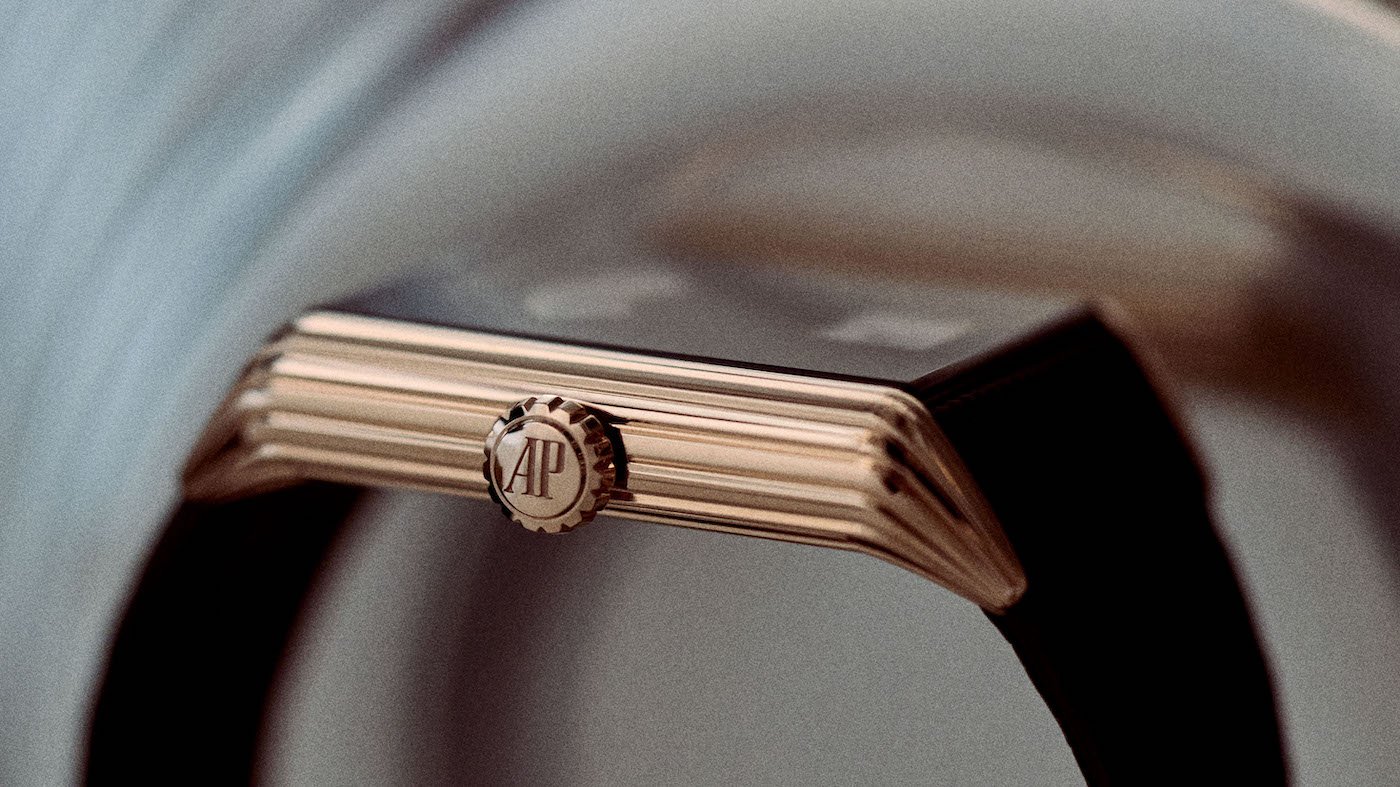
With a case measuring 32.6 mm by 34 mm, this new model adopts the aesthetic codes of pre-model 1271 to offer a contemporary homage to Streamline design. Its rectangular case in 18-carat pink gold is flanked by eight gadroons on each side, extending into elegant lines that taper into pointed lugs, evoking aerodynamic motion. This distinctive CNC-machined motif is echoed on the caseback, crown, and oscillating weight – all in 18-carat pink gold. Exceptional precision was required to align the case back’s lines with those of the lugs, ensuring visual harmony.
The timepiece features a contemporary two-tone design with a black PVD-treated sapphire crystal. Two gold-framed apertures display hour and minute numerals printed in white on a black background. The Audemars Piguet signature appears at 6 o’clock in pink gold tones.
Despite its apparent simplicity, the sapphire dial demanded considerable work and bespoke assembly processes. While the original pre-model 1271 featured metal dials (in various gold tones or platinum), this reinterpretation meets modern standards by replacing the metal dial with a sapphire crystal while ensuring water resistance. Typically, this is achieved by pressing the crystal into a bezel, but the Neo Frame Jumping Hour lacks metal framing at 12 and 6 o’clock, leaving the sapphire exposed. To ensure 20m water resistance, the dial plate is bonded to the sapphire crystal and then screwed into the case – a technique developed specifically for this model.
This new timepiece underwent extensive ergonomic refinement to anchor its historic design in today’s world, and a new crown was specially constructed to enhance comfort during winding while offering a refined look.
The watch is paired with an elegant black calfskin strap featuring a textured motif conceived by Audemars Piguet’s Design team. Seamlessly integrated with the case, the strap meets the sapphire between the lugs, reinforcing the timepiece’s vintage inspiration.
Merging homage to the past and innovative techniques, this model is powered by the Manufacture’s first selfwinding jumping hour movement. Based on Calibre 7121, which equips the Royal Oak “Jumbo” models, the new Calibre 7122 was developed entirely in-house. It combines an instantaneous jumping hour with trailing minutes, delivering precision, performance, and reliability.

With a robust 52-hour power reserve, Calibre 7122 features a patented shock-absorbing system that mechanically prevents hour jumps in case of impact, making the watch suitable for everyday life. To enhance shock resistance, the hour disc is crafted in titanium, while the minute disc which is displayed progressively through the aperture, is made of aluminium.
On the back of the watch, the movement is visible through a sapphire caseback, revealing refined Haute Horlogerie finishes such as Côtes de Genève and satin brushing, along with a dedicated oscillating weight complete with further fluting.
The jumping hour revolutionises time display by replacing traditional hands with numerals that jump every 60 minutes. This system first appeared around 1650 in night clocks and was adapted in the 18th century for pocket watches to improve legibility. Initially, the jumping hour was paired with a secondary dial featuring an hour hand. From 1890 onwards, minute indication appeared on a rotating disc viewed through a second aperture.
With the rise of wristwatches during the interwar period, the jumping hour gained popularity for its modern display and practical advantage: the full dial with two apertures helped protect the fragile mineral glass of the timepiece. These wristwatches elegantly combined form and function.
Audemars Piguet played a pioneering role in introducing jumping hour wristwatches. Between 1924 and 1951, the brand sold 347 timepieces with this display complication, including 135 with dual apertures. The first model (No. 27826) featured a square case, a single aperture, and a minute hand, powered by Calibre 10HPVM. In 1924 alone, 14 jumping hour watches were delivered, square or rectangular, using Calibres 10HPVM or 10GHSM – the latter powering most of the 212 watches with hour aperture and minute hand produced until 1951.
With their covered dials, dual-aperture wristwatches offered Audemars Piguet a canvas for aesthetic exploration. Beyond square and rectangular cases, the brand created cushion-shaped models, those with removable or hidden lugs, engraved cases, and even triple-aperture designs. Pre-model 1271, marketed in 1929 and 1930, was among the first to feature dual apertures. Only 14 pieces were made in four variants: white gold, white and yellow gold, white and green gold and a unique platinum piece. Nearly all were sold before the October 1929 stock market crash, which ended the Roaring Twenties.
The platinum model, now housed in the Audemars Piguet Musée Atelier, served as the inspiration for the Neo Frame Jumping Hour model. It was sold to the son of a famed Broadway shoemaker.
Jumping hour wristwatches faded at the onset of World War II but saw a revival in the 1960s and 1970s during the Space Age design era. Their true renaissance came in the early 1990s, when Audemars Piguet began combining the complication with minute repeaters – a practice the brand continued for two decades.
With the new model, which pays contemporary tribute to 1930s design, Audemars Piguet continues to honour horological tradition through technical and ergonomic innovation.
TECHNICAL SPECIFICATIONS
FUNCTIONS
- Hours and minutes.
CASE
- Rectangular 18-carat pink gold case, pink gold and sapphire caseback, pink gold crown, water-resistant to 20 m.
- Case thickness: 8.8 mm.
DIAL
- Black PVD-treated sapphire dial, gold-toned micro blasted apertures.
CALIBRE
- Selfwinding Calibre
- Total diameter 29.6 mm (12 3⁄4 lignes)
- Total thickness 4 mm
- Number of parts 293
- Number of jewels 43
- Minimum guaranteed power reserve 52 h
- Frequency 4 Hz (28 800 vibrations/hour)
STRAP
- Black calfskin textured leather strap with 18-carat pink gold AP clasp.


