
 Español
 Français
 Pусский
 繁體中文
繁體中文 简体中文
简体中文 Select another language


hen François Junod built L’Ange, he was fresh out of art school and had only recently opened his workshop making automata in Sainte-Croix, where he was born in 1959. Perched a thousand metres above sea level, this small town was thriving thanks to a highly skilled workforce in micromechanics and internationally renowned brands such as Paillard (manufacturer of Hermès typewriters), Bolex cameras, Thorens record players and Reuge music boxes, among many others. Like three generations of his family before him, Junod studied micromechanics at the local college but instinct told him that factory life, even at this high standard, wasn’t for him.

When Junod was introduced to Michel Bertrand, an automaton maker who had moved from Paris to Sainte-Croix, his fate was, in the best possible way, sealed. He admits to having “fallen for” this poetic world of Pierrots and singing birds, and their “delicate gestures stirred by an archaic grace.”

Showing great foresight, the same Michel Bertrand, who patiently instructed a young François Junod in the restoration of antique automata, encouraged him to try out for the Ecole des Beaux-Arts. For his entrance exam, the micromechanic, who had dipped his toes in the world of automata, presented a scale model of a bicycle which he had made entirely by hand. He was accepted. Bingo!
Revival through art
Bingo! indeed, as this decision would, in its own way, transform the world of automata and set it on the road to renewal. A renewal which, encompassing art, artistic culture and mechanical expertise, would attain a new form of animated poetry.
But back to 1983. After studying sculpture at the Beaux-Arts, François Junod set up his workshop in Sainte-Croix. Orders soon came in, although customers were “surprised, sometimes disappointed” by a style more akin to art than traditional automata. “A lot of them didn’t understand this more artistic approach, very different to tradition,” Junod says. He made a dancer out of wire, inspired by Alexander Calder, miniature writing Pierrots, a magician’s table, an automated ostrich, even mechanical turnspits. He also worked in restoration.
Japan calling
In 1990 an order arrived from Japan, via Matsushita Panasonic, to create an orchestra of twelve animal automata that would play Le Boeuf sur le Toit by French composer Darius Milhaud.

This was, Junod confesses, “an unprecedently large piece, some of the animals were a metre seventy tall, and a huge technical challenge.” This animal orchestra would be a pivotal moment in his career. Still in Japan, he was then invited to take part in the 1994 World Festival Exhibition in Mie, visited by six million people. The automata he took with him were very different from previous creations: more contemporary and, in some cases, “a bit of a provocation,” such as one inspired by Edvard Munch’s Scream.
Shortly after, François Junod met Kenichi Kimura, patron and owner of the Arashiyama Music Box Museum, who had recently acquired the private collection of Guido and Jacqueline Reuge (of the eponymous factory in Sainte-Croix), prompting anger and dismay among the local community. "When Mr Kimura asked me what I thought of his museum, I answered honestly. I told him how pleased I was by his invitation, but also saddened to see the collection leave Switzerland. He was surprised, and perhaps touched, by such a frank response.” François Junod left Japan and had barely touched down in Switzerland when his telephone rang. At the other end of the line, a lawyer was asking him to drop everything and return to Japan for another meeting with Mr Kimura. The result would be a truly exceptional commission to reproduce a late-eighteenth-century masterwork by Jaquet-Droz: the Draughtsman.
With no complete schematic, working from fragments of sketches and photos, the task would take François Junod several years to complete. He would make five more draughtsmen and writers, all part of the Arashiyama museum’s collections.


François Junod continued to build his expertise, culminating several years later in his Alexander Pushkin. Thanks to a complex system of programmed cams, this humanoid automaton combines words and phrases into 1,458 short poems, each different and appearing in random order, making it impossible to predict which poem will come next.
The slightest pause
Japan taught François Junod something else: to seek not mechanical complexity but “the expressive value of a movement, a gesture.” This lesson was revealed to him while studying karakuri ningyō, wooden automata used in rituals or shown in theatres. Through his observations, he understood that emotion comes from the suspension of time. For the space of a breath, the gesture pauses and becomes human. “An infinite subtlety,” says Junod. The automaton becomes poetry.

Now, he says, “imperfection plays an essential role” in his automata. "A tiny irregularity, a hesitation, the slightest delay in the movement gives the impression that the figure is breathing, that there is something alive and expressing itself through the mechanism. A machine that is too perfect, too optimised, can seem soulless.”
Of course, these “imperfections” — which mirror those of our souls — must be created with only mechanical means!
Android versus automata
It’s a question we have to ask: what is the difference between today’s humanoid robots and humanoid automata? “A robot isn’t that complicated from a mechanical point of view, with axles, gears, belts… I sometimes borrow some of the materials they use. The complicated part is the coordination with the electronic commands, the programme. Then there’s the issue of consumption and repairability. When I look at these robots, on the one hand I’m impressed by the progress, by the sensors and the algorithms and the sophisticated movements, but on the other hand I feel there is a fundamental difference with automata. Whereas automata seek to spark emotion through the poetry of their gestures, without hiding their limits or fragilities, robots seek to impress by their performance, erasing any sign of flaws or faults.” He pauses before concluding, “They have more in common with machine tools than with automata.”
Watches, jewellery and automata
Sainte-Croix is also fertile ground for horology and so quite naturally the art of the automaton became interwoven with the fabric of contemporary Swiss watchmaking. In their pursuit of the exceptional, the foremost watch and jewellery houses increasingly look to the openings and possibilities offered by art mechanics for animated decors, miniatures, innovative complications, stars, flowers and fairies that move — sometimes combined with musical mechanisms.
Commissioned from François Junod by Van Cleef & Arpels, in La Fée Ondine a fairy sitting on a waterlily pad awakens and lifts her head while a flower opens its petals to reveal a butterfly, which the fairy admires as she beats her wings.

"It was like rediscovering a forgotten world,” says Junod, “where mechanisms become almost magical to awaken something enchanted in us.”
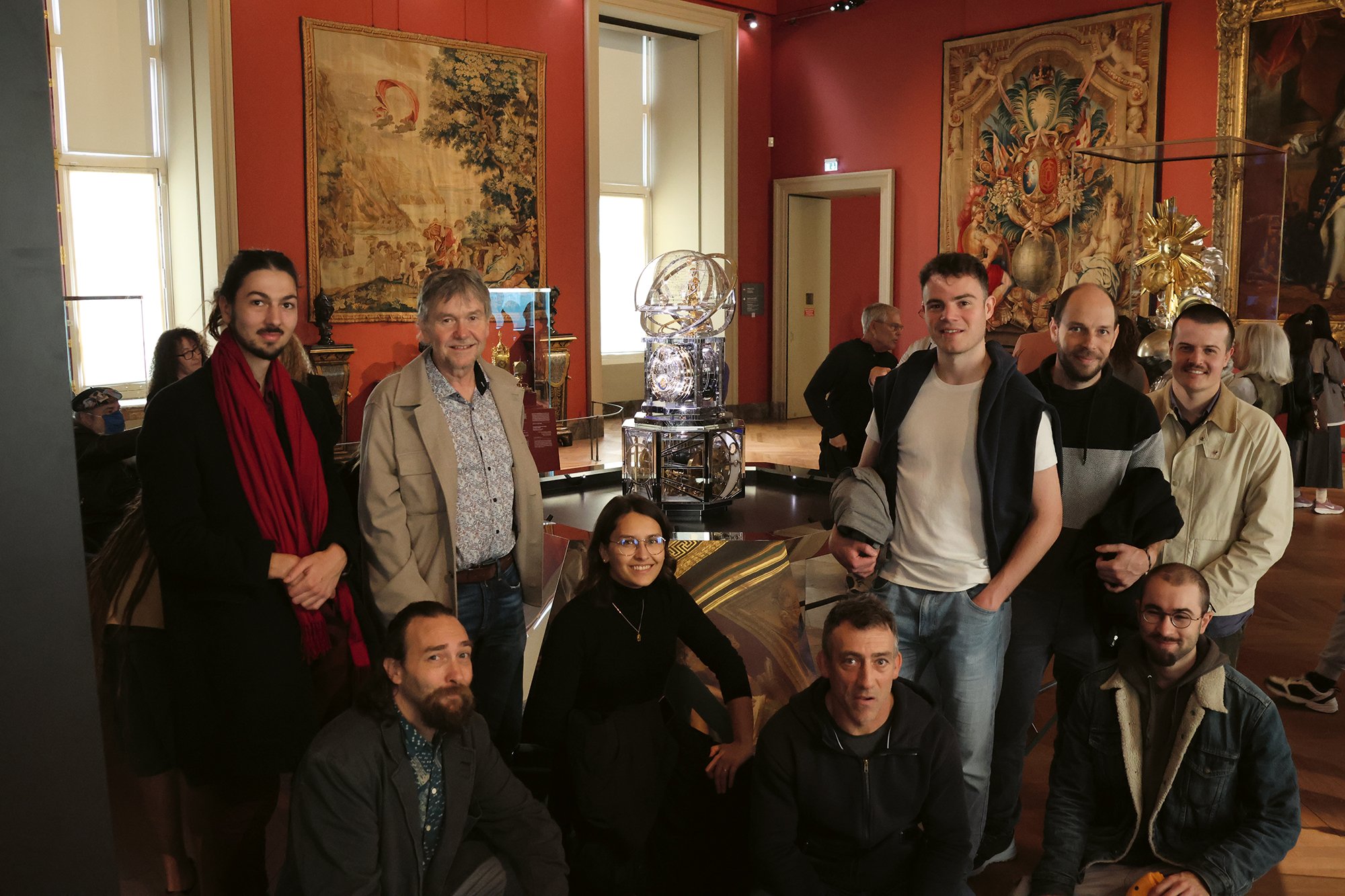
La Quête du Temps for Vacheron Constantin is another recent example of Junod’s genius, applied not to fairy tales but to the stars and the cosmos. 158 cams, almost 4,000 components, 22 horological complications, the whole thing orchestrated by two “music machines” and an automaton that moves in all three dimensions beneath a glass dome. (For more details, see Europa Star 4/2025)

A chain of knowledge
As François Junod beautifully puts it: "Automata aren’t simply mechanical objects. They convey memory and emotions.”
He is proof that a dying craft can be regenerated by art and by the continuity of knowledge, passed from one generation to the next. Working alongside François Junod are designers, sculptors, micromechanics, watchmakers, engineers and 3D modellers. All young. All determined to continue along their chosen path. The future of automata and mechanical artistry is in safe hands.