
 Español
 Français
 Pусский
 繁體中文
繁體中文 简体中文
简体中文 Select another language


n 1976, Citizen introduced the Crystron Solar Cell, the world’s first light-powered analogue watch — a technological breakthrough that would later evolve into Eco-Drive, one of the brand’s most emblematic innovations. Fifty years later, Eco-Drive remains a cornerstone of Citizen’s identity and a major contributor to its global sales.
One of the great strengths of the Citizen group is a highly integrated industrial ecosystem stretching from Japan to Switzerland, which, as Yoshihisa Yajima notes, allows it to “produce high-quality watches at scale.” With entities such as Miyota and La Joux-Perret, the group possesses substantial in-house manufacturing capabilities, ranging from components to complete movements. This structure enables the various brands within its portfolio across Japan, Switzerland and the United States (from Frederique Constant to Bulova) to pursue innovation in areas such as materials, precision and energy efficiency.


Despite the group’s diversification (notably into machine tools and Devices and Components), watchmaking remains the cornerstone of its structure: for the most recent financial year available, 2024–25, this activity accounted for just over half of sales, at ¥177.1 billion (USD 1.2 billion) out of the Citizen group’s consolidated total of ¥316.8 billion (USD 2.1 billion). For the 2025–2026 fiscal year, Citizen has raised its forecast to ¥337.5 billion in sales, including ¥190 billion for watches, which would keep watchmaking at around 56% of total revenue.

In the early 2000s, the group experienced steady growth, before performance plateaued as market conditions shifted. During the 2010s, however, the company returned to a recovery trajectory. Around 2015, revenue reached approximately ¥340 billion, marking the peak of the period. From 2013 to 2018, performance remained at a relatively high level, although it began to ease slightly in the latter half of the decade. While the Citizen Group experienced a downturn during the pandemic, results have gradually recovered, with revenue once again exceeding the ¥300 billion ($2 billion) mark.
The group noted that recent growth has primarily come from North America, where the Citizen and Bulova brands have benefited from strong demand, as well as from the rapid expansion of e-commerce and direct-to-consumer sales. For the 50th anniversary of Eco-Drive, Citizen therefore finds itself at the intersection of several dynamics: technological heritage, innovation, and the generational renewal of the watch market.
Like other major Japanese brands, it maintains in the background a vision of social contribution — one could call it “democratic” — in contrast with the increasingly exclusive outlook of Swiss watchmaking, and covering a wide range of price points, as reflected in its slogan: “Loved by citizens, working for citizens.” Even as the average price rises, the segment generating the vast majority of volumes — numbering in the millions of units per year — remains positioned between USD 200 and 600.


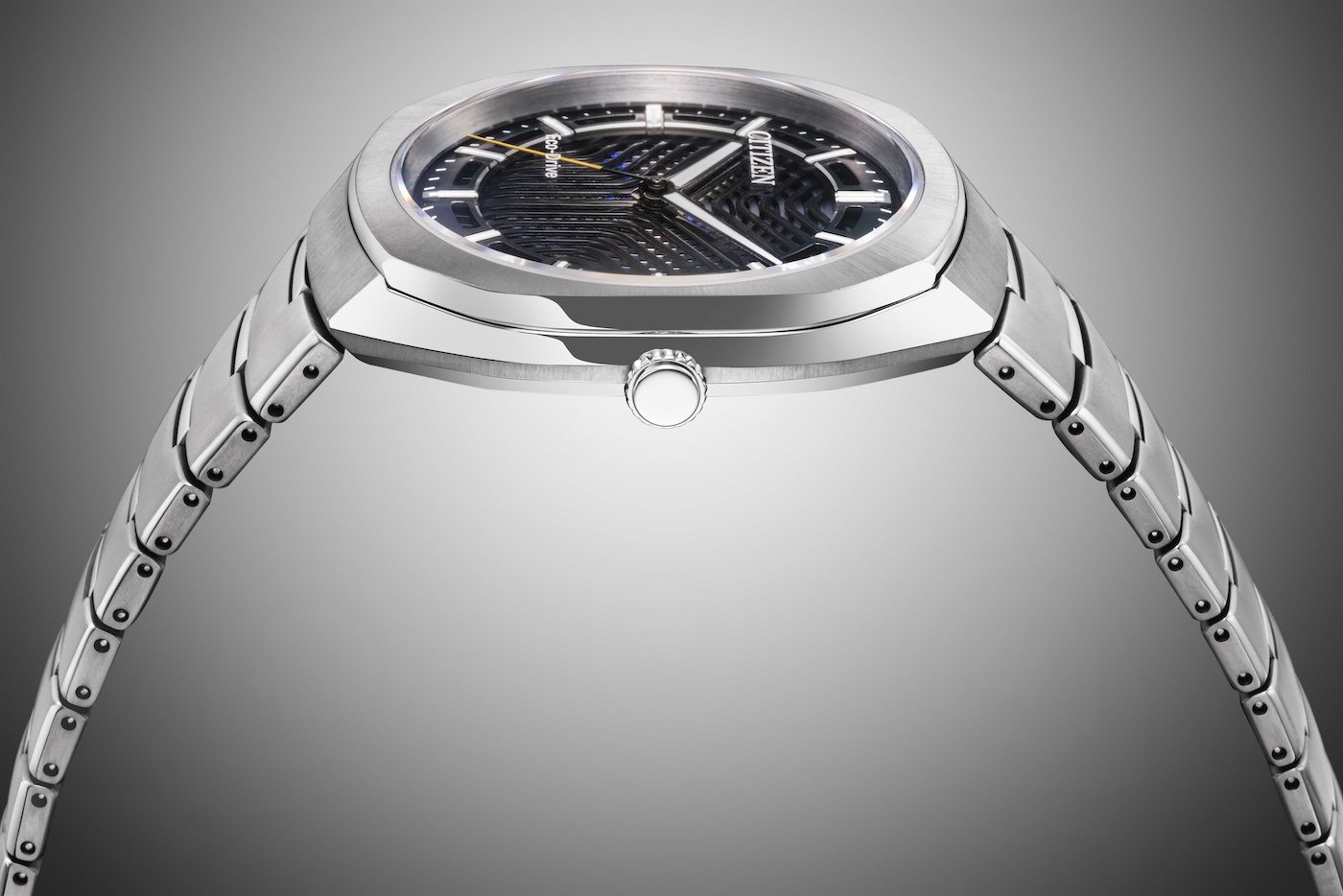
One point seems clear: while watchmaking is the group’s main engine, Eco-Drive is the main engine of its watchmaking! At the same time, like the watch market as a whole, the Citizen brand is gradually placing greater emphasis on mechanical watchmaking as well — notably with the high-performance Calibre 0200, that leverages La Joux‑Perret’s expertise and technical know‑how— and on the higher end with the The Citizen collection.

An update with Yoshihisa Yajima, who oversees all of this activity within the group and directly manages the Citizen brand itself.
Europa Star: Could you share Citizen’s main strategic objectives for 2026?
Yoshihisa Yajima: 2026 will be a major milestone for Citizen as we celebrate the 50th anniversary of Eco-Drive. The launch of the Citizen Crystron Solar Cell, the world’s first light-powered analogue watch in 1976, was a breakthrough for the industry, and reaching this anniversary is something we are extremely proud of.
Eco-Drive remains a unique technology because it can generate energy not only from sunlight but also from very low levels of light. Over the years, we have continued refining the technology in several directions: reducing energy consumption, increasing power autonomy, miniaturizing movements while adding more functions, and allowing greater freedom in dial design. One of the ongoing challenges is always to let enough light pass through the dial while offering a wide palette of aesthetic expressions.
For 2026, we are introducing several new models — both mechanical and quartz — but the central theme is the 50th anniversary of Eco-Drive. This technology remains a key pillar of the brand. Even though mechanical watches are gaining popularity, Eco-Drive still represents the largest share of Citizen’s sales, both in value and in volume.


Which markets performed best for Citizen in 2025? Which do you expect to grow the most this year?
North America delivered particularly strong performance in 2025, and online sales also continued to grow significantly, especially through Citizen’s official channels.
Attesa, Series 8, and, on the women’s segment, Citizen L, performed well in terms of products. During the year we also organized launch events for Attesa and Series 8, which helped increase their visibility in the United States and other markets.
We are also seeing growing interest from younger consumers. We sometimes refer to them as “Zillennials,” a blend of Generation Z and Millennials, who are gradually returning to watch purchases. They are interested in both Eco-Drive models and mechanical watches.
If we’re talking about European markets more specifically, other collections also performed strongly, including Promaster, Tsuyosa and several other lines. In June 2025, we also celebrated in Italy the 40th anniversary of Aqualand, marking the 1985 launch of the first dive watch equipped with an electronic depth sensor. The event received a very positive response.
For 2026, our objective is to maintain momentum in our strongest markets. Of course, U.S. tariffs have had an impact, but we have been able to adjust our pricing in order to preserve the value of our sales.


What have been the most important product lines launched over the past five years? What do they represent for Citizen’s strategy?
Over the past five years, we have focused on increasing the value-added of our collections.
The Tsuyosa line has been particularly important in attracting new customers, while the Eco-Drive 365, introduced in 2023, represents a major technological advance. Once fully charged, the watch can operate for 365 days even in complete darkness. As pioneers of light-powered watch technology, we continue to improve efficiency by reducing energy consumption and extending the running time.
In 2025, we also celebrated the 30th anniversary of The Citizen with limited editions. These included several types of watches and highlighted our capabilities in high precision, through the mechanical Caliber 0200 movement and Eco-Drive movements achieving accuracy of ±5 seconds per year.
in addition to the 2023 launch of the E365, The Citizen celebrated its 30th anniversary in 2025 and released several limited‑edition models featuring Caliber 0200 and the high‑accuracy Eco‑Drive movement Cal. A060 (annual accuracy ±5 seconds).


How do you organize your production and operations?
Manufacturing is one of Citizen’s fundamental strengths. We are among the few watch groups capable of producing almost all components in-house. The Citizen Group is a unique watchmaking organization, with development and manufacturing operations in both Japan and Switzerland.
In 2013, we consolidated Japanese watch production under the Citizen Watch Manufacturing structure. Bringing these factories together allowed us to create a more integrated and efficient organisation for producing Citizen watches.
This approach enables us to produce high-quality watches at scale. Because we control not only final assembly but also the manufacturing of parts and components, we can adjust every element of a watch to achieve the best possible balance between quality, performance and cost. Having all these capabilities within a single structure significantly improves both efficiency and flexibility.


What are the main focuses of your R&D?
Citizen has several key areas of research and development. Materials are one of them — Super Titanium (read our article here, editor’s note), for example, remains an important innovation for us. Precision and accuracy are another focus, with developments in high-precision quartz and mechanical movements.
However, our philosophy does not revolve around a single technological direction. Precision is fundamental, but a watch is also an object worn every day. Comfort, durability and aesthetics are therefore just as important. We always try to find a balance between technical performance and the beauty and emotional appeal of the watch.


What synergies exist between Citizen and the group’s other entities worldwide?
Although the group includes many different brands, we do not seek to merge their identities. Each brand must retain its own positioning and character.
At the same time, we benefit from strong synergies, particularly on the technical side. For example, our collaboration with La Joux-Perret led to the development of the Caliber 0200 mechanical movement. Technical exchanges like this allow us to create new products while benefiting from the expertise of the group’s various entities.
The synergies also extend to manufacturing and components. Some Frederique Constant models are powered by movements manufactured by La Joux-Perret, while certain Accutron by Bulova models feature movements developed specifically for them by Citizen. Beyond product development, we also cooperate commercially — for example in distribution, logistics, sourcing and shipping — to identify new opportunities across different markets while preserving the individuality of each brand.