


 Español
 Français
 Pусский
 繁體中文
繁體中文 简体中文
简体中文 Select another language


n the early 1970s, the Swiss watch industry was under fire. The arrival of Seiko’s Astron in 1969 had changed the rules: quartz watches were more accurate, increasingly affordable and required less maintenance than the products on which Switzerland had built its global supremacy. Yet the Swiss response was not simply resignation.
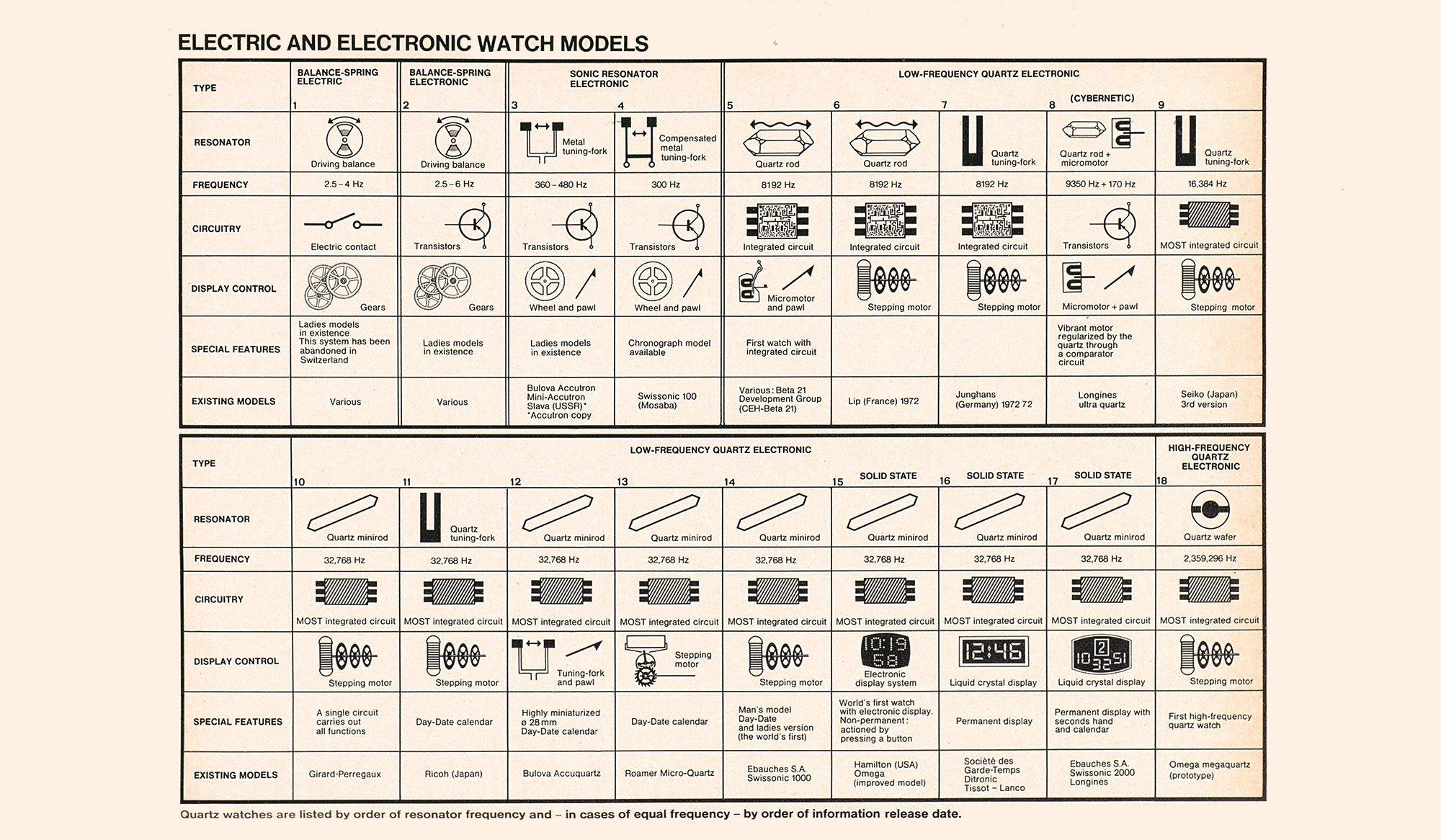
Among the most fascinating answers was the Swissonic 100 chronograph with ESA 9210 calibre, based on the ESA 9162 MOSABA movement. Presented within the ESA Swissonic 100 line, it remains the only metal tuning-fork chronograph ever produced in series. It combined a 300 Hz electronic oscillator with a fully mechanical chronograph module developed by Dubois Dépraz: a hybrid solution with virtually no equivalent in watchmaking history.


The movement emerged from Ebauches SA (ESA), at a time when Swiss manufacturers were exploring several paths at once: quartz, digital, solar and metal tuning-fork technology. The Swissonic 100 chronograph represented a “third way” between traditional mechanics and quartz. It did not abandon the mechanical culture of the Swiss Jura; instead, it placed electronics at the service of precision while preserving wheels, levers and a mechanical chronograph complication.
The sound of precision
Its principle was elegant. Instead of a balance wheel oscillating a few times per second, the ESA 9210 used a metal tuning fork vibrating at 300 Hz. The result was precision of around ±1 second per day, a level difficult for purely mechanical watches of the period to match.
The calibre also offered hacking seconds and quick corrections for date and day. Its most sensory signature, however, was acoustic: the soft 300 Hz hum of a miniature resonator in motion.

Max Hetzel, the Swiss engineer behind Bulova’s Accutron 214 calibre, inspired André Beyner of Ebauches SA to develop an improved metal tuning fork system. Beyner’s work helped overcome one of the classic weaknesses of the earlier tuning-fork regulated Accutron: positional error. The ESA solution used a µ-shaped resonator, improving stability and laying the foundation for a movement ambitious enough to drive a complication.
Dubois Dépraz and the impossible chronograph
That complication was entrusted to Dubois Dépraz in Le Lieu. The resulting chronograph module, associated with the DD 8281 chronograph platform and DD 2551 calendar platform, formed part of a four-layer architecture unlike anything else in horology.


The key challenge was the clutch: how to transmit energy from a high-frequency tuning fork to a mechanical chronograph. The solution was protected in British Patent No. 1,412,340, filed by Ebauches SA in 1972 and naming Gérald Dubois and François Berthoud as inventors.
The Swissonic 100 chronograph was presented at the Basel Fair in 1972, where Europa Star described it as “the first electronic chronograph”. It was later used by Omega as calibre 1255 in the Speedsonic f300Hz, by Longines as calibre L749.2, by Certina as calibre 749, and by Baume & Mercier as calibre BM 19210.

Omega was the only known licensee to submit the calibre for COSC certification, making the ESA 9210 the only tuning-fork chronograph movement ever to carry chronometer status.
From the Swiss Jura to NASA
Its history even touches space exploration. Through Hetzel and the Accutron, metal tuning-fork technology had already played a role in American spaceflight.
In 1978 Omega submitted a Speedsonic powered by calibre 1255 as part of the Alaska III programme. NASA ultimately retained the hand-wound Speedmaster Professional for operational use, largely because battery-powered wristwatches had no operational record in manned spaceflight.
Available documentation suggests that the rejection reflected operational risk considerations surrounding battery-powered watches in spaceflight rather than doubts about the movement’s intrinsic quality.
A surviving witness
One unresolved chapter concerns an alternative disc-clutch prototype calibre May 4, 1973, after the patent filing for the vertical clutch. Was it a parallel solution, or a later attempt to simplify production? The answer remains open and deserves further research with Dubois Dépraz.
Our research also comprises a complete NOS factory demonstrator of the ESA 9210 calibre, documented by an original Valjoux S.A. delivery note dated January 6, 1975. It was not made for retail sale but to demonstrate how the system worked.
With total production reported at around 21,000 movements and perhaps only 100 to 200 demonstrators made, a surviving NOS example is exceptionally rare.
A brilliant dead end
The Swissonic 100 chronograph was not a commercial success: too complex and costly to compete with mass-market quartz; too reliant on electronics to offer the emotional appeal of traditional luxury watchmaking. By 1975, what had seemed visionary in 1970 already appeared transitional.
Yet its failure was not technical. On the contrary, the ESA 9210 calibre represents one of the most sophisticated expressions of analogue engineering at a time when Swiss watchmaking was fighting for its future. Without CAD, digital simulation or silicon components, ESA and Dubois Dépraz solved a problem that would reappear in the early 1980s, when the Swiss watch industry set out to expand quartz technology: how to combine an electronic precision oscillator with a mechanical chronograph.


This is why the Swissonic 100 chronograph matters. It is not merely a curiosity of the quartz crisis. It is a material witness to a moment when the Swiss industry tried to defend its identity not by imitation, but by synthesis.
Electronics and mechanics, precision and craft, crisis and invention come together inside this singular calibre.
Not every endeavour, however brilliant, reaches its goal but it can leave its mark. The Swissonic 100 chronograph is one.


