
 Español
 Français
 Pусский
 繁體中文
繁體中文 简体中文
简体中文 Select another language


hich “chrono” will it be for Zenith? Over the course of a century - from its founding in Le Locle in 1865 by Georges Favre-Jacot, pioneer of the integrated manufacture, through to the mid-20th century and the golden age of chronometry competitions in Neuchâtel, Geneva and Kew-Teddington - Zenith amassed no fewer than 2,333 prizes. This was the era of celebrity regulators commanding extraordinary salaries, and advertisements proudly proclaiming observatory victories. Competition watches were tuned like racing engines, optimized to achieve peak precision at a specific moment in time.
The Zenith Calibre 135-O was developed specifically for observatory trials in the 1950s. Regulated by the legendary Charles Fleck and René Gygax, these movements achieved astonishing performances, measured in mere fractions of a second per day - typically around ±0.3 seconds/day for the very best examples. This exceptional level of precision enabled Zenith to secure five consecutive first prizes at the Neuchâtel Observatory between 1950 and 1954. The Calibre 135-O alone earned 235 chronometry prizes, a record for a mechanical movement.

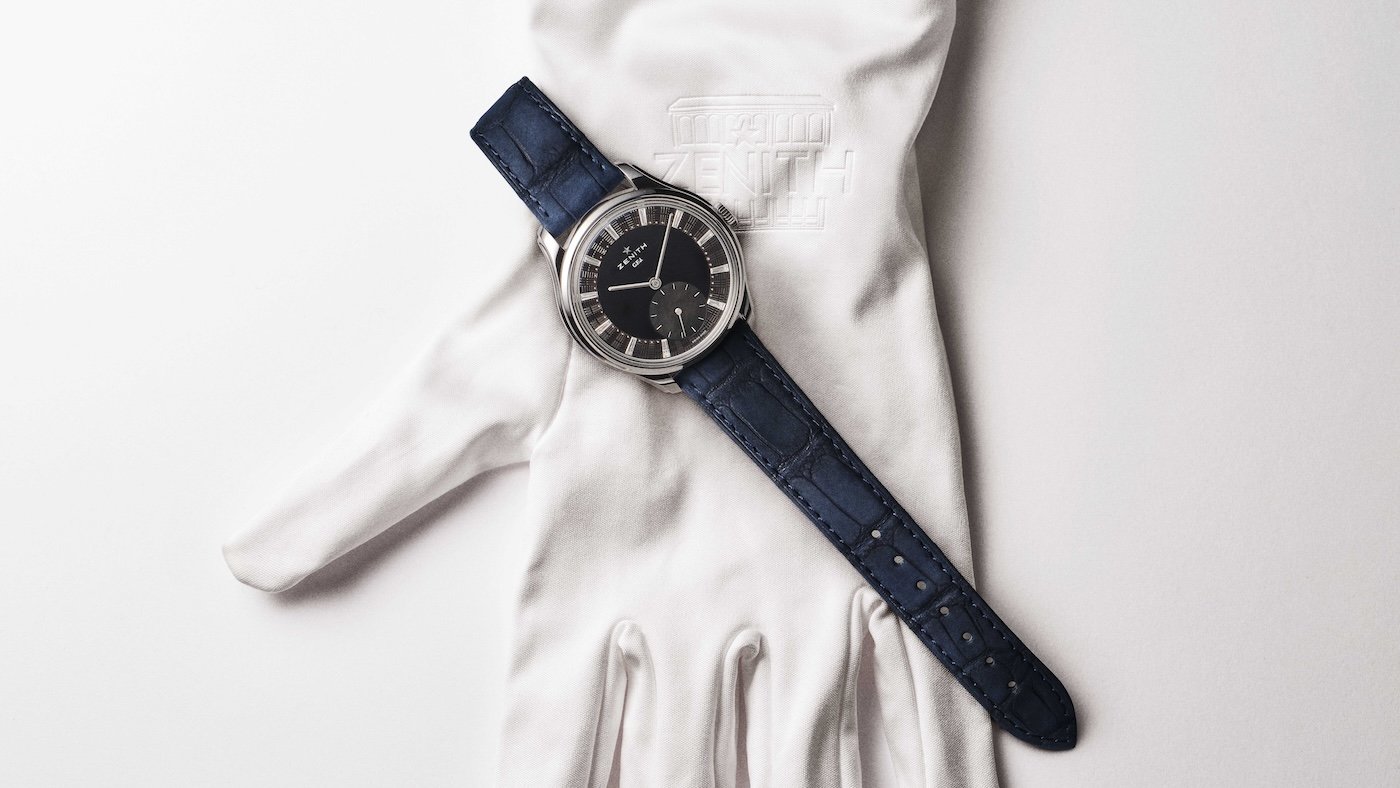
One more distinction can now be added to that tally: the Chronometry Prize won in 2025 by Zenith’s G.F.J. Calibre 135 - named after Georges Favre-Jacot to mark the manufacture’s 160th anniversary. This reinterpretation of the legendary movement is a resolutely traditional manual-winding calibre beating at just 2.5 Hz (18,000 vph), adjusted to a stated precision of ±2 seconds per day.


This model relaunches Zenith’s ambitions in pure chronometry. The manufacture had already revived the calibre briefly in 2022 through an ultra-limited edition created in collaboration with Kari Voutilainen and Phillips. This year, it returns in new iterations.


Yet in the second half of the 20th century, as traditional observatory competitions were swept away by technological change, another “chrono” came to define Zenith: the El Primero automatic chronograph, introduced in 1969. It represented a continuation of Zenith’s century-long pursuit of precision - but applied to the measurement of elapsed time, while bringing the practical benefits of automatic winding. Its high frequency of 36,000 vibrations per hour (5 Hz) made it possible to measure 1/10th of a second, with the chronograph hand beating ten times per second.
There is no need to revisit here the entire saga - Charles Vermot’s heroic rescue of the movement, the historic collaboration with Rolex on the Daytona, or the Defy El Primero 21 beating at 360,000 vph and displaying 1/100th of a second. Today, the chronograph continues to fuel Zenith’s creative imagination through countless contemporary interpretations.


For Europa Star, Romain Marietta - now in his forties and having spent half his life at Zenith - reflects on these two defining chapters of Zenith’s history, these two “chronos”: chronometry and the chronograph, the Calibre 135 and the El Primero. In the end, there is no need to choose between them. The challenge lies in honoring a dual heritage, and in deciding where to place the emphasis in an era that is increasingly difficult to read. Strategic precision, after all, is an equally delicate art.
Europa Star: For Zenith, the reinterpretation of the legendary Calibre 135 marks a strong return to chronometry. What message are you seeking to convey?
Romain Marietta: Historically, we are legitimate in two fields: chronometry and the chronograph. With the Calibre 135, the idea is to reopen this chapter devoted to pure precision. These watches are COSC-certified and officially designated as chronometers, but internally we push things even further, with tolerances of -2/+2 seconds per day. That is extremely ambitious.
Why place so much emphasis on these tolerances?
Because today many brands talk about precision without necessarily proving it. We produce around 250 Calibre 135 movements per year, and we are genuinely able to maintain these tolerances. That resonates strongly with collectors.

Does precision still matter as a differentiating factor in the digital age?
It is almost a philosophical question. Other technologies surpassed mechanical performance long ago, so the absolute pursuit of precision may seem futile. But chronometry is not just about numbers - it is a mindset. Our clients are demanding; they expect consistency between what we say and what we deliver. And Zenith is expected to perform in this territory.
Zenith was a pioneer of industrialisation and large-scale production as early as the 19th century. Today, Swiss watchmaking seems to speak only of craftsmanship, value and exclusivity. Your own production has also become more exclusive. Where do you position yourselves?
We are not producing industrial volumes like some others, but we still operate within a reproducible framework. Every single piece is adjusted by a watchmaker. The machine does not make the decisions - human expertise does. I would describe it as a highly rigorous “semi-industrial” approach, very much aligned with the spirit of Georges Favre-Jacot.
People remember Zenith’s more radical innovations in chronometry, with concept models such as the Defy Lab in 2017, followed by the Defy Inventor in 2019 and its 18 Hz oscillator. For several years, Zenith sought to modernize its image. With the Calibre 135, you are returning to chronometry, but in a far more classical way. Why pause this disruptive innovation?
It comes down to priorities and strategic choices. We explored extremely advanced solutions, particularly involving silicon components, but access to these technologies is complex. The Defy Lab was limited to just 10 pieces. Then between 2019 and 2020, we delivered between 300 and 500 Defy Inventor watches, but the internal context evolved. Today, we prefer to strengthen our core collection. And the Calibre 135 is directly tied to our history. It feels more coherent than pursuing pure futurism. We are a maison with more than 160 years of history behind us. That said, this research remains highly relevant at group level.


What about disruptive innovation in chronographs, such as the pursuit of 1/1000th of a second - something TAG Heuer already achieved with the Mikrogirder?
These are fascinating territories, but they are not our priority today. We mastered 1/10th of a second long ago with the El Primero. With the Calibre 135, by contrast, we deliberately reduced the frequency in favor of stability. We are focusing more on what I would call “silent” innovations - extremely useful advances in anti-magnetism, reliability and longevity. Some clients place their watches straight into safes, and we are aware of that, but we want our watches to be capable of withstanding every kind of challenge, ready to be worn anytime, anywhere.

You also mention the idea of a watch capable of running for ten years without servicing (Zenith currently offers a five-year warranty: a two-year international warranty plus an additional three years if the watch is registered online - not to mention the Zenith El Primero A386 Revival, which benefited from an exceptional 50-year warranty for the model’s anniversary, editor’s note).
That is one avenue of research. The goal is to improve overall ergonomics, robustness and ease of use - and, above all, long-term reliability.


Is this more conservative approach reassuring for your clients?
Yes, because continuity is a strength. With only a few exceptions, we are capable of repairing every Zenith watch produced over the past 161 years. We can even recreate components from archival documents.
How do you view certifications today? Why not rely on them more extensively?
They have their role to play, but they must remain coherent with our own internal standards. The logistical burden they involve is also considerable. We have already certified certain El Primero calibres through the COSC, and also through Timelab for 1/100th-of-a-second precision. But ultimately, the true level of rigor comes first and foremost from the manufacture itself.
Does chronometry remain a challenge for the future?
Absolutely. In fact, it remains one of the most demanding fields of innovation. Between magnetic fields, temperature variations and real-world usage conditions, there is still an enormous amount to achieve. After all, the wrist is probably one of the worst possible places to put an object designed to measure time… So the question of precision will never be entirely solved. And that is precisely what makes it so fascinating.