


 Español
 Français
 Pусский
 繁體中文
 简体中文
 Select another language


veryWatch is a watch market data and intelligence platform that tracks listings and sales across dealers and auction houses worldwide. By bringing together pricing, transaction and historical data, it aims to give collectors and industry professionals a clearer picture of how watches perform on the secondary market.
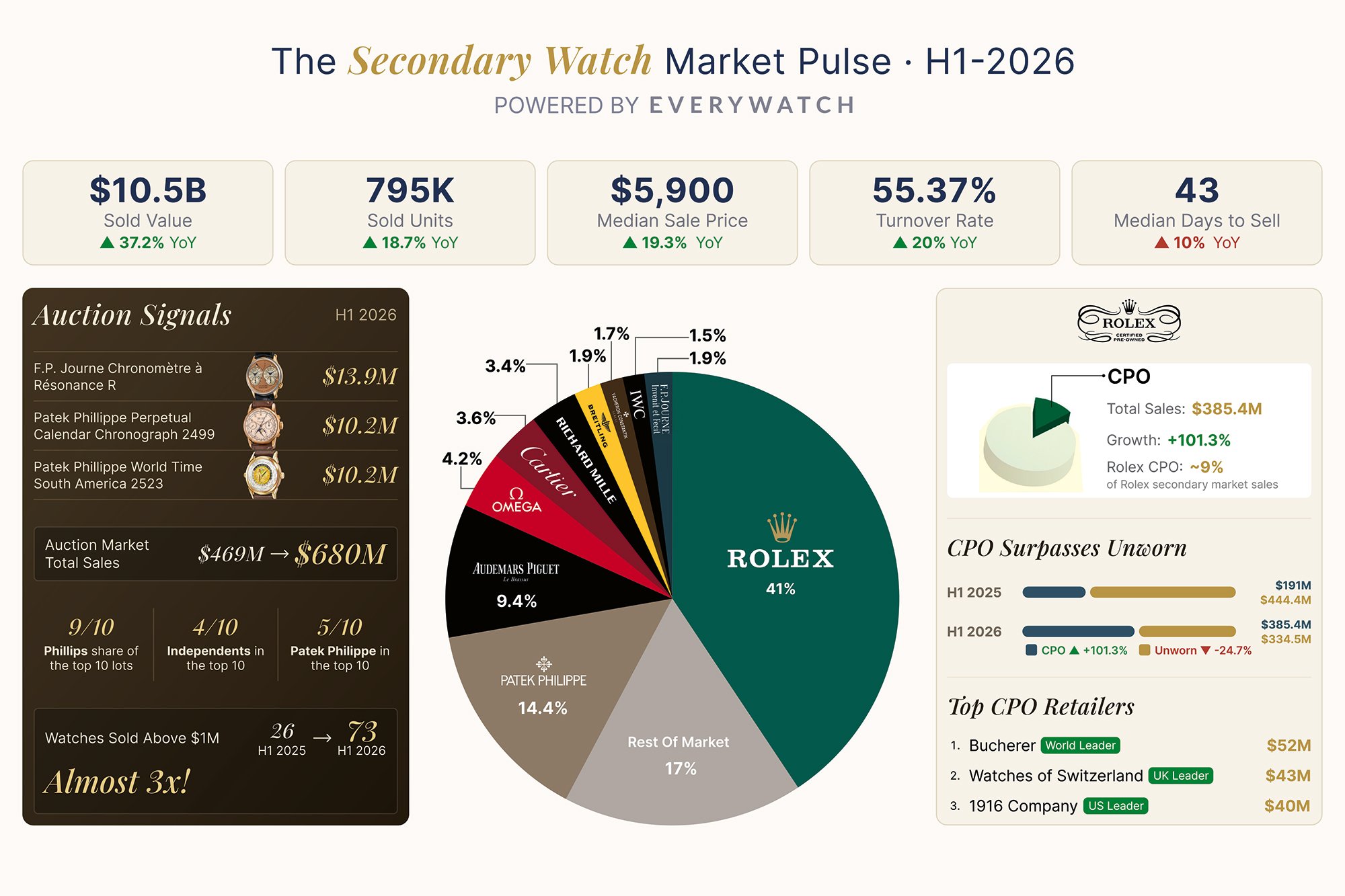
Its H1 2026 report describes a market gaining value faster than volume: transactions reached $10.5 billion in the first six months of the year, with growth increasingly concentrated around leading brands and higher-value watches. Independent watchmakers also made significant gains, although performance varied sharply between names.
Does this signal a sustained recovery, or a more selective market in which buyers are becoming increasingly discerning? Giovanni Prigigallo, Co-Founder of EveryWatch, discusses the figures with Europa Star, explains why liquidity matters more than headline records, and considers how brand-backed resale and better data could reshape the industry.

Europa Star: Your latest data points to a strong first half of 2026. What are your three main takeaways regarding the evolution of the secondary watch market?
Giovanni Prigigallo: First, the market got bigger and moved upmarket. Secondary transactions reached $10.5 billion, up 37%, but units grew only 18.7%, about half as fast as value. Collectors are trading up, not just buying more. Seven-figure auction lots nearly tripled, from 26 to 73.
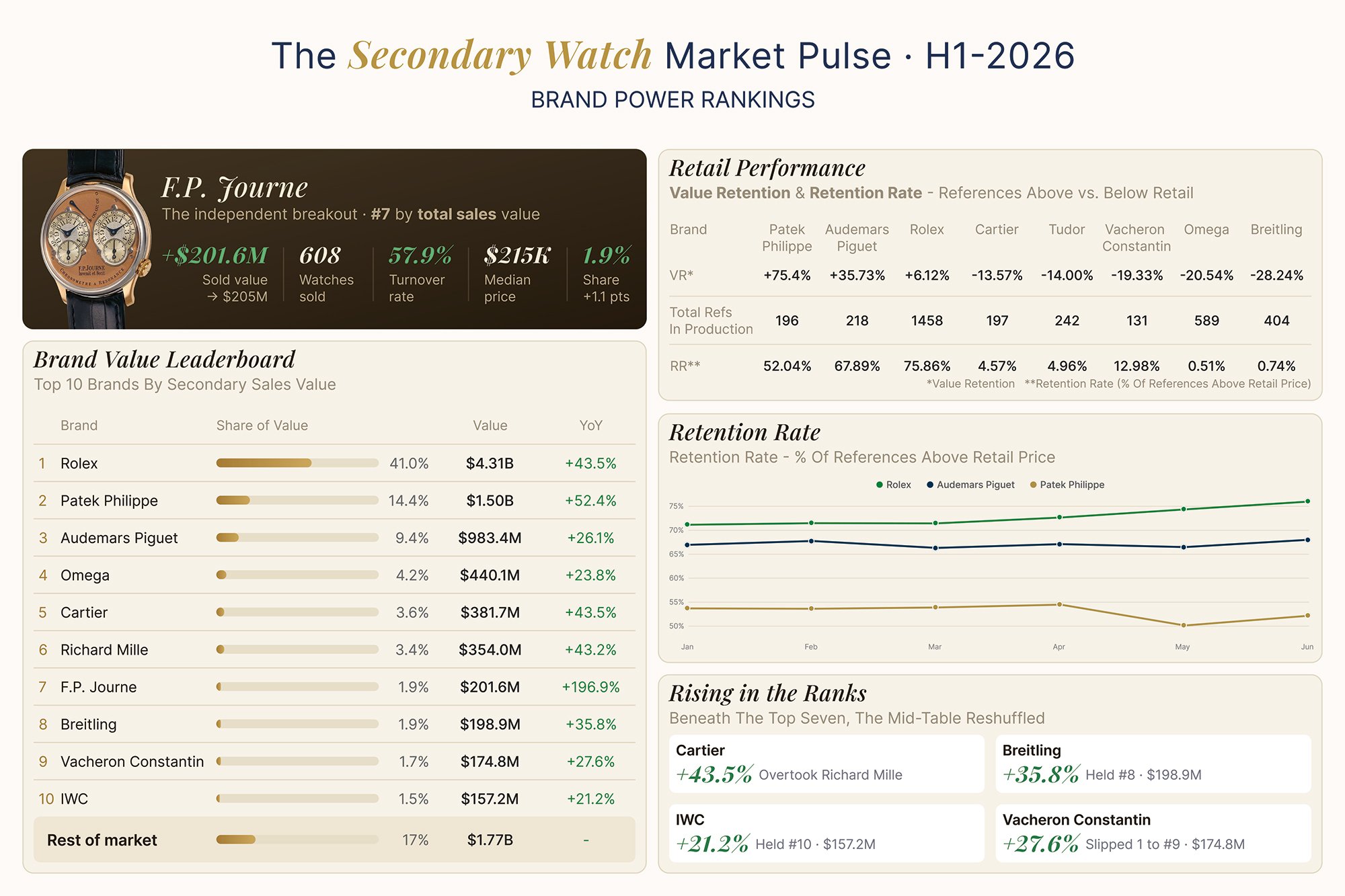
Second, the top is concentrating. The three largest brands now hold 65% of the market, up from 57% in full-year 2025, and the top ten hold 83%, up from 75%. Rolex alone is at 41%, with $4.3 billion and more than 227,000 watches sold.
Third, independents are where the energy is. As a category, they grew 89% to $633.8 million, which is more than LVMH’s entire watch portfolio on the secondary market, at $617 million.
Does this mark the beginning of a new growth cycle, or is caution still warranted?
Both. The growth rests on strong fundamentals. Almost half of everything listed sold, which is real liquidity, not a bubble. Buyers are paying for quality, and brand-backed channels like Rolex Certified Pre-Owned are adding trust.
But I would be lying if I said every signal was green. Median time to sell went from 39 to 43 days. That is a small change, but it is the metric I will watch most closely in H2.
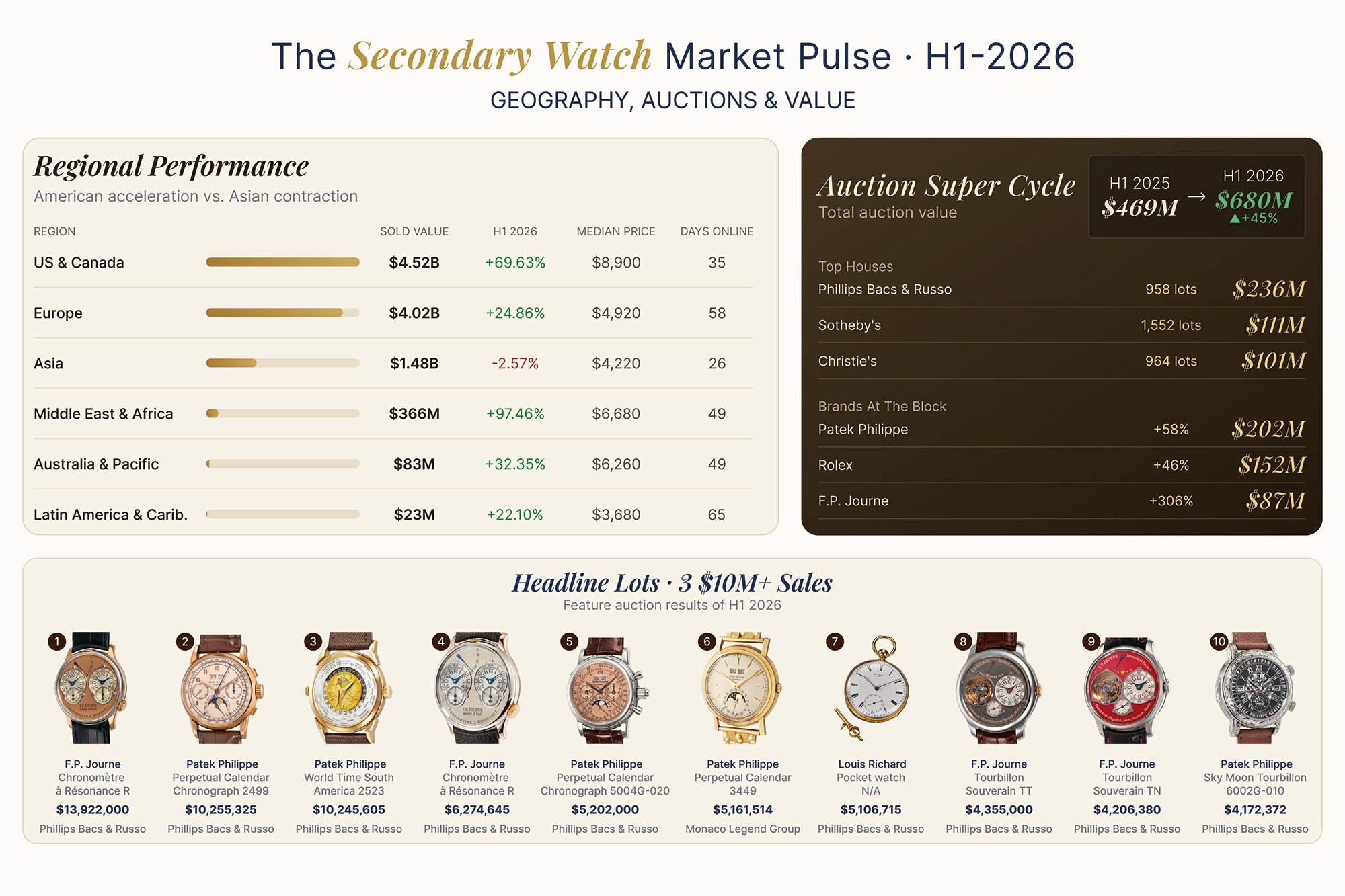
Growth is also uneven. Asia fell 2.6%, while the US and Canada grew almost 70% to $4.5 billion. And not every independent is winning: Franck Muller’s sales value fell 64.8%.
So yes, I would call this a new cycle, but a selective one. It rewards the right brands and references, and it punishes weak ones faster than before.
What is the one number from your latest data that every watch industry executive should be watching – and why?
$10 billion. That is where Rolex’s secondary-market sales are heading for full-year 2026 at the current pace, close to what Rolex itself turns over in Switzerland. For the first time, the secondary market for one brand is about as big as the primary business behind it.
The secondary market is outgrowing the primary market. Any executive who still treats pre-owned as a side channel is looking at the wrong side of the balance sheet.
Which watch reference best captures the market’s dynamics?
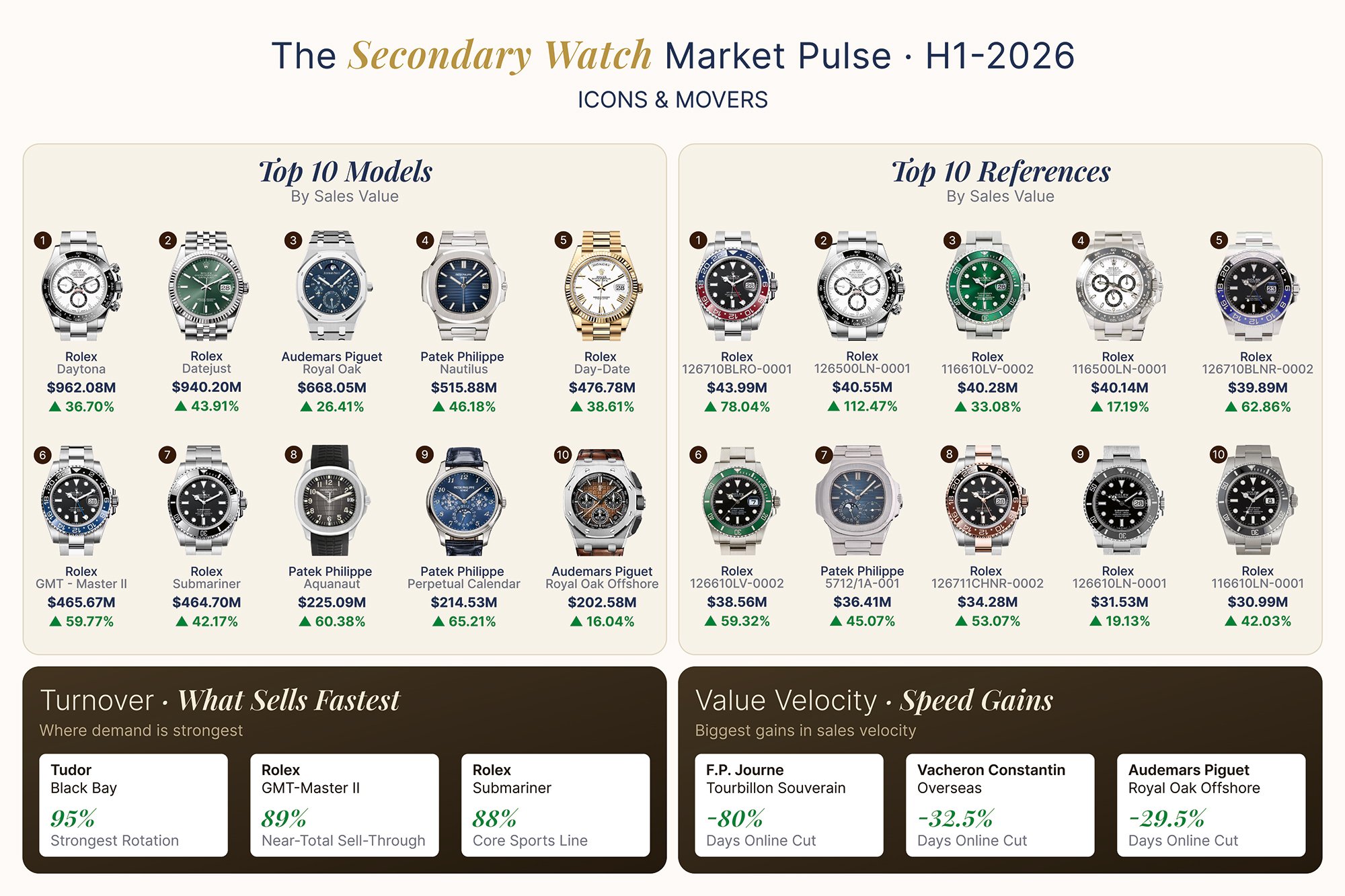
The Rolex GMT-Master II 126710BLRO, the “Pepsi” on a Jubilee bracelet. It was the top-selling individual reference at $43.99 million, up 78%, after dealers confirmed in February that it was being discontinued. It helped push the whole GMT-Master II collection up 60%, past the Submariner.
It shows that brand decisions made in Geneva now show up in secondary prices within weeks. If I could name a second watch for the top end, it would be the F.P. Journe Chronomètre à Résonance Souscription at $13.9 million.
You place considerable emphasis on liquidity. Why does it matter more than scarcity or price appreciation?
Scarcity is a story, and price is an opinion until someone pays it. Liquidity is proof. Our report is built on more than 795,000 watches that actually sold, not asking prices or forecasts.
A watch can be rare and still impossible to sell. Turnover and days to sell tell you whether demand is deep enough to absorb supply. Look at Tudor: 61.98% turnover, the highest among the top 30 brands. It is not a scarcity play, yet it is one of the healthiest brands in the market.
Now compare Franck Muller, where median days online rose 92% while value collapsed. Liquidity picked that up long before price did.
Is the rise of independent watchmakers a structural shift or another speculative cycle?
Mostly structural, with pockets of speculation. A new wave of collectors, many from tech, is falling in love with the craft and the nerdy detail behind it. With supply this scarce, it feels like the early days of a new asset class.
The data supports that. F.P. Journe sold only 608 watches for $201.6 million and ranked seventh among all brands, with turnover above 57% even as its median price rose 82% to $215,000.
What makes it structural is breadth. Ten years ago, only a few legacy names sold above $1 million. Today, that group includes Journe, Voutilainen, Rexhep Rexhepi/Akrivia and Dufour.
The speculative part is the long tail. Some names are riding the category label without the liquidity to justify it, and outside F.P. Journe, most independents still trade less liquidly than the big houses.
Which indicators do you personally look at first when assessing the secondary watch market’s health?
I start with turnover rate, then median days to sell, then the gap between value growth and volume growth. Records make headlines, but the $13,937 median Rolex sale across 227,106 watches tells you more about market health than a $13.9 million lot.
Next, I look at the premium versus retail across the whole catalogue, not only the sports models. Across 3,435 references, 75.86% of Rolex references trade above retail. That breadth matters more than any single hot reference.
Last, I look at which brands are losing liquidity. Declines show up there first.
What has Rolex Certified Pre-Owned achieved so far, and what does it tell us about the potential of brand-backed resale?
H1 2026 was the tipping point. Rolex CPO sales grew 101% to $385.4 million and overtook unworn Rolex sales, which fell to $334.5 million. A year earlier, unworn grey-market sales were $444 million against $191 million for CPO. That is a complete reversal.
It suggests CPO is draining supply from the grey market and supporting prices. Bucherer leads at $52 million, followed by Watches of Switzerland at $43 million and The 1916 Company at $40 million.
The broader lesson is that brand-backed certification turns directly into liquidity. If it keeps compounding, it will change how the whole secondary market prices trust. The brands that move early on CPO will be the winners.
What does the Swiss watch industry still misunderstand – or overlook – when interpreting secondary-market data?
Three things. First, it still treats the secondary market as a threat or as noise, when it is the most honest real-time signal of demand the industry has.
Second, it relies on narrow datasets. Value retention for Rolex, Audemars Piguet and Patek Philippe is materially higher than other sources report, because we cover more than five times as many references and much broader price data. For Patek Philippe, some of the best performers are hyper-complications that rarely trade and mostly sell at auction. Miss those and you misprice the brand.
Third, the industry looks at averages instead of distribution. Patek Philippe has the highest average premium at 75.4%, while Rolex’s average is only 6.1%. Yet Rolex has the broadest strength, with 75.86% of references above retail. Those are two very different stories, and a single average hides both.
Is your ambition for EveryWatch to become the “Bloomberg of the watch market”? How far along that path are you, and what remains to be built?
That is the direction. Market intelligence is the core, not a side product. We track more than 7.6 million listings from over 2,000 dealers and auction houses, with more than 35 years of market history. The H1 report alone covers 650 dealers and 472 auction houses.
Where we are today: we are the reference source the press uses. Our data is quoted by the Financial Times, The New York Times, Robb Report and GQ.
The next step is to become the tool the industry works from every day. That means brands, dealers, insurers and investors using our data for pricing, CPO strategy, portfolio valuation and decisions. Bloomberg did not win by publishing reports. It won by becoming infrastructure, and that is the goal.


