
 Español
 Français
 Pусский
 繁體中文
繁體中文 简体中文
简体中文 Select another language


hile some watches serve the simple, utilitarian purpose of telling time - most of mine, truth be told, are humble three-handers - the GMT complication stands apart. It isn’t merely about tracking hours, minutes, and seconds; it’s about the elegant interplay of distance, culture, and connection. The GMT may be the most diplomatic of complications - a bridge between cultures, continents, and conversations. Where most of my watches simply tell time, the GMT negotiates it. Its design alone commands admiration, but a GMT watch goes beyond that.
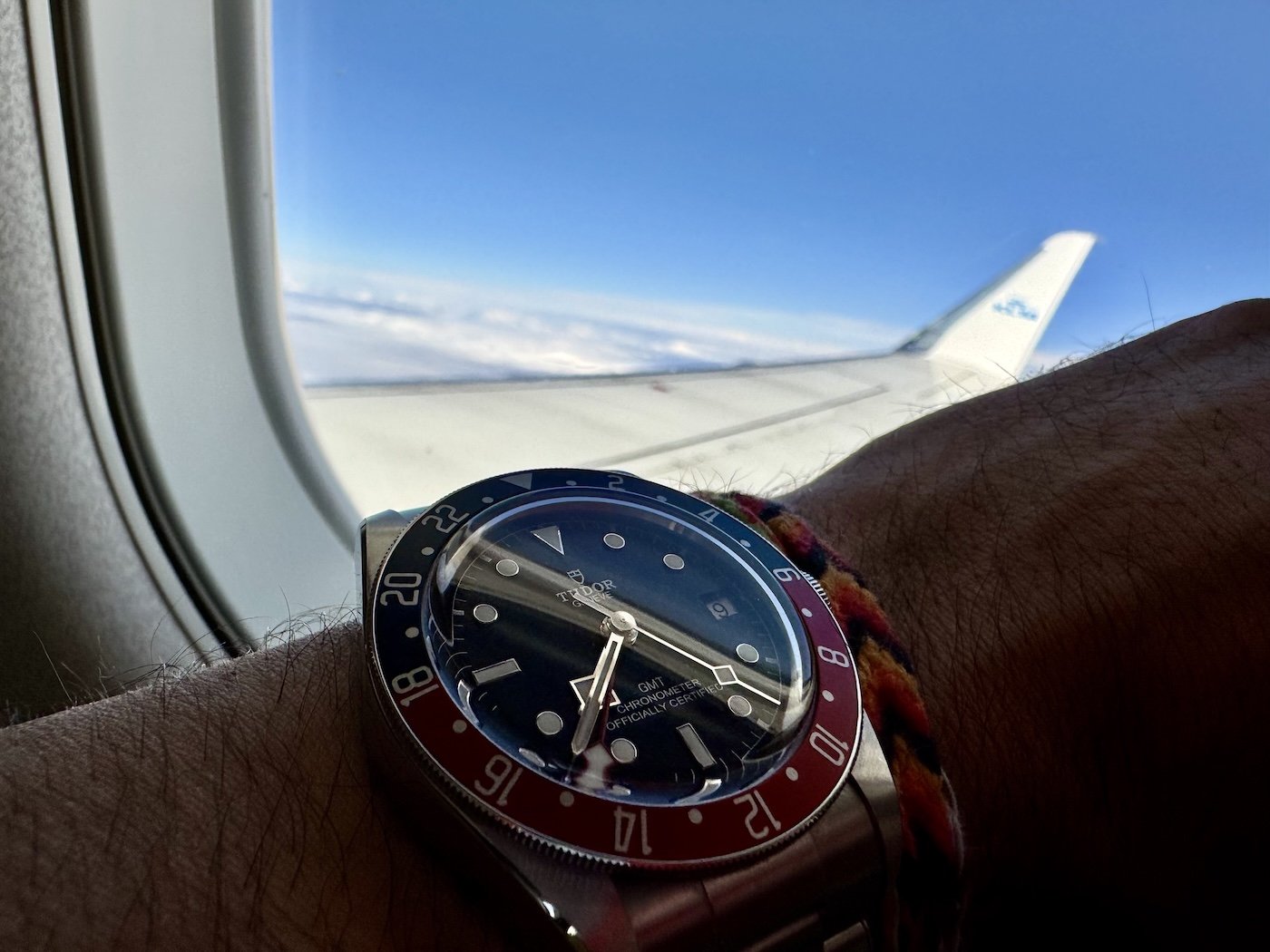
This affinity is evident in the watches I own, where the GMT holds a special place (and don’t get me started on world timers - that’s a story for another time). During a recent transatlantic trip, as I glanced at my Tudor Black Bay GMT - one of my trusted travel companions - I found myself asking a deceptively simple question: When is the right moment to change the time on a GMT while in transit? What began as a practical concern quickly evolved into a meditation on time, distance, and the subtle rituals of travel.

Within Europe, where most of my journeys are confined, a one- or two-hour difference renders this question more of an intellectual exercise than a logistical puzzle. But on this occasion, with a six-hour shift ahead and a critical appointment awaiting me upon landing, precision was no longer optional. Living in Switzerland has sharpened my sense of punctuality - every minute matters. A seemingly small question became the spark for these reflections, which I now commit to paper.
The GMT may be the most diplomatic of complications - a bridge between cultures, continents, and conversations. Where most of my watches simply tell time, the GMT negotiates it. Its design alone commands admiration, but a GMT watch goes beyond that.
A little time travel of its own
The story of the GMT complication is already legend (read more here). In the 1950s, when jet engines were shrinking oceans and turning nights into brief intermissions between destinations, PanAm pilots found themselves with a modern problem: the world was moving faster, and their watches needed to keep up. Rolex, in true Rolex fashion, rose to the challenge with the GMT-Master.
That red-and-blue bezel wasn’t just eye-catching - it was functional. It separated day from night at a glance, a neat trick when your dawn might be someone else’s midnight. A sturdy watch of steel and glass became a kind of compass for a world in motion - a tool for those crossing time zones not only physically, but mentally, and sometimes even spiritually. The GMT complication offered reassurance, clarity, and calm - not only to pilots and controllers, but to travelers like me.
But its foundation is older still. Long before jetliners, there was Zulu Time - today known as UTC, and once upon a time as Greenwich Mean Time. In the 1920s, the British Royal Navy needed a single, unshakable reference. Greenwich became that fixed point, and from there the world synchronized its skies and seas.

Zulu Time doesn’t bend to borders or daylight savings. It doesn’t care if it’s sunrise in Geneva or midnight in Mexico City. It simply is - a single, steady rhythm. Behind the scenes, every flight plan, every air traffic handoff, every calculation beats to that rhythm. So, when a pilot says “1700 Zulu”, it isn’t just a timestamp. It’s a quiet reminder that, however fragmented the world may seem, it can move in harmony.
And that, to me, is what makes the GMT complication so compelling. It’s not about showing off clever mechanics. It’s about that subtle reassurance: no matter where you are - or how far you’ve gone - there’s a small piece of time on your wrist keeping everything - and everyone - connected.
When is the right moment to change the time on a GMT while in transit? What began as a practical concern quickly evolved into a meditation on time, distance, and the subtle rituals of travel.
GMT for the rest of us
And yet, the GMT complication never belonged exclusively to cockpits. It slipped out long ago. Diplomats embraced it, as did journalists chasing deadlines across continents, musicians moving between hemispheres, and film stars living in a state of permanent transit. Time zones are political by nature, as pretty much everything is. They represent compromise, assertion, even ideology—drawn not just across maps, but across lives. A GMT hand quietly acknowledges this, negotiating not just hours but histories.
What began as twenty-four neatly drawn segments of the globe has since become a far messier cartography: India with its half-hour, Nepal with its quarter-hour, and China insisting on one official time across five zones. The result? Thirty-eight distinct time zones - a reminder that order is constantly negotiated, never absolute.
And perhaps that is why, for someone working in diplomacy, the GMT complication feels like diplomacy itself on the wrist. Not quite a War Room lined with thirty-eight synchronized clocks, but close enough - a small, elegant embodiment of a world that refuses to tick in perfect unison. To glance at a GMT hand is to acknowledge that order and disorder coexist on the same dial. It’s Casablanca in miniature: one world insists on structure, the other seeps through in shadows.
The complication mirrors this duality. There’s the GMT flyer (I’ve never liked calling it “true GMT”—they’re all true!), where the local hour hand jumps independently - a gift to the perpetual traveler. And then there’s the caller GMT, where the GMT hand adjusts instead - perfect for those tethered to faraway boardrooms or loved ones, but firmly grounded. It’s the difference between the diplomat posted abroad and the one holding the fort at home - two roles, equally essential, each telling its own story.
Zulu Time doesn’t bend to borders or daylight savings. It doesn’t care if it’s sunrise in Geneva or midnight in Mexico City. It simply is - a single, steady rhythm. Behind the scenes, every flight plan, every air traffic handoff, every calculation beats to that rhythm.

My steel companion
The Tudor Black Bay GMT was among my first acquisitions after diving seriously into the world of horology. I picked it up just a few hours before a transatlantic flight, to be used as those PanAm pilots intended it - a way to mark a modest milestone (as I tend to justify most of my acquisitions). Back then, I was learning the language of horology - and the GMT felt like a new dialect to master. I did what any newcomer might do: adjusted the hands to match the time zones that mattered to me, without yet understanding how much more this watch could offer.
I remember first seeing it in A Week on the Wrist with James Stacey, gallivanting through San Francisco. It clicked instantly - this would be my travel watch. It wasn’t about specs or status. It simply made sense - for the kind of travel I do, and the type of traveler I am.
The Black Bay GMT doesn’t apologize for its presence. Yes, it’s thick. No, it doesn’t try to hide that fact. It sits tall on the wrist - confident, almost defiant. “I’m built for purpose, not pretense”, it seems to say. Yet somehow, its bulk is never brutish. There’s a vintage elegance in its lines, an aesthetic nod to a time when watches didn’t need to shout. They whispered - quietly, assuredly - and still made their point.
True, it may be due for a refresh. Everything is, eventually. But the GMT still delivers with that unmistakable Tudor solidity. It doesn’t chase attention, but earns it - silently, consistently. Those who know, notice. And when you’d rather go unnoticed - slipping through airport terminals or dimly lit city streets - it accommodates that too. Once or twice, it’s even been mistaken for its more famous sibling, which always gives me a quiet chuckle.
As our friends at Watches of Espionage like to say, a watch is never just a watch. It’s a tool - a measure not just of time, but of presence, discretion, and intent. The Black Bay GMT, in all its steel-clad humility, remains precisely that: a tool. One that reminds me to move with purpose, to stay grounded, and to always, always know what time it is—wherever I may be.
The Black Bay GMT doesn’t apologize for its presence. Yes, it’s thick. No, it doesn’t try to hide that fact. It sits tall on the wrist - confident, almost defiant. “I’m built for purpose, not pretense”, it seems to say.

The question of when
And then comes the great philosophical question - one that seasoned travelers quietly wrestle with at every gate: When do you set the local time on your GMT? It sounds trivial, but it’s anything but. Do you adjust the local time the moment you step onto the first flight, surrendering early to London time and, in essence, slipping into the future? It’s a neat trick: you stay in sync with where you’re headed and minimize the risk of missing that precious connection.
Or perhaps you hold out until the second leg, stubbornly keeping home time - Geneva, in my case - on your wrist. A quiet act of temporal defiance, refusing to leave before you’ve actually gone. Romantic (I have been accused of it one too many times), certainly, but not without risk. Still, that’s what the reference hand is for: keeping track of the people you’ve left behind without accidentally waking them in the middle of the night.
Then there’s the third option: the in-flight choreography. You change the time at every leg, turning the act into a ritual. After accounting for the time difference on the first hop, you reset your watch on the long haul in a small, almost ceremonial gesture - a last bow to home, a symbolic crossing of an invisible line. It’s less about precision (Zulu time will handle that) and more about declaring, “Yes, the journey has begun”. Your mind starts adjusting long before your feet touch the ground.
Or, of course, you can do nothing - wait until you land. Living in the moment has its charms, but it comes at a price: your body may lag, your mind may resist, and you risk arriving physically present but not yet there.
Each choice has its champions. Early adjustment smooths rhythms but risks confusion. Late adjustment preserves clarity but prolongs disorientation. It’s not unlike the dilemmas of statecraft: whether to negotiate preemptively or wait until the facts are fixed. The GMT watch doesn’t solve this; it frames it - a quiet question whispered from your wrist: Where do you belong right now? Our relationship with time has always played out not only on the wrist, but across every medium where we seek meaning.
Cinema has long played with this tension. Alain Delon in La Piscine (1969) lounges in a timeless haze, seemingly unbound by any clock, though the world ticks somewhere beyond the frame. George Clooney in Up in the Air (2009), by contrast, lives by departure boards and layovers, his identity scattered across time zones. The GMT complication suits both lives: one dreamy and detached, the other precise and itinerant. Think too of Before Sunrise (1995), where time becomes both a limit and a liberation - two strangers racing the clock even as they lose themselves in the moment. Or The Man Who Fell to Earth (1976), where Bowie - himself a time traveler of sorts - drifts through a world out of sync with his own internal orbit.
Music, too, plays in this register. Thelonious Monk’s “Straight, No Chaser” bends time but never breaks it, just as the GMT hand cuts a clean trajectory while the hour hand dances around it. Bowie in “Time” reminds us of both time’s tyranny and its elasticity. Miles Davis’ album “In a Silent Way” offers a kind of temporal ambiguity - fluid, echoing, almost suspended - while Philip Glass builds structure through repetition, showing that even minimal changes over time can feel monumental. A GMT watch embodies that duality - strict yet forgiving, structured yet improvisational, depending entirely on how you live with it.
And in literature, time has always been more than just chronology. Proust collapses years into a single taste of madeleine and tea. Virginia Woolf’s “Mrs Dalloway” compresses lifetimes into a single day, the chiming of Big Ben marking moments both ordinary and profound. Borges, ever the cartographer of the infinite, turns time into a labyrinth - one where every moment branches into endless possibilities. The GMT hand, in its quiet rotation, speaks this same language: linear on the surface, infinite underneath.
A GMT doesn’t just tell you the time. It asks the only question that matters: Where are you now - and where are you going?
A GMT doesn’t just tell you the time. It asks the only question that matters: Where are you now - and where are you going?
The usual suspects
And then there are the watches themselves - the characters on this stage.
The Rolex GMT-Master II, heir to the original jet-age archetype, still defines the category: equal parts glamour and utility, with perhaps more parts glamour as of late. It is the diplomat of the group - capable, composed, and quietly confident that history is on its side.
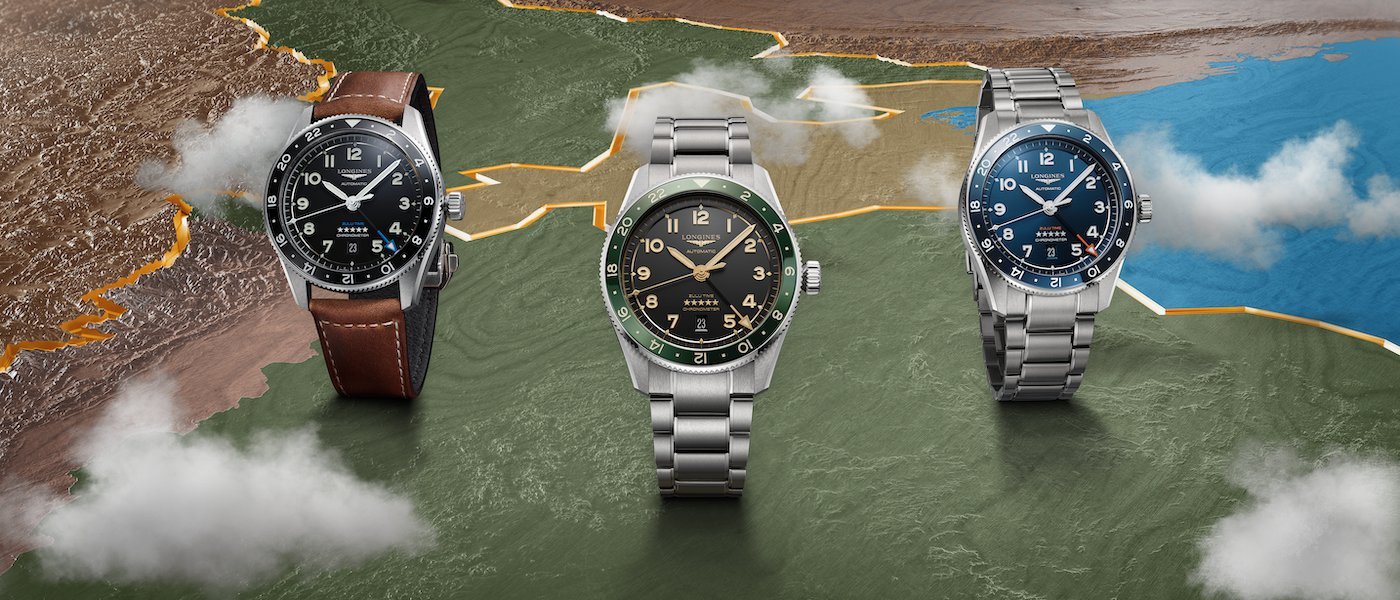
The Longines Zulu Time, one of the newest entries into the canon, brings a refined, almost scholarly sensibility to the GMT arena, with nods aplenty. Less brash, more conversational, it feels like the watch of someone who prefers to observe first and act later. It carries its heritage lightly but sincerely - evidence that Longines hasn’t forgotten how to balance precision with poetry.
And then, the Grand Seiko GMT from the Elegance Collection, favoured by the wunderkind Shohei Ohtani - a beautiful, inspired choice for those who understand subtlety. Its proportions whisper refinement, its finish speaks in the soft dialect of Japanese craftsmanship. It stands, not as a statement, but as punctuation - necessary, considered, and perfectly placed.

Finally, something a little different, one from the holy trinity - the Vacheron Constantin Overseas Dual Time. Over two generations, it has quietly carved a place for itself, perfectly embodying what the Overseas should be: elegant, assured, and precise. The complication feels natural, inevitable, as though tracking two time zones were its birthright. And while the three-hander is beautiful in its simplicity, the Dual Time feels complete - purposeful, worldly, precisely as the name suggests. Each of these watches is more than a tool; they are worldviews rendered in steel, titanium, (some gold?), and intention.

Between here and there
To wear a GMT watch is to make a quiet, deliberate statement. It signals a life straddling borders - not confined to one place, one rhythm, one clock. It’s the horological equivalent of a diplomatic passport: at once at home and abroad, anchored and untethered. The question of when to set the time - before, during, or after the flight - becomes less about practicality and more about belonging. It reveals where your heart chooses to be: in the place you’ve left, the one you’re heading to, or somewhere in the weightless in-between.
Perhaps that is why the complication endures long after technology rendered it unnecessary. Phones will tell you the time anywhere, but they won’t tell you where you are in it. A GMT watch is less a device than a perspective - a way of inhabiting the world with intent. It acknowledges that most of us live not in a single time zone, but across several, in fragments and echoes, in departures and returns.
To glance at that extra hand is to recognize the delicate choreography of a life lived in translation. You are both here and elsewhere, present and already gone - a diplomat of your own shifting hours. And perhaps that is why, for me, the in-flight choreography feels like the only fitting choice. It mirrors the life I lead: always in motion, always negotiating between places, languages, and time zones.
And so, the GMT remains. Not merely a watch, but a philosophy. Not a tool, but a quiet companion. A steady heartbeat on the wrist, reminding us that time is not a cage but a current. And identity - like diplomacy, like music, like cinema - doesn’t live at the destination. It lives in the movement, between here and there.
A steady heartbeat on the wrist, reminding us that time is not a cage but a current.