V
an Cleef & Arpels is a brand apart within the
Richemont Group. Like the Cartier “flagship vessel”,
it is not placed under the direct supervision of
the group’s watchmaking boss, Jérôme Lambert. Its
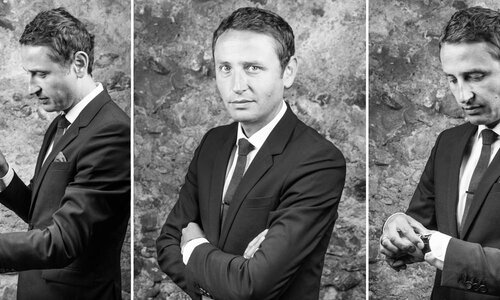
CEO, Nicolas Bos, has the particularity of assuming
both the operational and artistic management of
the brand. And its many years in the jewellery business
mean that it has been outrageously successful,
whereas Richemont’s watchmaking business has
been severely impacted during the past three years
by the Chinese crisis. Moreover, its managerial stability
stands out in a group that is in the throes of
restructuring.
Founded in 1906 and acquired by Richemont in 1999,
the Paris-based company specialised early in a niche
market that has been much copied ever since: that of
poetic complications, mainly for women. It also has
the unique feature of selling its jewellery and watch
designs only in its own boutiques (of which it has over
120). According to estimates by the bank Vontobel,
Van Cleef & Arpels’ turnover approaches the one-billion
Swiss franc mark, which would make it the second
most profitable brand after Cartier.
Production-wise, its flagship collection is incontestably
the Alhambra. But the highlight of the watchmaking
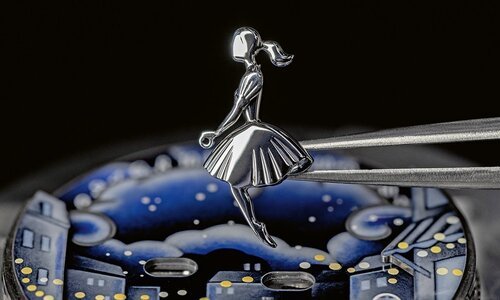
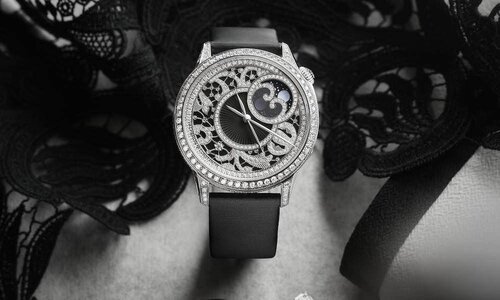
show at the last SIHH was, of course, the new Lady
Arpels Planetarium, a conversation piece developed in
collaboration with the independent brand, Christiaan
van der Klaauw. And that is another point that sets it
apart from its fellow companies at Richemont, who are
very reluctant to reveal the names of their partners:
whether it be van der Klaauw, Jean-Marc Wiederrecht
or François Junod, Van Cleef & Arpels makes no mystery
about its collaborators – although the same cannot
be said of its business results!
“For more than a century, the company has expressed
itself first and foremost through its jewellery, with a
vast abundance of creative designs. Jewellery gave us
the chance to explore a large number of fields of expression,
such as nature, dance, poetry and theatre.
It’s from these fields that we draw the philosophy that
corresponds to us, centred on positive values, such as
childhood, naivety, innocence. Today, that corresponds
both to our jewellery and watch creations,” sums up a
serene Nicolas Bos. Europa Star went to meet him.
A number of jewellery companies have made forays
into watchmaking, but have not stayed, or just
maintain that business at a minimum. As a jeweller,
how do you establish yourself in the watchmaking
business for the long term?
Watchmaking is still quite a technical, rather masculine
world. It’s an engineer’s world first and foremost.
Our vision of time is rather unusual. It’s more narrative,
more feminine, geared to the rhythm of nature
and not to measuring performance, chronographs being
the most extreme example of that. Our colleagues
do that very well already!
Via luxury jewellery watches we’ve developed a philosophy
that exploits the potential of mechanical movements
to design poetic complications. Watchmaking
is to jewellery what cinema is to photography: it sets
it in motion! Our vision is very simple: we don’t start
with the technical or mechanical side, but with the narrative.
For example, we unashamedly show the very “demonstrative”
side of the automata. It’s poetry, but it’s
not restricting.
«Watchmaking
is to jewellery what cinema is to photography: it sets
it in motion!»
The brands of the Richemont Group have vertically
integrated their production to a large degree
in recent years. But in your watchmaking business
you’ve done the opposite and struck up numerous
partnerships with other companies…
It’s true that, since ours is essentially a jewellery-making
culture, we haven’t systematically integrated watchmaking
know-how. Instead, we brought together the
most competent figures in the watchmaking world
and got them to work with our Paris-based jewellers.
The idea was first of all to design the cases around existing
movements.
But in fact Van Cleef & Arpels has often co-produced
watches in the past. With Universal, for example. Our
company has always sought out the best movements
so as to affiliate them with our design expertise. That
also explains our philosophy of promoting the watchmakers
who work with us, whether it’s other brands
like Jaeger-LeCoultre or Piaget, or independent watchmakers
like Jean-Marc Wiedderrecht. For our customers,
it’s reassuring.
We made this strategic choice because our watch
products are part and parcel of our jewellery offering.
Also, our watches are highly specific products, which
isn’t necessarily easy to explain. We’re still an atypical
brand. For example, we tried out an interesting experiment
one day with the Chronopassion boutique
in Paris. It’s geared much more to the technical aspects
than us, but in the end the customers came to buy the
products from us... I don’t think our watch range is traditional
enough to do “wholesale”.



 Español
 Français
 Pусский
 繁體中文
 简体中文
 Select another language