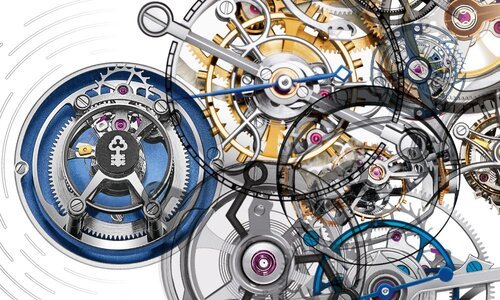
In conventional watchmaking, skeletonising a watch’s movement
was a rare speciality practised by a handful of master watchmakers.
It was a balancing act that consisted of removing as much
material as possible, yet without detriment to the rigidity and
toughness of the components, now visible and exposed.
In conventional watchmaking, skeletonising a watch’s movement
was a rare speciality practised by a handful of master watchmakers.
It was a balancing act that consisted of removing as much
material as possible, yet without detriment to the rigidity and
toughness of the components, now visible and exposed.
W
e owe their introduction to the watchmaker André-Charles Caron
who, around 1760, was the first to unveil the “secrets” of how a
movement functioned. Inspired by the Encyclopaedist current of
thought, the public hurried en masse to his workshop to discover
what lurked beneath the science and art of watchmaking.
A "science” that has now been overtaken in its primary function
of providing the most exact time possible, mechanical horology
is seeking to maintain its artistic pre-eminence by revealing its
fascinating internal organs as far as possible. The big difference is
that today, the idea is not so much to expose an existing movement
as it is to design from scratch a movement destined to be exposed.
The caseback, exterior – or what is left of it – and movement are
therefore designed in tandem to form one inseparable whole.
So today, “skeletonisation” has little meaning. It would be more accurate
to speak of three-dimensional sculpture.
Today, “skeletonisation” has little meaning. It would be more accurate
to speak of three-dimensional sculpture.
The movement’s architecture is now the decoration in itself. There is no more “flesh” to be removed, only “bones” to be assembled. Might this be one of the principal means by which mechanical watches can continue to attract? The number
of watchmakers who practise it would seem to prove just that.
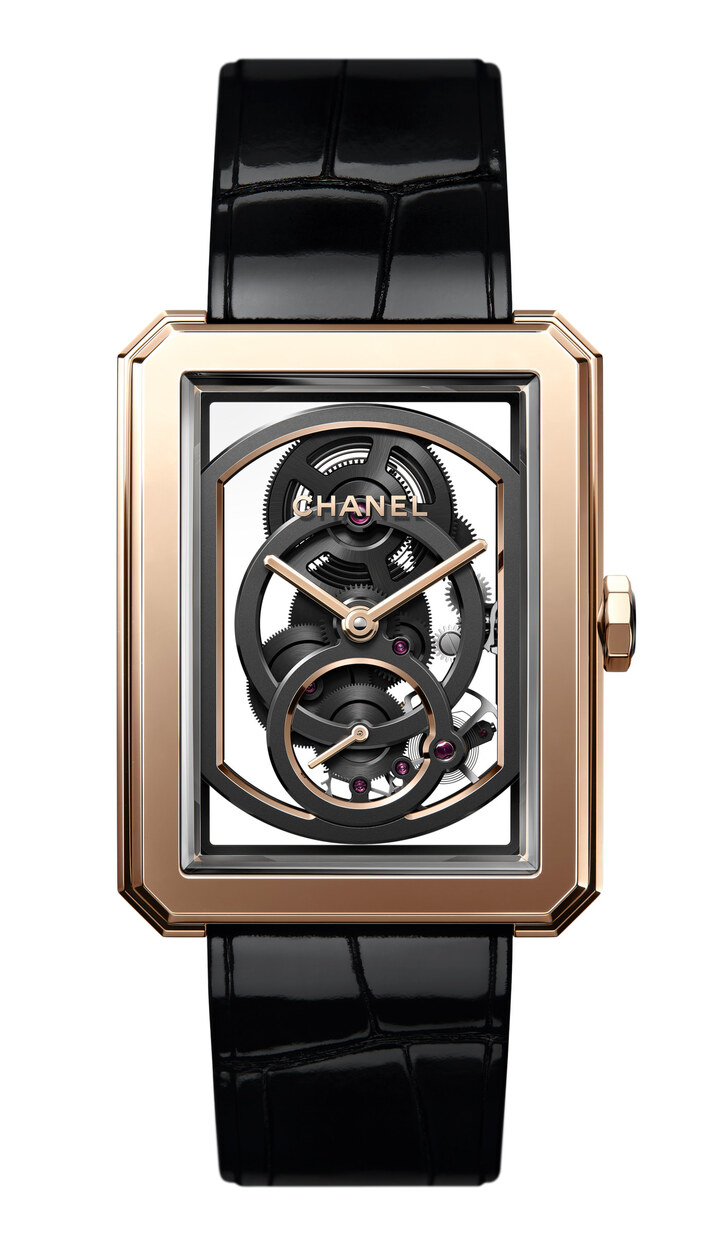
CHANEL BOY-FRIEND SKELETON
The in-house Calibre 3 equipping this watch was specifically
conceived and designed not only to fit into the case of the
Boy•Friend, but to constitute its entire "décor“. Here, the function,
form and arrangement of the different components are
placed entirely at the service of the aesthetics. The movement
is part and parcel of its own case. A skeleton like this cannot be
anything but unique. From 20,000 to 50,000$
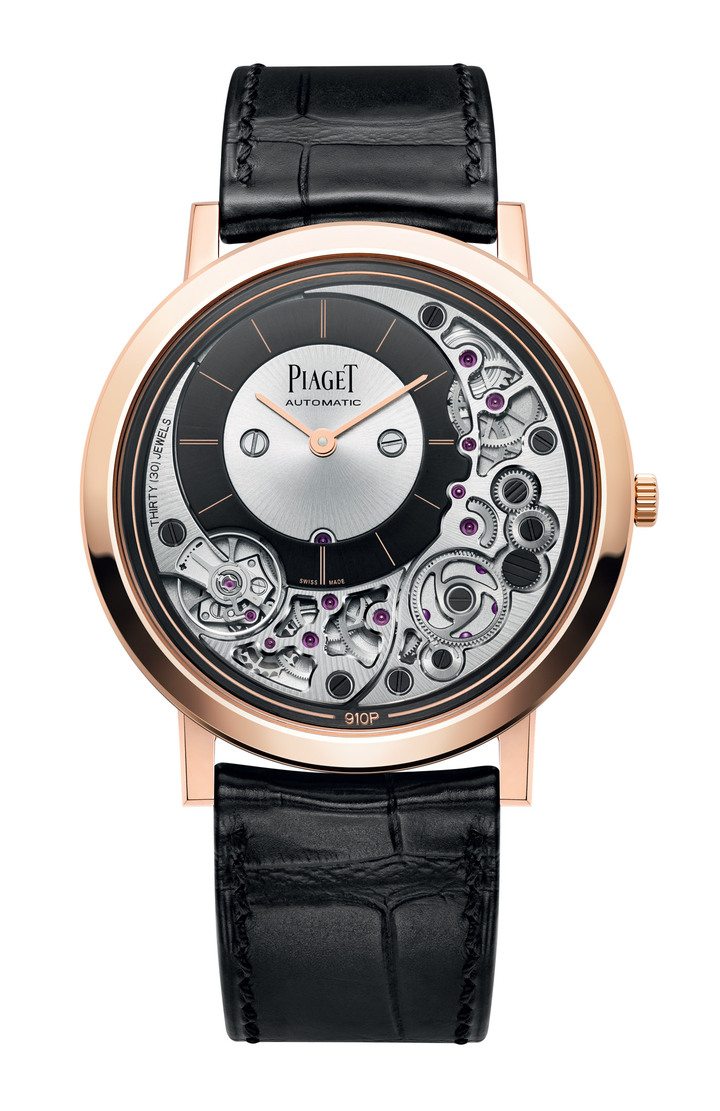
PIAGET ALTIPLANO ULTIMATE AUTOMATIC
Just 4.3mm thick, this watch is one of the best illustrations of
the fusion of movement and exterior design. To achieve this
extreme thinness, the movement and case form a single piece,
the latter serving as the base plate to which the 219 ultra-fine
components are fixed. The result is avant-garde, reverse-engineered
architecture in which aesthetics and technique are an
integral part of one another. From 20,000 to 50,000$
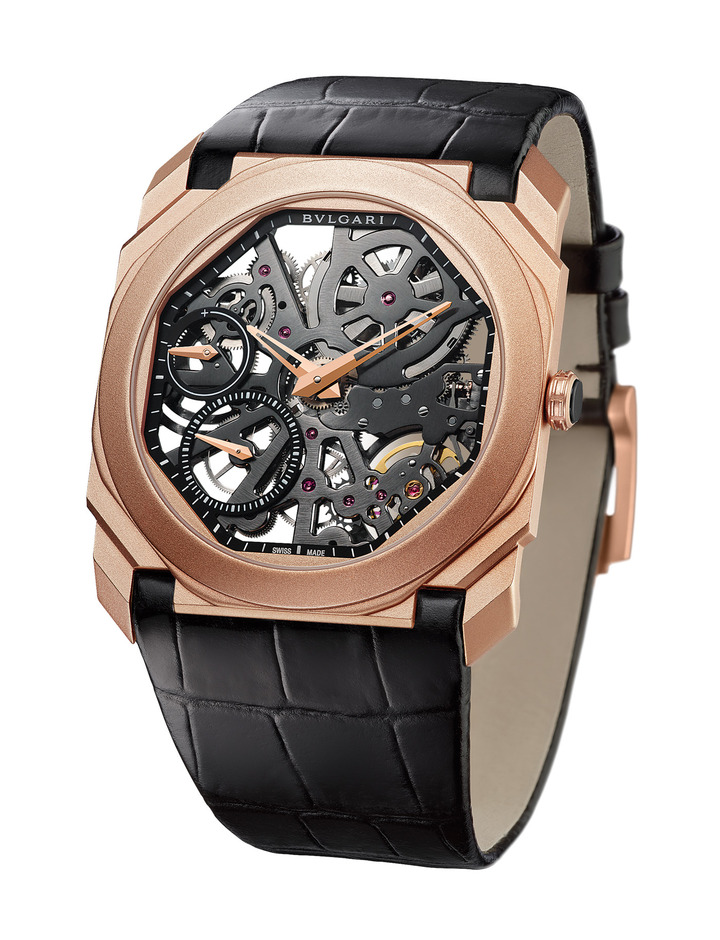
BULGARI OCTO FINISSIMO SKELETON SANDBLASTED
Every component of the BVL 128SK manufacture calibre has
been chiselled away to leave a kind of mechanical web set in
an Octo case in sandblasted pink gold. Just 2.35mm thick, this
mechanical movement also has a small-seconds dial and a 65-
hour power reserve indicator.
Even stripped naked, the Octo looks good.
From 20,000 to 50,000$
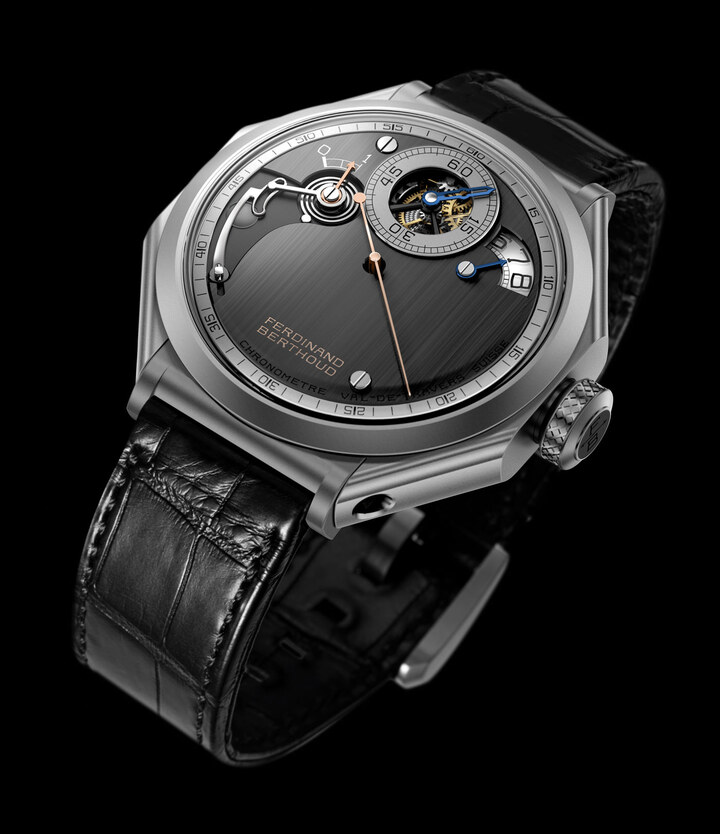
CHRONOMÉTRIE FERDINAND BERTHOUD - CHRONOMÈTRE FB-1R.6-1
Inspired by marine chronometers, driven by a fusee-and-chain
mechanism, this regulator features an original display of each
function, split over the dial. Hours are displayed in an arched
window at 2 o’clock, and minutes are shown in a subdial at
12 o’clock. A complicated power reserve display dominates an
opening in the space between 8 o’clock and 10 o’clock on the
dial. The seconds are directly linked to the 60-second tourbillon,
which is featured on the caseback side, along with the
mobile-cone power reserve system.
From 200,000 to 500,000$
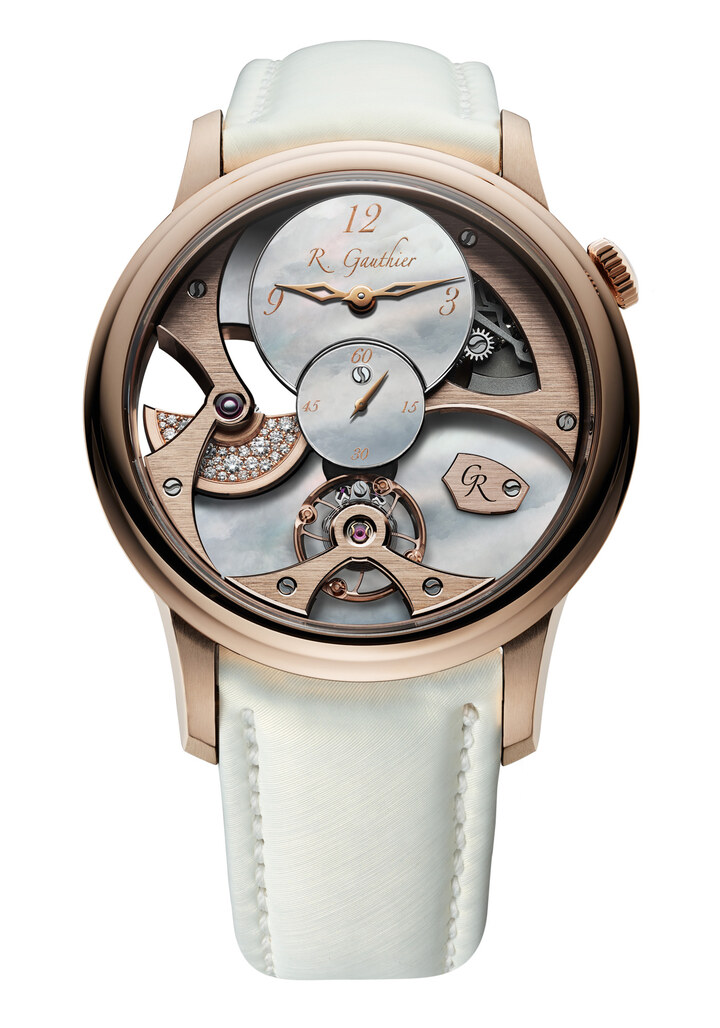
ROMAIN GAUTHIER INSIGHT MICRO-ROTOR LADY
With its highly visible, intricately engineered, automatic movement
featuring a snow-set micro-rotor and a gently shimmering
mother-of-pearl dial, the Insight Micro-Rotor Lady – Romain
Gauthier’s first ladies’ watch – "is for those women who want
their timepieces blessed with more than just a pretty face", explains
the watchmaker. The movement’s spectacular decoration
includes handcrafted and hand-polished bevels, snailing,
straight-graining, circular-graining and hand-frosting, as well
as handcrafted and hand-polished jewel countersinks.
From 50,000 to 100,000$
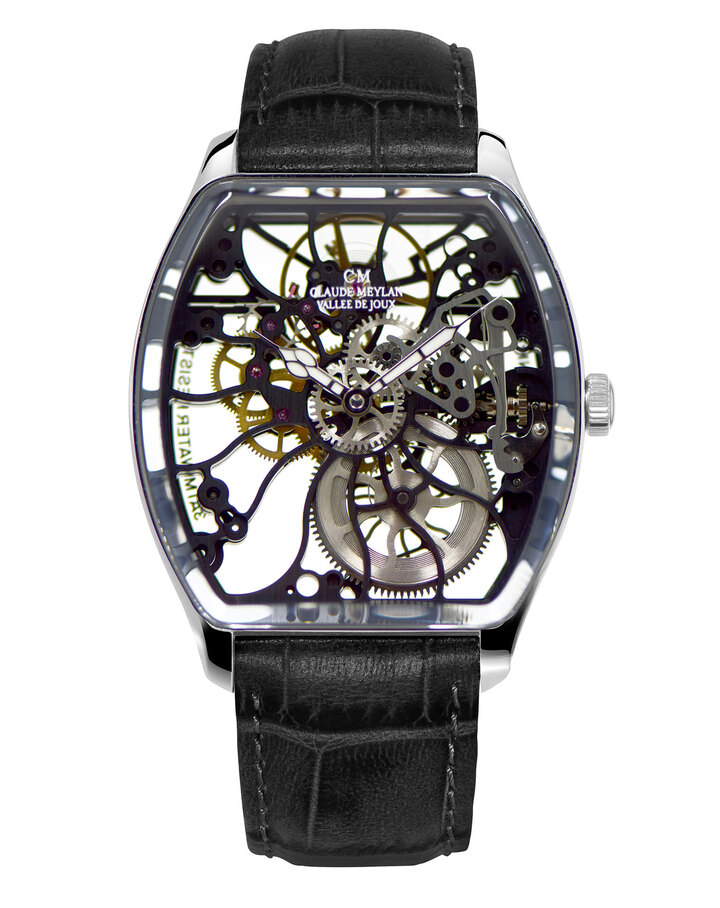
CLAUDE MEYLAN TORTUE BLACK
Born into a family of master watchmakers in the Joux Valley,
Claude Meylan defines himself as a “sculptor of time” who “undresses”
all the parts of the movement and constantly seeks to
“push the art of skeletonisation to new horizons”. Witness this
Tortue Black of rare elegance and great finesse.
From 5,000 to 10,000$
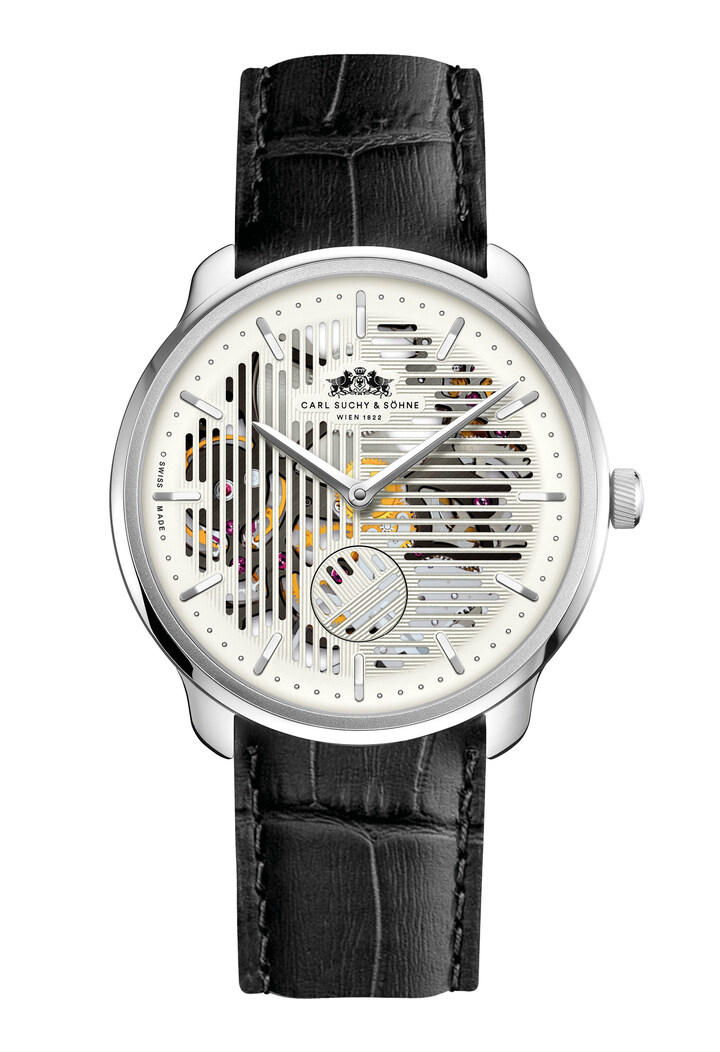
CARL SUCHY & SÖHNE THE WALTZ NO 1 SKELETON
The Waltz N°1 is equipped with the ultra-thin automatic movement
VMF 5401/180 designed and produced by Vaucher
Manufacture Fleurier. It has been modified by Zurich-based
watchmaker Marc Jenni - a former member of the Académie
Horlogère des Créateurs Indépendants (AHCI) - to fit a rotating
seconds disc at 6 o’clock with a striped pattern that aligns
with that of the dial once a minute. In this semi-transparent
version, the movement is seen through the openworked dial as
if through an Art Nouveau “mashrabiya”. From 10,000 to 20,000$
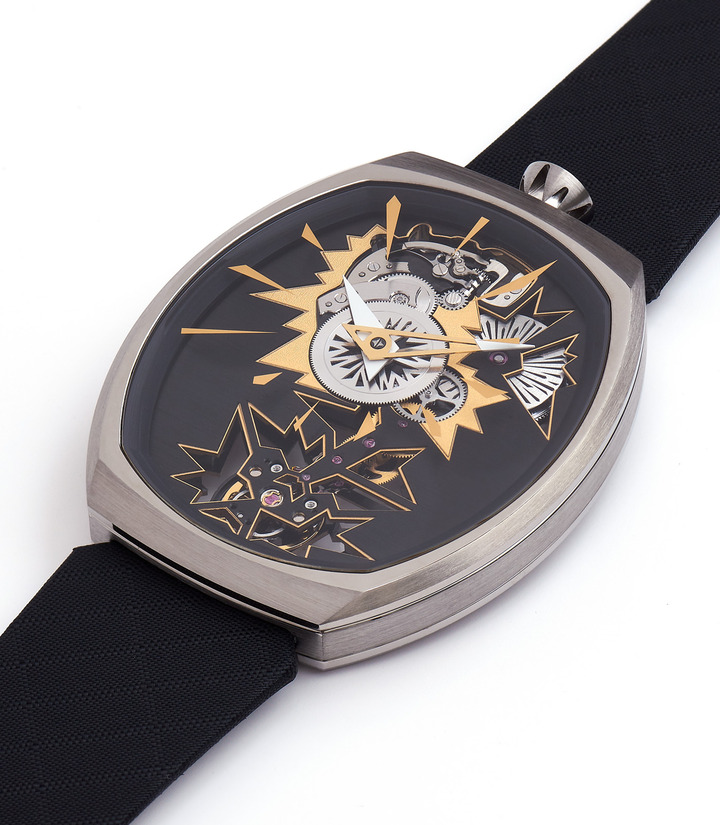
FIONA KRÜGER CHAOS MECHANICAL ENTROPY
“Time always advances towards the random, disorder and chaos”
is a favourite saying of Fiona Krüger, known for her famous
Skulls. Here, she seeks to express the notion of chaos and entropy
in the very design of the movement, which is subjected
to an “explosion” that seems to blow it apart. The gear train is
stretched across the entire length of the movement, the broken
hour and minute wheels are off-centre and the apparently
shattered barrel mainspring can be seen in the upper righthand
corner through a seemingly ravaged plate and bridges.
From 20,000 to 50,000$
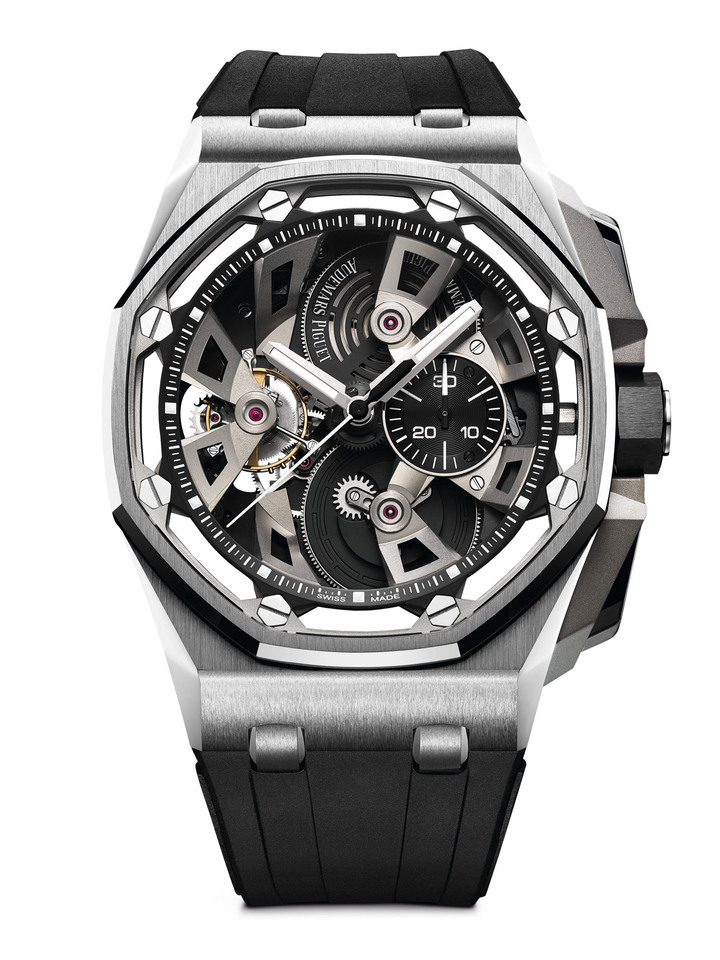
AUDEMARS PIGUET ROYAL OAK OFFSHORE TOURBILLON CHRONOGRAPH 25TH ANNIVERSARY
Openworked and distinctive, this Royal Oak Offshore would
hardly be recognisable as part of the family were it not for
its octagonal shape. The watch offers a view of the tourbillon
at 9 o’clock, a 30-minute counter at 3 o’clock, and two mainspring
barrels that offer the most substance to the watch’s
skeletonised foundation. Rather than metal and rubber, the
pushers and crown are now made from ceramic. The watches
are available in either 18k rose gold or stainless steel, each
limited to 50 pieces, and are powered by the hand-wound
Calibre 2947. From 200,000 to 500,000$
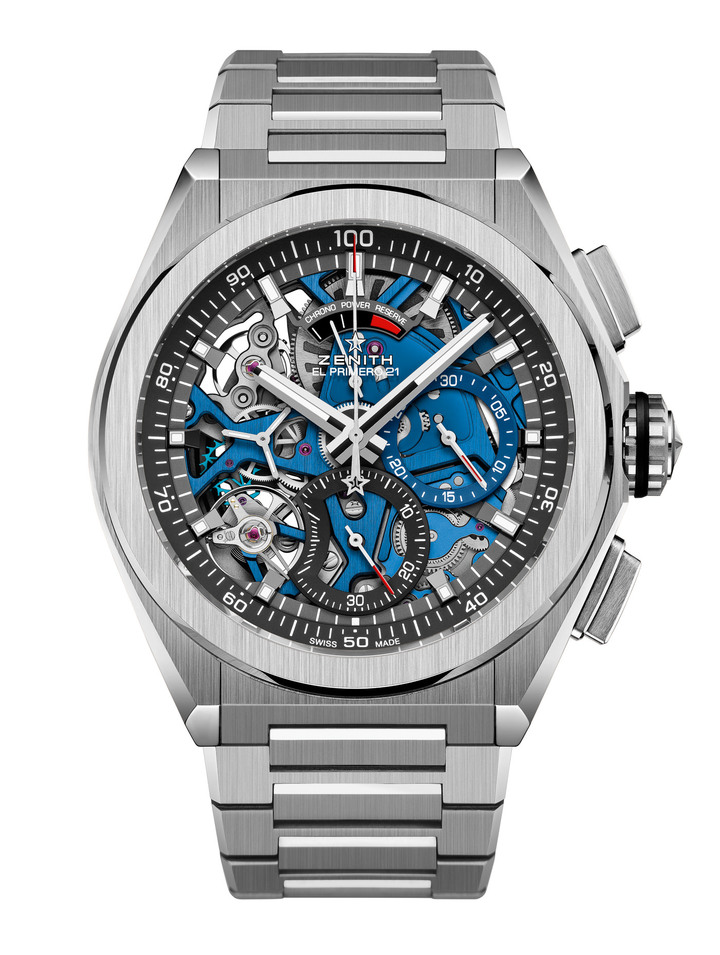
ZENITH DEFY EL PRIMERO 21 BLUE
This El Primero timepiece, which is paced at a frequency of
360,000 vph (50 Hz), ten times faster than its predecessor is an
impressive piece of engineering in action. Accurate to 1/100th
of a second, as you can read from the inner bezel with its scale
graduated from 1 to 100, the second hand sweeps round the
dial at the lightning speed of one revolution per second. The
completely openworked dial shows a resolutely contemporary
décor advantageously setting off a very unusual blue base plate.
From 10,000 to 20,000$
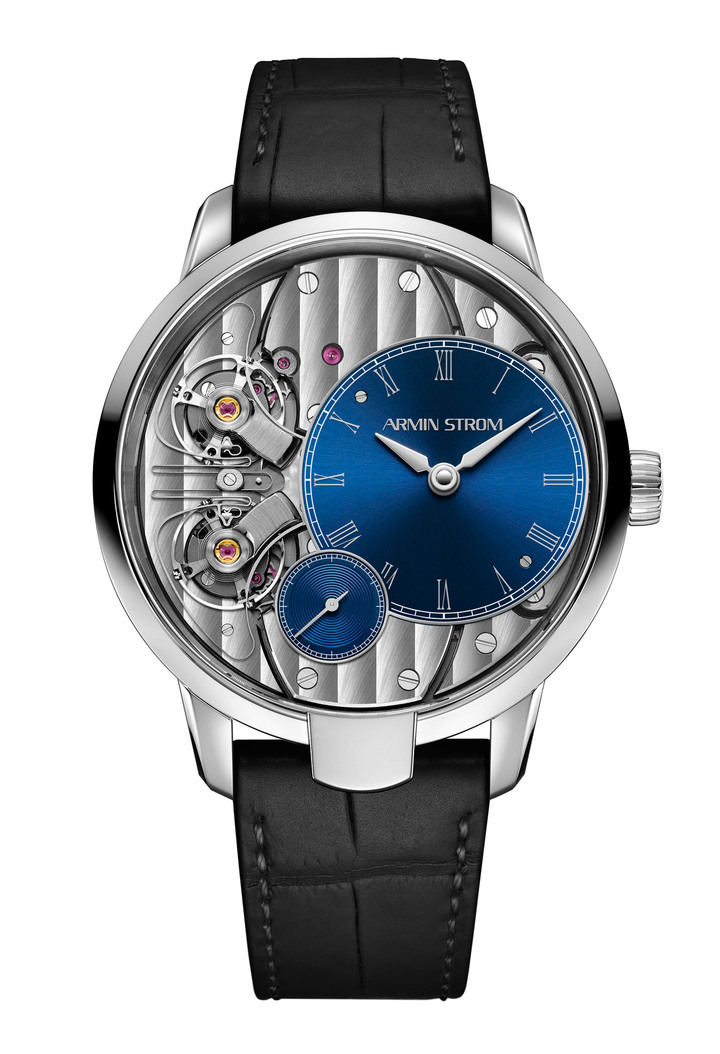
ARMIN STROM PURE RESONANCE WATER
The raison d’être of the Mirrored Force Resonance is to display
the interesting functionality of the resonant balances while
improving the watch’s overall precision. The resonance clutch
spring provides the watch with a fascinating and patented “animation”
of the way it functions. This remains in line with the
philosophy of Armin Strom as a brand: no nonsense, just good,
proprietary mechanics presented in an impeccably finished
and interesting way. The resonance clutch spring is exciting in
another way, too: it visually proves this timepiece’s resonance.
From 20,000 to 50,000$
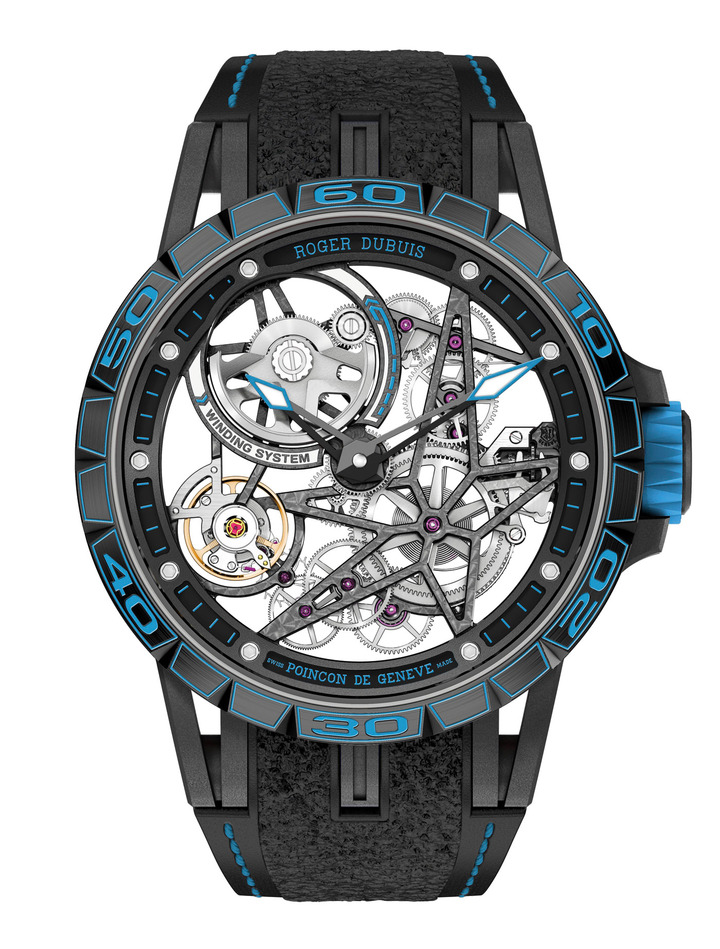
ROGER DUBUIS EXCALIBUR SPIDER PIRELLI AUTOMATIC SKELETON
In black titanium with deep blue accents or touches of white
evoking the tarmac so beloved of the tyre manufacturer, the
case contains an in-house, self-winding mechanical calibre of
166 components, with a skeletal micro-rotor and fine-tuning in six
positions. Entirely openworked with an NAC-coated main plate
and bridges and Poinçon de Genève finishing; all this mounted
on a black rubber strap inlaid with rubber “from certified Pirelli
winning tyres having competed in real races", according to the
description, for the benefit of fetishists of the brand.
From 50,000 to 100,000$
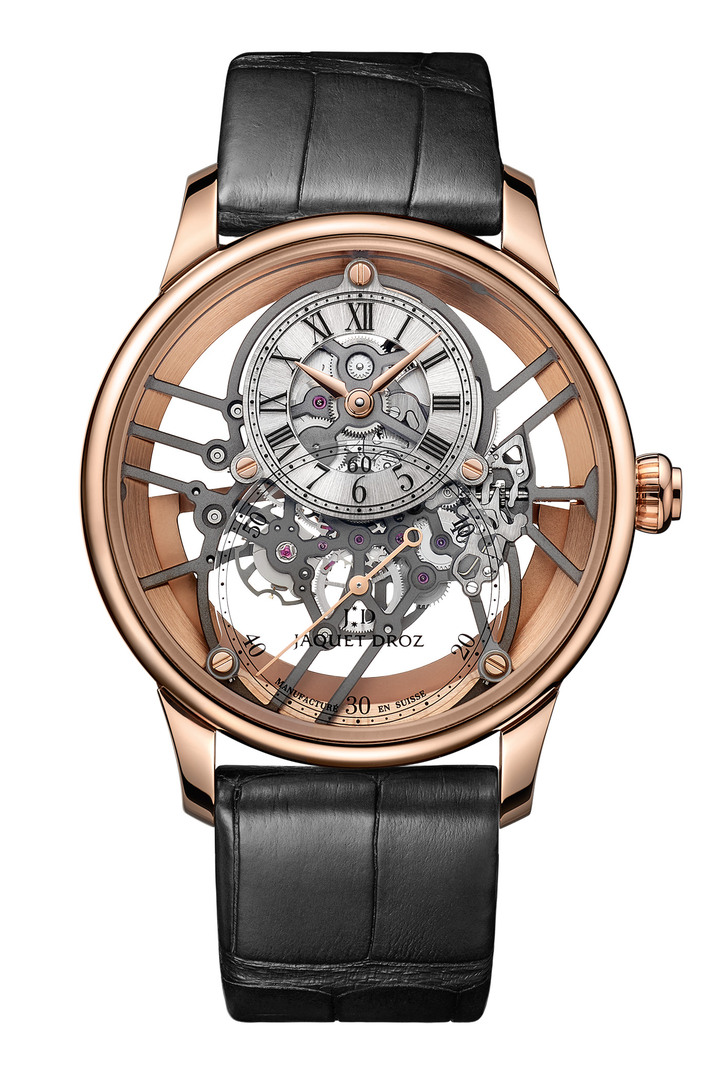
JAQUET DROZ GRANDE SECONDE SKELET-ONE
For the first time, Jaquet Droz presents its emblematic Grande
Seconde with a sapphire dial built into a skeleton composition.
The casing ring has been omitted, offering greater openness;
the hour dial is in sapphire and the oscillating weight entirely
openworked, with only the bridges holding the movement,
which can be seen in its entirety, together.
From 20,000 to 50,000$
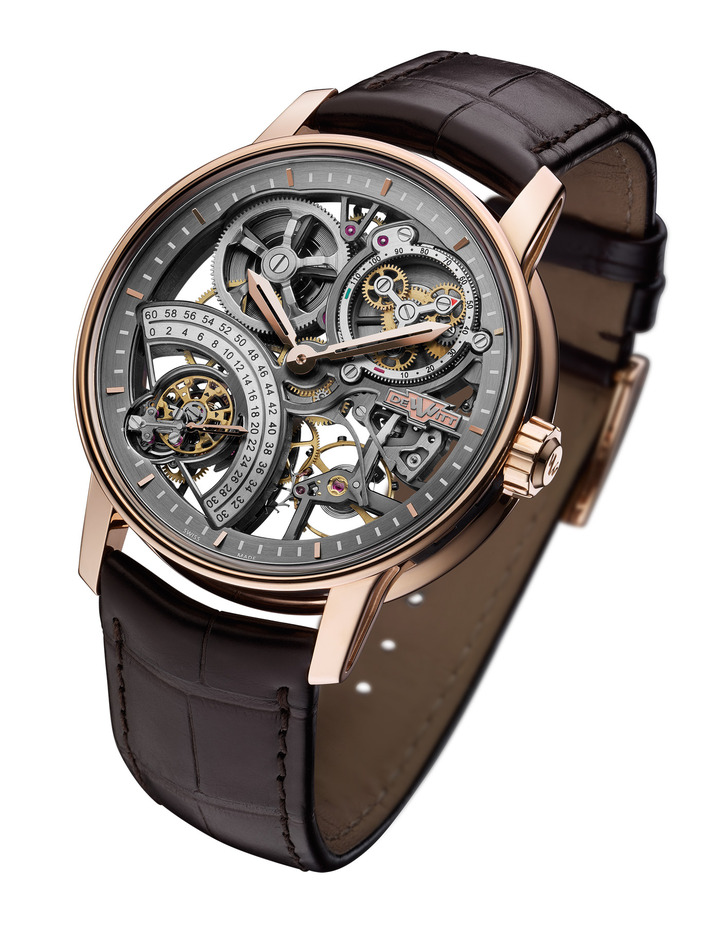
DE WITT ACADEMIA SKELETON
For this manually wound skeleton movement, Jérôme de Witt
has chosen “a highly complex mathematical structure”. Based
on the satellite principle already created for the 2005 Tourbillon
Differentiel, the 100 hours double barrel power reserve is indicated
by an arrow located on this differential, which is in constant
rotation. Placed at 7 o’clock, the seconds hand changes
direction after 30 seconds thanks to a disconnecting gear system,
and performs an instantaneous jump that sends it in the
opposite direction to mark the following 30 seconds. The seconds
are therefore indicated in two different directions, which
gives the seconds hand a totally new way of moving.
From 50,000 to 100’000$
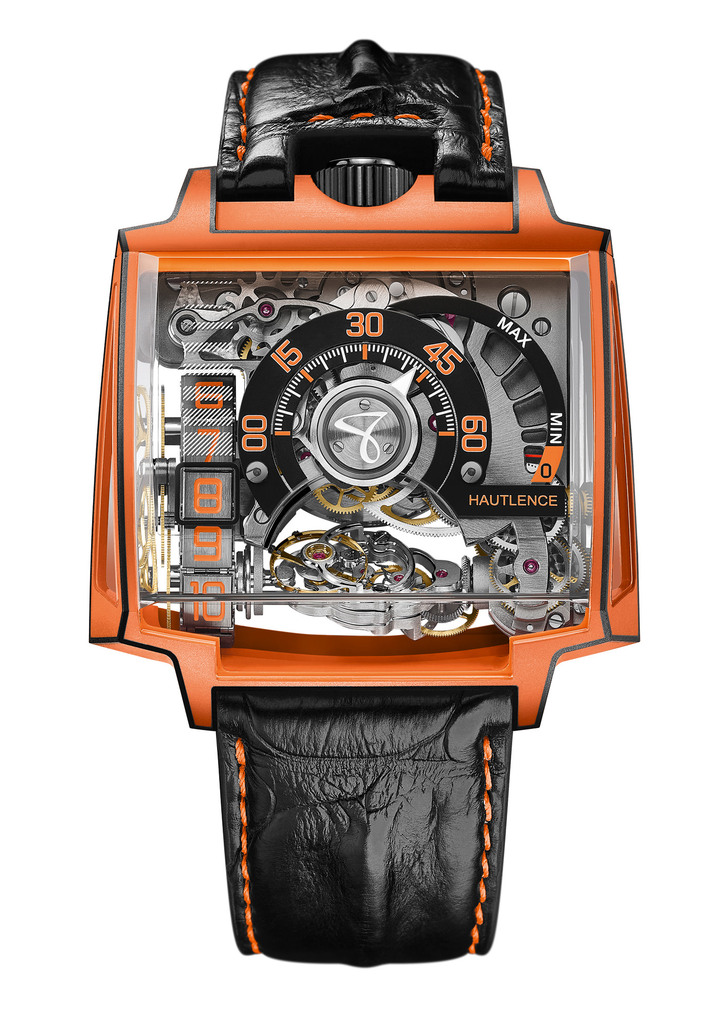
HAUTLENCE VORTEX GAMMA MAGMA
Immediately recognisable by the 12 articulated links of its hour
chain, which turns for 3-4 seconds every 60 minutes, leaving
us time to admire the mechanics in action, this is an volcanic
new version of the Vortex Gamma. Its case is made from
HLLightColor, a material charged with ceramic nanotube particles,
and six three-dimensional sapphire crystals. The minutes
dial, made from almost entirely transparent sapphire, has an
opening offering a generous view of the calibre. The Magma
plays on its contrasts of black, depth, and colour, creating
visual effects and an interplay of luminescent and transparent
forms. From 100,000 to 200,000$
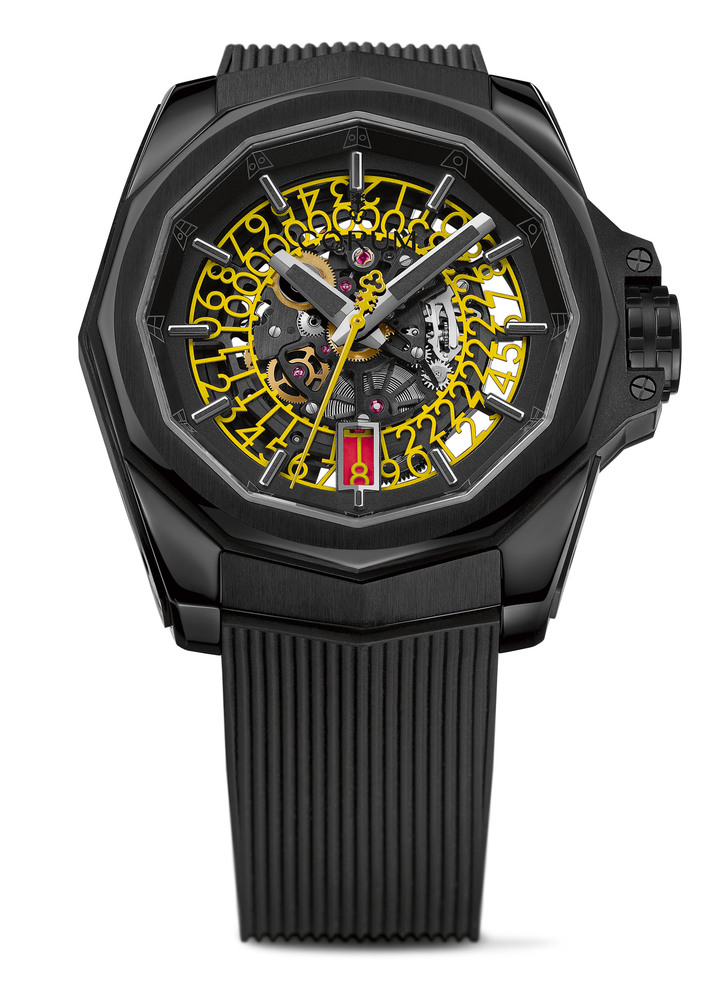
CORUM ADMIRAL AC-ONE 45 SQUELETTE
No sapphire disc here. To create transparency, the floating, filigree
date figures, advanced by an invisible transmission system
beneath the inner bezel, have been individually blanked
by electrical discharge machining. This aerial architecture
accentuates the three-dimensional effect of the Admiral 45
Squelette, the in-house calibre of which is visible on the lower
bridge. Contrasting with the lightweight, coloured lacework
of the figures is the sturdy case in matte black DLC titanium.
Transparency married to mass. From 10,000 to 20,000$
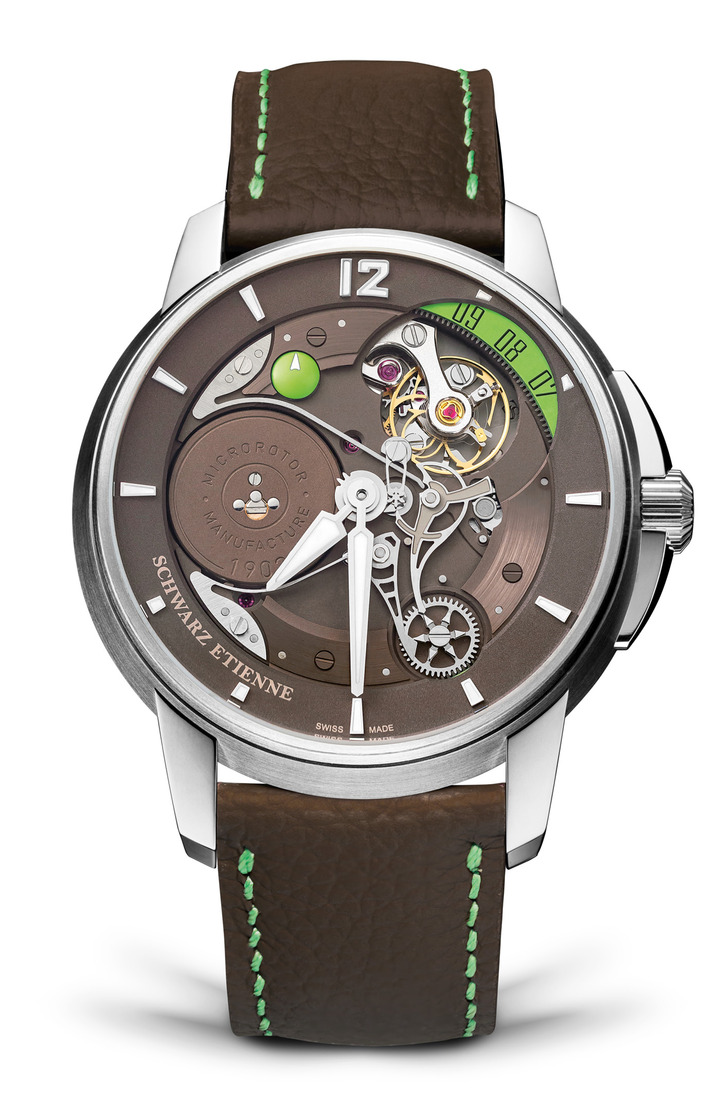
SCHWARZ ETIENNE ROSWELL 08
By showcasing its ISO 100.11 in-house calibre, a back-to-front
movement with the balance and date mechanism innovatively
positioned on the dial side, Schwarz Etienne offers a timepiece
that is at once technically sophisticated, playful and educational.
The balance operates in full view, as does the entire date
mechanism which traverses the whole movement and is displayed
in a green aperture at 2 o’clock, while a small-seconds
dial in the shape of a green pastille revolves at 11 o’clock.
From 10,000 to 20,000$
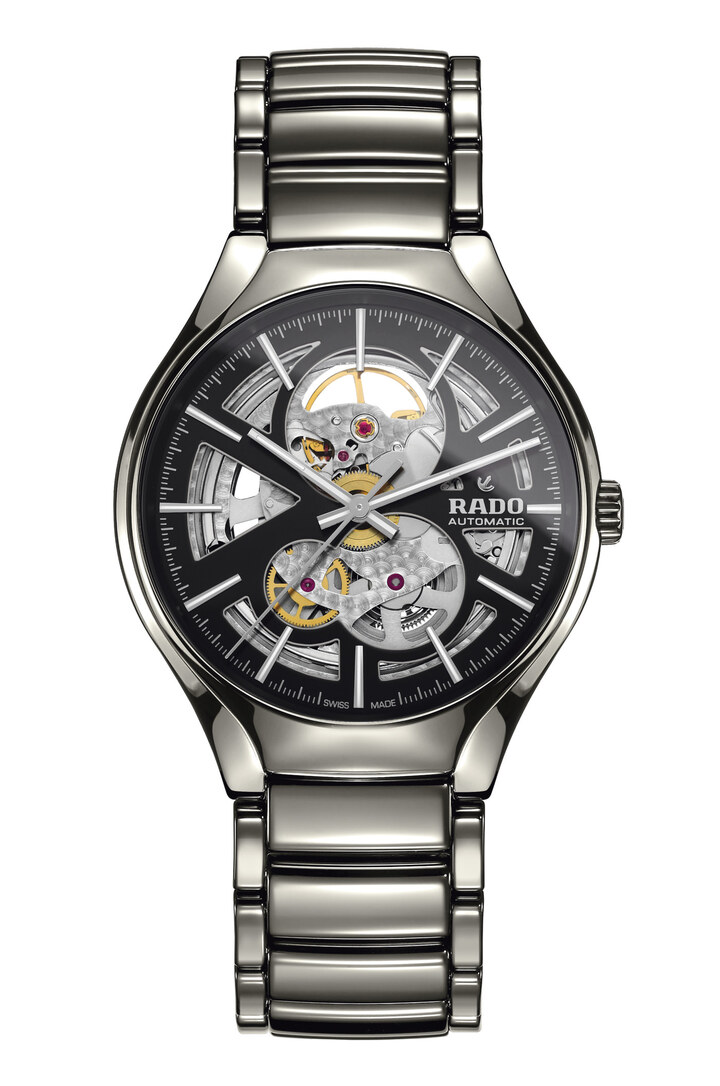
RADO TRUE OPEN HEART AUTOMATIC
Who would have thought that a ceramic case – hardly a transparent
material – could frame a skeleton movement? Or to
be more exact, an “open-heart” movement, as Rado calls it.
Because this is not so much a skeleton movement as a movement
with a dial generously divided into broad black, geometric
or circular openings, revealing the main components that
go to make it up. From 1,000 to 3000$
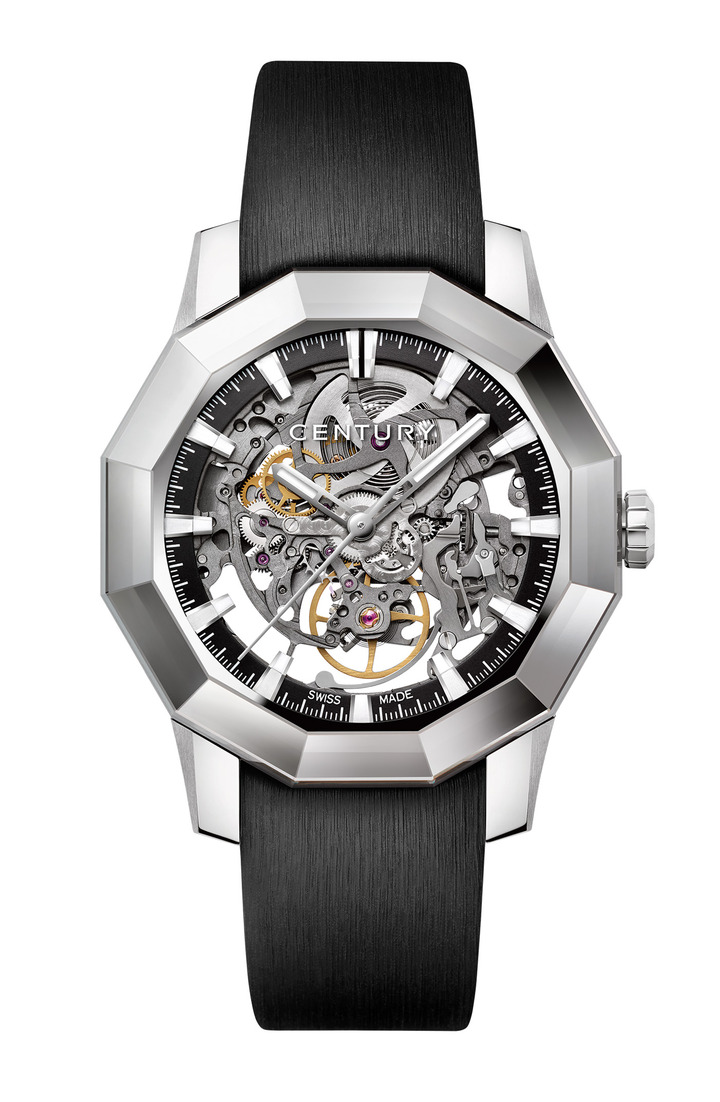
CENTURY PRIME TIME
The dodecagonal case in sapphire – scratchproof, wearproof
and hand-cut – from Prime Time is one of Century’s most recognisable
signature features. Here, the case goes for a sporty
look, hosting a movement in which the bridges, barrel and
main plate are openworked for greater transparency. The sense
of depth is accentuated by the thick, raised indices and the
openworked hands. From 5,000 to 10,000$
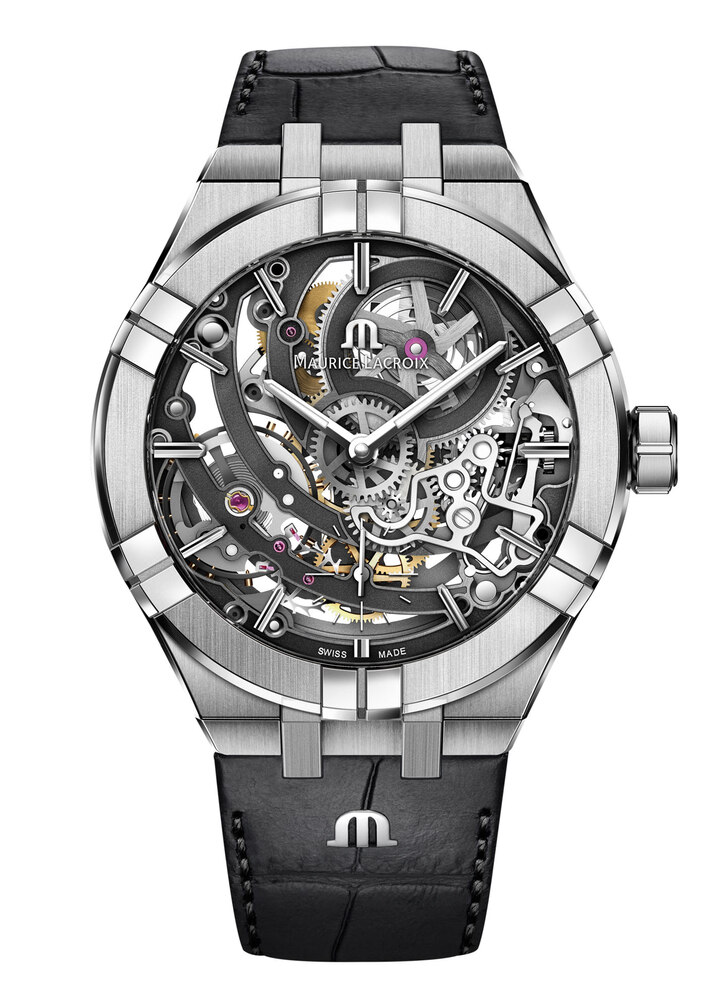
MAURICE LACROIX AIKON AUTOMATIC SKELETON
Designed specifically for the Aikon Automatique Squelette,
the ML234 calibre is self-winding. Like all the Maurice Lacroix
skeleton movements for the past 25 years, this was born of a
design choice. The movement is structured by five concentric
circles radiating out from the centre of the hollowed barrel, at 1
o’clock. Balance bridge, winder mechanism, oscillating weight
– all these elements are hollowed out as far as possible to create
a transparent lacework of mechanical parts beneath a sapphire
crystal divided by rhodium-plated indices.
From 5,000 to 10,000$
All mentioned prices are indicative and correspond to price segment.



 Español
 Français
 Pусский
 繁體中文
繁體中文 简体中文
简体中文 Select another language