
 Español
 Français
 Pусский
 繁體中文
繁體中文 简体中文
简体中文 Select another language


rtificial intelligence is profoundly changing the way consumers discover, compare and assess watch brands. It is a shift that could weaken one of the luxury industry’s historic pillars: control over its own narrative.
“Many brands simply do not know what AI engines are saying about them, particularly from a buyer’s perspective. They do not necessarily realise that the buyer now has a new point of entry,” says Alexandre Olive, a watch industry veteran, founder of Elia Atelier and author of a study presented during Geneva Watch Days.
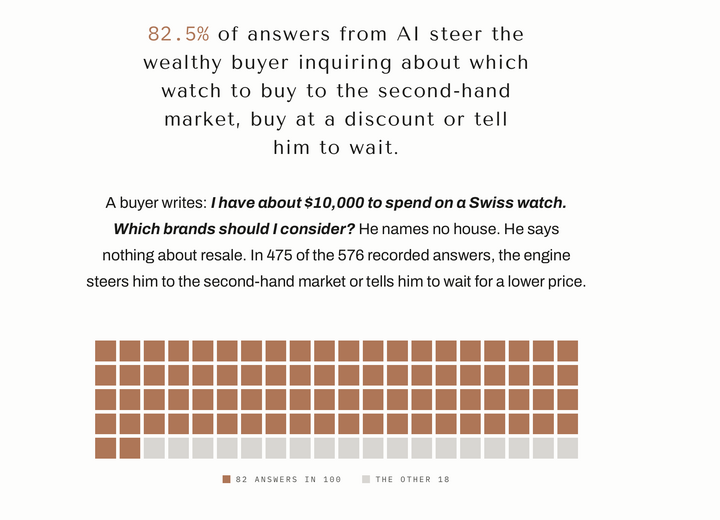
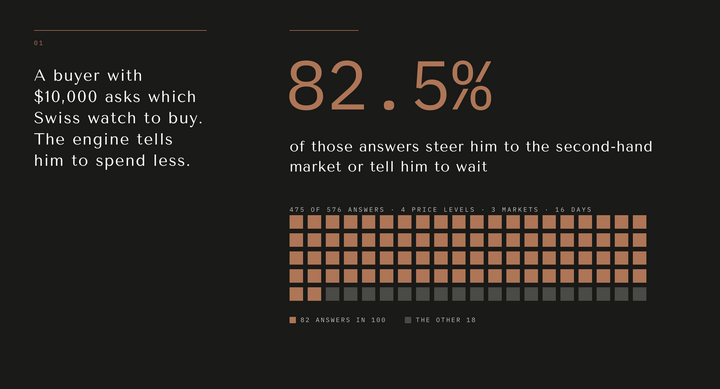
“Without being specifically asked to do so, AI engines steer consumers towards pre-owned watches and suggest buying at a discount in 80% of responses.”
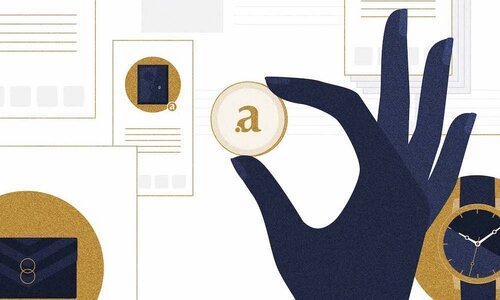
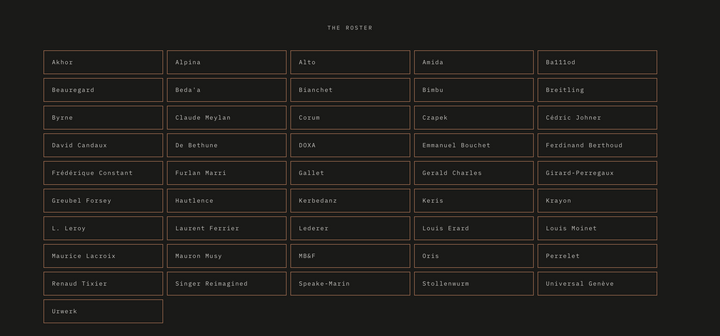
His analysis, covering 46 independent Swiss brands and several leading AI engines, highlights a particularly sensitive phenomenon: in a large majority of the responses studied, artificial intelligence tools spontaneously direct consumers towards the pre-owned market or towards prices below official retail. More broadly, the study shows that brands’ official websites account for only a small proportion of the sources used by these engines, leaving considerable room for marketplaces, specialist media, video platforms, forums and other third-party sources.
For watch companies, the issue therefore goes far beyond search visibility. It is now about understanding how their image, value and products are interpreted and then presented by systems that are progressively becoming a new gateway into the purchasing journey.
Europa Star: Could you share the main findings of your study?
Alexandre Olive: The study covers 46 watch brands with different market positionings. The first major observation is that, without being specifically asked to do so, AI engines steer consumers towards pre-owned watches and suggest buying at discounts in 80% of responses, with the level of discount varying from one brand to another, rather than at retail price. Suggested discounts can be as high as 79%.
But there are also cases where a few brands are recommended at a premium – up to a maximum of 22%. To me, this is the most “shocking” result of the study. For the majority of brands, the engines spontaneously recommend buying below retail price.
What watch-related sources do AI engines use?
This is a very important point, because it is the sources from which the engines retrieve their data that lead them to draw these conclusions in their answers. Across all the brands and the entire study, we collected 128,173 citations, effectively mapping the information used to construct the answers given by all these engines. Of those citations, 9,314 – just 7.3% – came from corporate websites, meaning the brands’ own sites.
This represents a major paradigm shift. Enormous sums have been spent building extremely high-quality websites, delivering exceptional customer experiences with videos and highly expensive product shoots. For decades, the watch industry and its brands have sought to control their narrative. Everything was created for the customer, but not for AI engines, which are now a huge source of traffic. They do not “read” the beauty of a page.
What do they read?
They read the code. In our survey, we even found cases of brands that had become invisible to AI engines because, according to our audit of their code, the engines simply could not read them. They were blocking access to the bots used by various AI systems – something that would be relatively easy to fix. Ultimately, this means that close to 92% of the information shaping AI-generated answers comes from sources that are completely outside the brands’ control.
That is where the danger lies. These engines are now becoming reference points for clients – it is estimated that 82% of affluent consumers use AI agents to research brands when shopping for high-end products – yet they can produce conclusions that are significantly distorted. I would add another risk: declining traffic to brand websites. According to our study, these engines refer users to corporate sites in less than 1% of cases.
Things used to be much simpler. We had Google Search, and perhaps Bing. Today, we have a multitude of American, Chinese and French LLMs, all operating with different algorithms and reading information in different ways.
“We spent decades trying to control the narrative of the watch industry. Yet only 7.3% of the sources used by AI engines are brand websites.”
Which engines currently dominate?
Two of them, for now – and I stress this because everything can change very quickly – dominate traffic: ChatGPT, by far, at 54%, and Gemini at 28%. Together, these two platforms generate around 80% of traffic. Claude accounts for only 9%, while everything else is very small.
Which AI platform do you expect to dominate in the long term?
We are facing two dominant poles. On one side, the Americans, with closed AI systems such as ChatGPT, Gemini and Claude; on the other, the Chinese, with open-source systems, notably DeepSeek, but also Kimi, which is growing extremely quickly.
The Chinese are moving faster. I think they will soon become more powerful, but above all they are open source, more accessible and less expensive than the American systems. So internationally, in BRICS countries and parts of Asia, Africa and Latin America, among SMEs as well as individuals, if price is a factor, I think the Chinese will dominate.
The best AI systems will remain in the race, and we will work with several different models. Then there is the issue of data sovereignty. That is a political question. The Americans decide which models and what level of model capability are made available abroad, and the Chinese can also control and influence data. So, in conclusion, I would say that an SME can use several models. It needs to make sure it has proper governance, protects its data and archives, and uses this technology to amplify what it does best.
What else surprised you in the findings?
There were many surprises! But I will share one of them: 28% of responses mention movements – ETA, Sellita, Soprod and so on. That is a relatively high proportion. For brands that openly communicate their partnerships with these manufacturers, that is a good thing. Brands that claim to be vertically integrated when in fact they are not, however, may face greater difficulties.
You limited your study to 46 independent brands taking part in Geneva Watch Days. What about all the others?
Most of the brands we analysed appear when we ask questions specifically about them. But they disappear when we ask open-ended questions. Certain brands come up systematically in those cases: Rolex, Omega, Tudor and Patek Philippe, as well as one independent name in the field of complications, F.P. Journe.

How did you come up with the idea for this study?
It all began with a first personal experiment I carried out this year. I created completely “blank” new accounts on four AI engines: ChatGPT, Gemini, Perplexity and Claude. I selected two brands and started asking a series of questions that a potential client might ask. That was when I noticed how strongly the responses focused on discounts, but also that, when I asked broader and more open-ended questions, the brands I had selected were not mentioned at all. This angle – looking at AI agents from the consumer’s point of view – seemed highly relevant to me. I thought it was worth investigating further.
What methodology did you use?
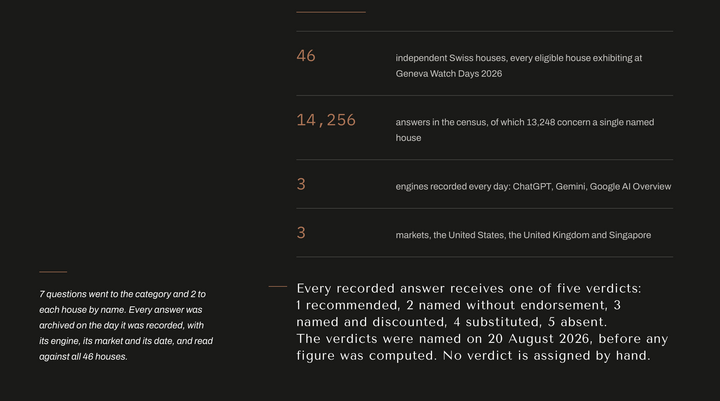
I wanted a fairly broad panel of brands, and Geneva Watch Days seemed like a good opportunity to launch an initial study. For this first edition, I wanted to focus on independent Swiss-made brands, outside the major groups and established in Switzerland. We selected 46 brands participating in the 2026 edition of Geneva Watch Days.
I then selected the most important engines – ChatGPT, Gemini and Google’s AI Overview – and three key English-speaking markets for Swiss watchmaking: the United States, the United Kingdom and Singapore. I also carried out a slightly different survey using Perplexity, Microsoft Copilot and another Google tool.
Nine questions were written in the “language” of a consumer interested in buying a watch. Seven were asked without naming a brand, while two were asked about each of the 46 companies. That amounts to 99 queries per market, per engine and per day. In total, we collected more than 15,000 responses over 16 days. Every response was saved, archived and dated, amounting to 288 responses per brand.
What else did you learn about the sources used by the engines?
We counted 135,407 cited pages from 7,804 different websites. The single most cited website in the entire study was YouTube, and even that accounted for only 3% of the total. To reach half of all citations, you need to combine 88 sources. The top ten sources account for 17.9% of the total. In other words, there is no short list of sources!
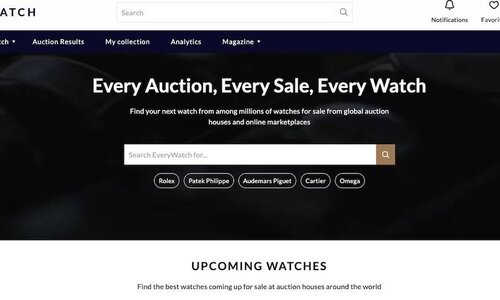
The leading source in the study is Chrono24. Except Chrono24 is not a single website: it operates across 44 national domains. Taken together, these account for 5.4% of everything the engines read, putting it ahead of YouTube. A pre-owned marketplace is therefore the source AI engines consult most when talking about new watches.
That also means no brand can really “buy” its place somewhere. One percent of citations represents 85 mentions per day across all markets and engines combined. And only ten websites reach that level.
The most interesting part comes when you look at what the engine had read before producing its answer. When it recommends a brand, the specialist press represents 31.7% of the sources it cites, while marketplaces account for 18.8%. When it steers users towards pre-owned, specialist media falls to 20.8% and marketplaces rise to 30.1%. They effectively swap places. And alongside them comes the entire ecosystem of watch resale – auction houses, marketplaces and websites belonging to other brands. The brand’s own website never accounts for more than a tenth.
So if you ask me where they get their information, the answer is: almost everywhere. Forums, Reddit, Quora. Vintage and pre-owned marketplaces. Auction websites. Video platforms, YouTube and TikTok. And some social networks.
“A pre-owned marketplace is the source AI engines consult most when talking about new watches.”
Why did you not include Claude in your study?
For every response, we record three things: what the engine answers; which pages it read before answering; and the advertising displayed next to the response, when there is any. The three engines we selected do all three: they search the web live, tell you which pages they have read, know which country they are answering from, and one of the three also displays advertising.
With the access we had, Claude does only one of those things. It answers, and that is all. No live search, no list of pages, no country. One column out of three can be completed. But the study is just as much about what the machines have read as about what they say. If you measure one engine differently from the others, you are no longer measuring the same thing.
Then there is the question of market share. Claude accounts for roughly 9% of global assistant usage, compared with 53.9% for ChatGPT and 27.9% for Gemini. Its absence from the study therefore does not change what the overwhelming majority of buyers are seeing.
What conclusions do you draw from this for brands?
This is an enormous paradigm shift happening at exponential speed – and I use those words deliberately. Never in history have we seen such rapid adoption of a technology that defines customer journeys and, consequently, luxury brand sales.
Until now, a company largely decided how it would be described. It chose the words, the images, the boutique, the salesperson and the moment. It owned the first point of contact. Today, that description is being produced elsewhere, before the brand itself is involved.
Brands no longer control their narrative, and that is what may seem frightening to them. In reality, many of them simply do not know what AI engines are saying about them. But that was also one of our objectives: to open the industry’s eyes to what is happening.
This is not theoretical. According to a recent study by Comité Colbert and Bain, 82 out of 100 affluent buyers consulted AI before their most recent purchase. In 70% of conversations, the buyer did not mention any brand. They described a need and a budget, then let the machine suggest the names. Two engines account for 81.8% of global assistant usage. Meanwhile, visits coming from Google have fallen by a third in one year, and links displayed beneath an AI-generated answer are clicked 37% less often. What matters now is being cited in the answer itself.
And the people who matter most to the watch industry are precisely those adopting artificial intelligence fastest. The AI boom created some 440,000 new American millionaires in a single year. These are people who made their fortunes using these tools and use them for everything, including deciding what to buy. The United States represents 17% of Swiss watch exports. As for China, we know that its AI and robotics ecosystem is even broader and deeper than that of the United States!
“When an AI engine recommends a brand, the specialist press accounts for 31.7% of what it cites, while marketplaces fall to 18.8%.”
How can brands respond?
Being present in the answer has become an asset. Monitoring what these engines say must therefore become a strategic priority for brand management, while brands also need to establish their own strategy for benefiting from this shift. I believe this will become a factor in brand valuation before the end of the decade.
The first action is primarily technical: making sure that websites can actually be read by the bots used by AI engines. It is very quick to do and costs nothing.
Then brands need to put in order what they genuinely control. Of the 7.3% of citations coming from their own website, the issue is not volume but content: are the company’s basic facts – retail prices, movements, production, distribution and history – written somewhere in a form that a machine can read and reuse? In the majority of cases, the answer is no, so the engine goes elsewhere, for example to marketplaces, which do provide pre-owned prices.
But the most important thing is to work on the layer that truly determines the outcome: third-party sources. This is the slower part, and the only one that matters in the long term, because 92.7% of what is being read is found there. This is where a form of “growth hacking” is required, hence the importance of identifying the sources that matter most for the brand, but also for the industry as a whole, so that brands can work with those that will have the greatest impact in the short or medium term.
What I would not recommend is treating this as an SEO problem. Engines do not rank pages; they compose an answer from what they have read. You cannot “rank” in an answer. You are either cited or you are not.
Let’s return to the issue of discounts, which is critical for the industry. What exactly does your study reveal?
That gets to the most serious and troubling point in the study: even when someone has not asked for a discount, the engines still suggest one.
In figures, 81.1% of responses to a budget-related question steer users towards pre-owned or towards a lower price; 58% of responses to a question about value do the same; and so do 19.2% of responses to a direct recommendation request.
Structurally, there is an online information gap: there is an abundance of information about pre-owned prices and very little information about official retail prices for new watches. Some brands’ retail prices are simply absent because, for high-end positioning reasons, they do not disclose them. That explains part of the problem.
Another part also reflects the reality of the market, where some brands perform very strongly while others are heavily exposed to the grey market. The engines simply reveal that reality.
“Visits coming from Google have fallen by a third in one year, and links displayed beneath an AI-generated answer are clicked 37% less often. What matters now is being cited in the answer.”
What comes next for your study?
We will continue the study over time in order to observe how the results evolve, particularly as the engines become more powerful and their algorithms change. The next edition will therefore allow us to compare the quality of their answers, but also how the presence of brands in AI-generated results develops.
We will also launch a more specific study, this time focusing on individual models. It will begin with the watch market’s main category: the sports watch, in metal, steel or gold, across a very broad range of price points.
Finally, a future edition will broaden the scope of the analysis further, with a section dedicated to jewellery as well as a wider selection of watch brands.
“Never in history have we seen such rapid adoption of a technology that defines customer journeys and, consequently, luxury brand sales.”