W
atch auctions are on a roll, with Aurel Bacs at Phillips
dominating the field. How do you view the auction houses
that work in that market?
I’ve been taking part in auctions since 2004, but I was collecting
watches well before then, through private suppliers and retailers.
At that time Christie’s dominated the market, and the
precursor of watch auctions, Antiquorum, was on the decline.
The present definitely belongs to Aurel Bacs at Phillips. But I’m
not sure that will last. The milieu has become highly competitive;
Antiquorum is trying to make a comeback, incidentally.
The critical issue for Phillips will be whether or not it will be
able to regenerate, either in terms of its watches or its buyers,
after having obtained and put on the market outstanding collections
from certain private customers. Will they be able to
keep that up in the long term?
Christie’s and Sotheby’s have an advantage with new customers
who are just making their debut in watches: they’re
very well-known names in the auction world and these newcomers
might already be familiar with them for other products.
You shouldn’t forget the brand power wielded by these
auction houses in the face of Phillips’ current dominating
role. Phillips still has to build its brand image.
You manage Elite Advisers, an investment fund devoted
exclusively to watches, which is quite unusual. Not long
ago, your collection was estimated at around 25 million
dollars. What is your approach to buying watches?
I’ve never bought a watch specifically for a customer, to tell
the truth. I buy them first of all for myself; some of them I’ll
keep and others I’ll sell. That’s how I manage the portfolio
that my customers have access to. Today, the collection consists
of 150 watches. I only keep the rarest items and I avoid
models in only ‘average’ condition.
The advantage today is that the number of buying channels
has multiplied. Even on eBay, I’ve been able to buy some
very fine Longines, Mido or LeCoultre models! On the other
hand, I’d like to be able to buy directly from private individuals
more, and build up a relationship with them, but that’s
not as easy as it used to be, because today their immediate
reflex is to contact an auction house.
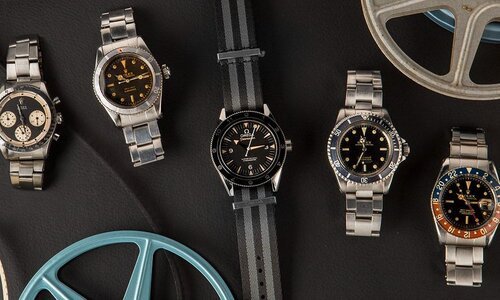
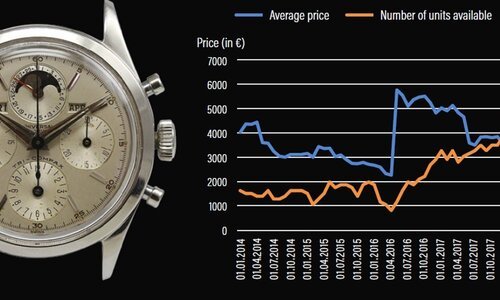
There’s a real frenzy for vintage watches today and sellers
are always asking for more. I still make a profit, but it has
shrunk. In actual fact, my dream when I sell a watch is to be
able to buy it back a few years later. That’s my benchmark
for setting the sale price. If I set the rates too high, I’ll suffer
myself. That’s my self-regulating system!
Yes, prices are soaring, new records are being set all the
time... Aren’t we experiencing a kind of vintage watch
‘bubble’? Will you really be able to buy those watches
back in a few years’ time – unless prices collapse?
You always hear people talking about ‘bubbles’ as soon as a market
starts to grow rapidly. I’m very familiar with the term, having
previously worked in the City’s merchant banking milieu... But
you have to take a closer look: people think that the market for
vintage watches as a whole has enjoyed non-stop growth these
past few years. But the rapid rise in prices actually only concerns
a small portion of the market – that of really rare watches over
which people have gone ‘loco’. More standard watches are still
as difficult to sell as ever. Don’t hope to make a quick profit. You
can see the same mechanisms at work on the used car market.
One gets the impression that when it comes to collectors’
watches there are Rolex and Patek Philippe, who
monopolise all the top rankings, followed far behind by
the rest of the field.
I wouldn’t be so categorical. Rather, I’d juxtapose the rarest
and most prestigious watches with the most standard models,
within each brand. That’s the distinction that really counts, over and above the brand itself. Personally, I sometimes prefer
a Longines chronograph to a Patek Philippe chronograph,
depending on the condition and the model. You can find rare,
excellently well-made watches that are likely to gain further
value at Mido, Omega, or Audemars Piguet. But it’s very difficult
today to buy this type of watch, because they either stay
in private collections, or they’re already on the market at very
high prices precisely because of their rarity and quality.
You yourself once owned the Patek Philippe 1518 in stainless
steel, which became the most expensive wristwatch
in history, having sold for 11 million francs at Phillips last
year. How much did you sell it for to the person who “hit
the jackpot”?
I can’t reveal that exact price, but I can tell you that the sum
was much lower... In my view, the sale price was overblown
for that model, it isn’t in phase with its actual value. I’m always
fighting to make sure prices stay ‘fair’. But you know,
the world of auctioneering is still rather a strange place...
Have any new players entered the market? Is that what’s
pushing up the price of certain exceptional models so
much?
What I’m observing is that Asian buyers of contemporary Patek
Philippe or Audemars Piguet watches are now directing their
interest towards the world of collectors’ watches. Yet paradoxically,
certain vintage Patek Philippe models are still underestimated
in my view, such as references 1379, 5004, 3970 and 5020.
It’s quite strange... Their 1990s models are highly valuable. Their
last model that really corresponded to my taste was the reference
5970. From the 2000s, they tended to increase the diameter
of their new models. For me, a watchmaker as prestigious
as Patek Philippe should not be influenced by the ‘fashion’ of
disproportionately large watches that we’ve been seeing for the
past fifteen years. They ought to be the ones setting the tone!
How would you rate the numerous independent brands
that sprang up in the 2000s – basically the ones you find
in the Carré des Horlogers at the SIHH? Will collectors
be falling over one another to snap up their by then vintage
models in a decade or two?
I don’t think so. Those brands appeared at a time when
the market was very buoyant and there was plenty of cash
around. And when it comes down to it, the most successful
brands today are those with a history and a vintage image.
We can see that the market for vintage is creating great interest
in the production of contemporary watches. I’m more
inclined to think that these watches, which appeared at a tipping point, will always be associated with a precise, restricted
period. Which doesn’t mean to say that I’m not interested
in certain more contemporary brands, but they’re
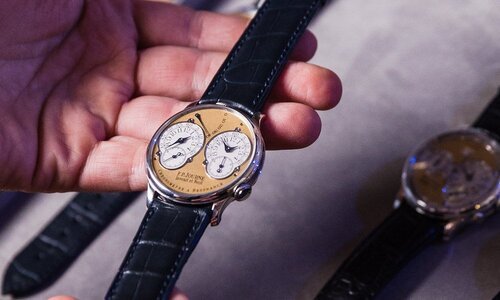
more of the type of F.P. Journe or Hublot...
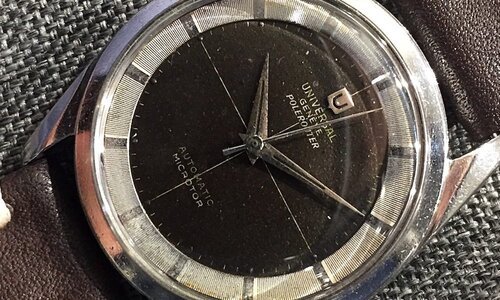
We’re seeing a few paradoxes today: I’m thinking of a
brand like Universal, whose contemporary watches are
‘dormant’, while their vintage watches are showing impressive
ratings...
I don’t see any paradox there. On the contrary, I’d even say
that the fact that the brand has disappeared off the contemporary
radar raises its rating as a collectors’ brand. Look at
me, I’m a great fan of Longines’ historical chronographs,
whereas the ‘contemporary’ aspect of the brand isn’t very
highly rated. The current state or production of a brand does
not have an influence on the rating of its older products. In
my view, the movements of the 1940s or 50s were better than
the ones being produced today!
It’s an absolutely shameful result for Sotheby’s that they
weren’t able to find a customer for that model. Aurel Bacs
would have sold it with a 1000-percent mark-up at Phillips!
But I’ve never collected pocket watches myself. They’re a bit
too ‘traditional’ for my taste, although I admit that some
models are absolutely extraordinary
What we’re seeing is that the entire vintage market has become
more global, thanks both to the internet and to the
auction houses, whereas it was much more fragmented and
regional when I started my collection. That should, logically,
keep it on a successful course.
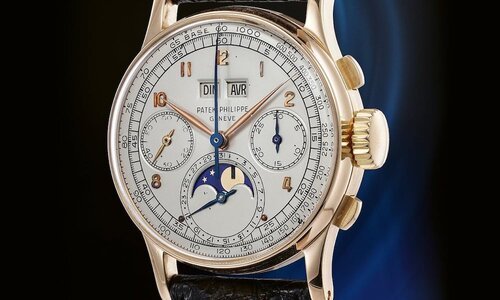
It would be the Patek Philippe 1518 in pink gold and steel
which was apparently – so it’s supposed – sold to the king of
Romania. Does it really exist? I hope so...



 Español
 Français
 Pусский
 繁體中文
 简体中文
 Select another language