A Tour of the Autumn Watch Fairs
Last November the venerable nations of the Old World hosted three watchmaking fairs targeted at the general public: Munich Time in Germany, SalonQP in London and Belles Montres in Paris. Europa Star was there. Here are our top picks.
BEST OF THE LATEST SALONS... MUNICH TIME (Stage 1)
A Tour of the Autumn Watch Fairs
Last November the venerable nations of the Old World hosted three watchmaking fairs targeted at the general public: Munich Time in Germany, SalonQP in London and Belles Montres in Paris. Europa Star was there. Here are our top picks.
STAGE 1 - MUNICH TIME
The Munich Time fair in the Bavarian capital’s
prestigious Bayerischer Hof brought together an
impressively broad palette of international names
tempted by the potential of Europe’s biggest economy,
as well as many German brands. On their arrival,
visitors were greeted by a posse of Richemont
group brands as well as LVMH ; Swatch Group
was nowhere to be seen. There were also many
independent watchmakers to be discovered: Swiss
brands such as Carl F. Bucherer, German brands
Nomos, Tutima and Sinn, and French independent
manufacturer Bell & Ross. And we shouldn’t leave
out Greubel Forsey, fresh from its victory in the
Grand Prix d’Horlogerie de Genève. From the highly
affordable to the eye-wateringly inaccessible, there
were plenty of familiar faces.
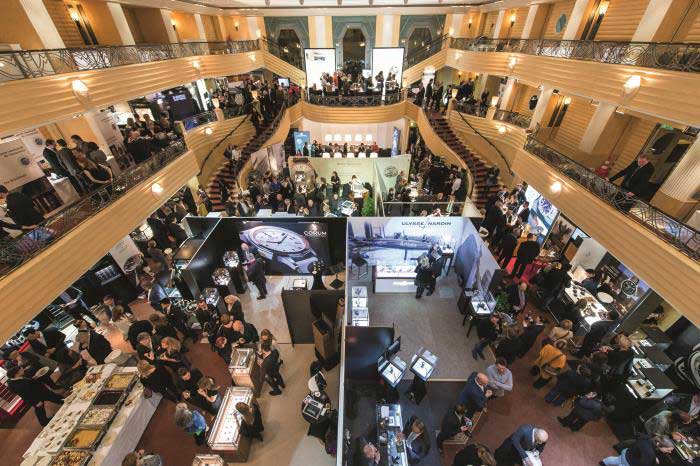
With its relatively restricted area the fair felt dense:
large and small brands alike occupies substantially
the same footprint, offering far less of a contrast
than Baselworld. All the exhibitors we talked to
appreciated the visitor demographics, with many
experienced collectors making the trip alongside
interested amateurs.
Interview with Rudolf Kreuzberger, Munich Time
Rudolf Kreuzberger - Munich Time
“WE WANTED TO RECREATE A RETAIL BOUTIQUE,
BUT ON A BIGGER SCALE”
Originally based in Vienna,
where he launched a fair
that’s still going strong
today, Rudolf Kreuzberger
had the right idea when he
decided in 2008 to create
a Munich-based version.
Today, Munich Time is recognised
as a major entry point
for German consumers.
The roots of Munich Time go back to 2001,
the year Rudolf Kreuzberger founded the
Vienna Time salon in Austria. “Vienna
Time was the first international watch
fair targeted at the general public, even
before London or Mexico. At that time
we already had partnerships with the
major watch brands, which brought in
visitors from Germany,” explains the
entrepreneur. In 2008 he set up a fair
in Germany itself, in Munich, as a sort
of German offshoot of Vienna Time.
Since then, with 86 brands present this
year, the Munich fair has overtaken its
Viennese parent in terms of the number
of exhibitors. And although retailers also
attend it, the main objective is to put
brands in contact with their end clients.
So, how did 2015 Munich Time go?
We’re happy, because we welcomed even
more visitors – over 11,000, which is one
thousand more than last year. 2012 remains
our record year, however, with
12,000.
Is there a correlation between the buying
climate and the number of visitors
to the fair?
Yes, it couldn’t be clearer. It’s an interesting
phenomenon that we have seen
repeated over the years: participation
in the fair is perfectly aligned with economic
cycles.
How do you persuade the brands to
participate?
We offer them contact with their end
clients. Brands are increasingly looking
for a direct relationship. That’s why they
are opening their own boutiques. But
they also appreciate the fact that we
draw in a high-quality clientèle, people
who wouldn’t necessarily feel comfortable
walking into a mono-brand boutique,
because they don’t want to feel
they have to buy into a particular message,
or make a purchase. At our fair
they can wander around any number
of brands, and let themselves be taken
by surprise or won over by something,
without feeling an obligation to buy. In
fact, we consider ourselves to be like a
retailer, but with a very big shop!
What is quite striking is the relatively
restricted dimensions of the booths,
even those of the big brands.
Yes, that’s what encourages direct contact
between the brands and their clients!
The juxtaposition of big and small
is deliberate. I don’t want to organise a
fair where there are only luxury brands.
Like Baselworld, we want to be inclusive.
And are the brands OK with this?
Obviously, some would prefer clearer
delineation. But it’s like a shop: you can
look at a Rolex, and you can also look
at a Tissot.
“Since 2008, with 86
brands present this year,
the Munich fair has overtaken
its Viennese parent
in terms of the number of
exhibitors. And although
retailers also attend it,
the main objective is to
put brands in contact with
their end clients.”
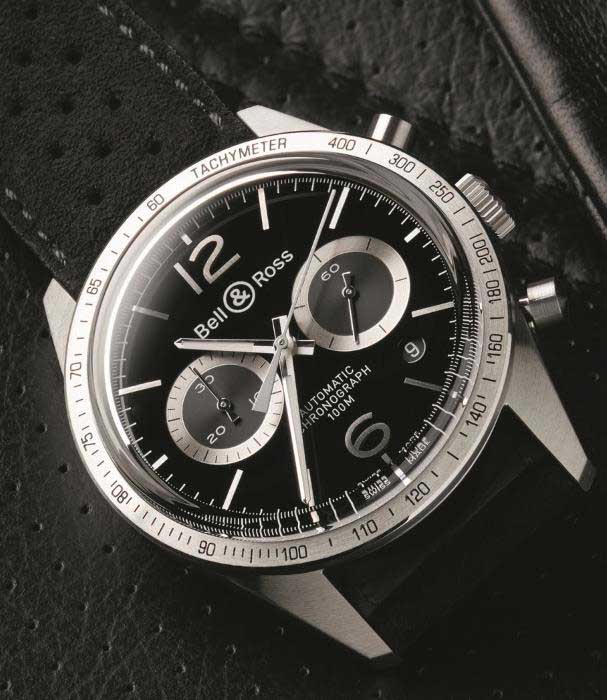
A French brand braves Munich. Two of
Bell & Ross’s models really capture the
imagination. First, the BR Vintage 123
GT and BR 126, which take us back
to the high-octane world of 1970s
motor cars. And second, the BR-X1 line
expands the company’s horizons with
an impressive new Haute Horlogerie
version, the BR-X1 Chronograph
Tourbillon (limited to 20 pieces), which
comes in a 45mm multi-material case.
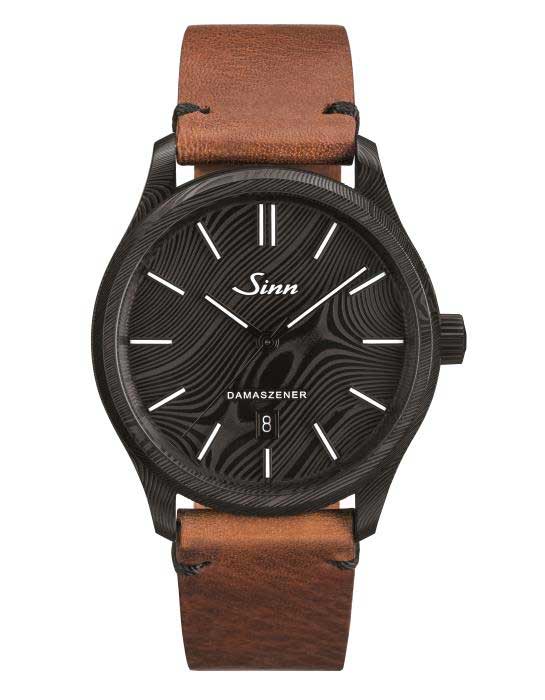
The 1800 S Damaszener by Sinn is a
new 100-piece limited edition watch
made of Damascus steel, which
gained its legendary reputation from
its use in swords, knives and blades.
Each watch is unique, as it is impossible
to manipulate the moiré markings
of the steel.The 1800 S Damaszener by Sinn is a
new 100-piece limited edition watch
made of Damascus steel, which
gained its legendary reputation from
its use in swords, knives and blades.
Each watch is unique, as it is impossible
to manipulate the moiré markings
of the steel.
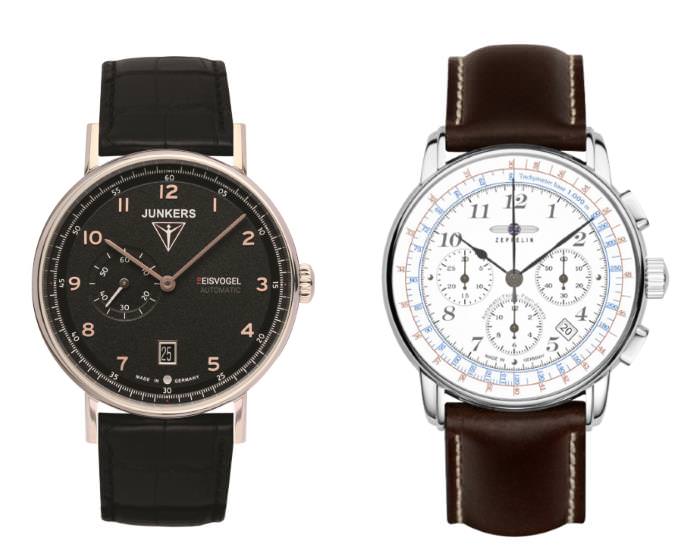
The brands Junkers and Zeppelin share
(at least) two characteristics: they both
belong to Point Tec, a firm based near
Munich, and they are themed around
air exploration. Junkers has dedicated
the Eisvogel collection to the plane
that completed the first ever flight
from Spitzbergen in the direction of
the North Pole. The Zeppelin LZ 126
was the first passenger airship to be
used for long-distance flights.
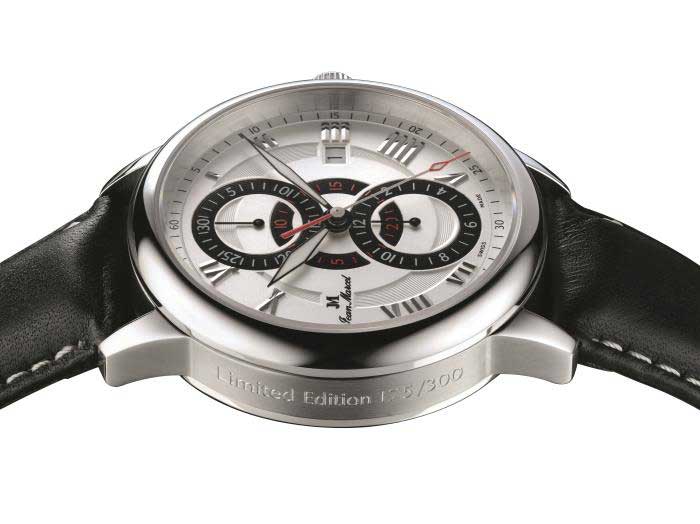
Jean Marcel, a brand founded in
Baden-Baden in 1981 by Jürgen Kuhn,
has a particular distinguishing feature:
verticality. Watches in the Palmarium,
Astrum and Quadrum II collections all
share the distinction of a vertically-oriented
display. These features, grouped
under the copyrighted term ‘Vertical
Limit’, are what make Jean Marcel’s
creations immediately recognisable.
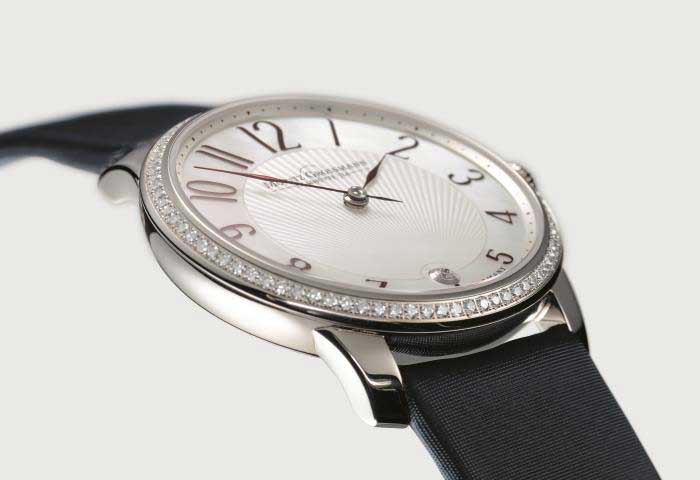
The Glashütte manufacture Moritz
Grossmann, under the able leadership
of Christine Hutter, has launched a
new ladies’ watch – the Tefnut Lady.
The brand’s DNA is present in spades:
painstaking attention to detail,
timeless elegance and gently playful
graded numerals. Not forgetting of
course a new in-house calibre, its fifth,
christened the 102.0, with a height of
just under 4mm.
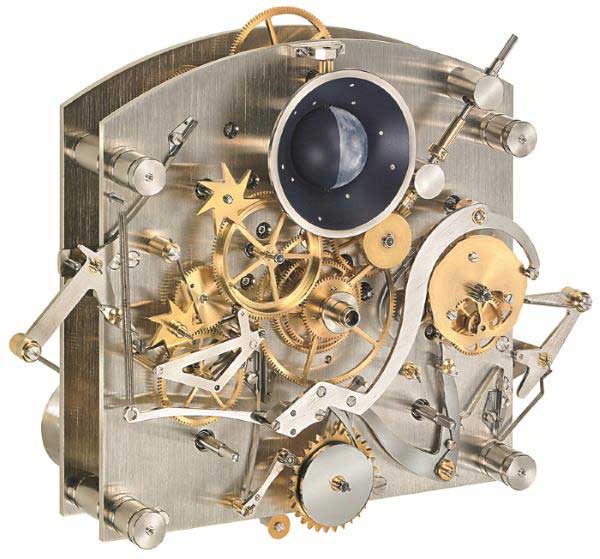
Erwin Sattler, a Made in Germany
family company, is probably one of
the most well-known clockmakers in
the world. In their case the neologism
‘Haute Pendulerie’ is entirely appropriate.
To confirm its status,
the manufacture presents its most
extraordinary precision pendulum clock
yet: in addition to the time display, the
dial of the Opus Temporis includes a
perpetual calendar and a hand-painted
spherical moon.
Germany-based watchmaker Alexander
Shorokhoff is fascinated by the
concept of the avant-garde, which is
the name of one of his main watch
collections. The Avantgarde Babylonian
II features an entire cosmos, complete
with celestial bodies and signs of the
zodiac. The dial of the Barbara model,
meanwhile, contains a piano keyboard
with vivid colours in the centre.
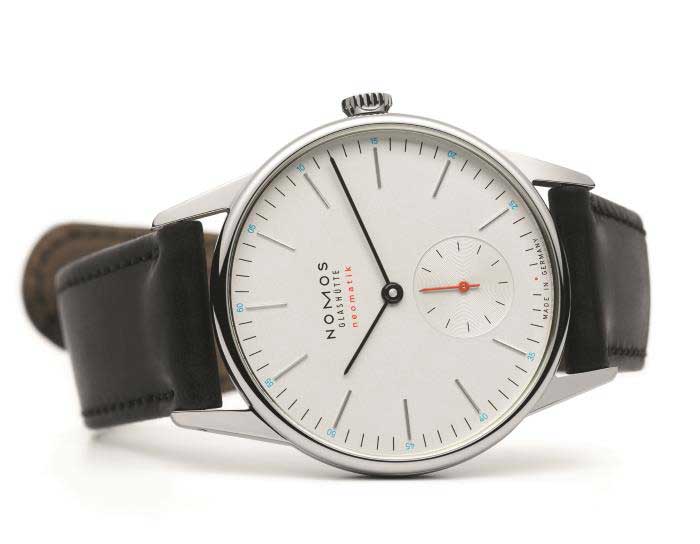
Flat and elegant, Bauhaus-inspired, in
the ‘affordable luxury’ segment, 100%
manufacture and sporting a new
in-house calibre, Nomos Glashütte’s
new Neomatik will be on more than a
few wish-lists. The five core models –
Tangente, Orion, Metro, Ludwig, and
Minimatik – come in two versions:
one with cyan blue accents on a
white silver-plated dial, and the other
with fine details in neon orange on a
champagne-coloured dial.
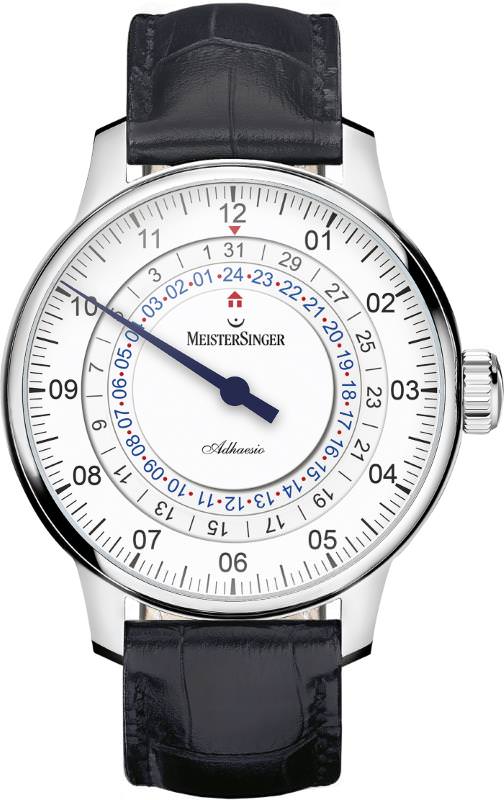
With the Adhaesio, the single-hand
watch specialist MeisterSinger has
developed a new, elegant and eyecatching
dual timer. An individual
needle-sharp hour hand points to
the current time of day or night at its
wearer’s location, accurate to within
five minutes. Above the MeisterSinger
logo, an arrow points to the second
local time on a 24-hour ring. These
two times are separated by a second
ring showing the date.



 Español
 Français
 Pусский
 繁體中文
 简体中文
 Select another language